Journals on Medical Casereports |BJSTR

The Biology of the Facultative Halophyte Atriplex patula L.

Introduction

The genus Atriplex L. is represented by about 250 species globally. Molecular and morphological data have provided some evidence supporting the inclusion of the Chenopodiaceae in the family Amaranthaceae with the former family Chenopodiaceae now listed as a subfamily Chenopodioideae [1]. However, Welsh et al. [2] and others still use the nomen Chenopodiaceae in systematic treatments. Atriplex patula L. (spear orach, spearscale) is a facultative halophyte that tolerates low to moderate levels of soil salinity [3]. It is a widespread weedy species that occurs in agricultural fields, on roadsides, on the margins of coastal salt marshes, and in other areas where disturbance has occurred. Atriplex patula produces dimorphic seeds which allows the species to be established in unstable habitats [4, 3]. Welsh [1] indicated that A. patula was possibly introduced in North America from Europe, Asia, or North Africa in the 18th century, and its occurrence has been documented in at least 10 provinces in Canada and 29 states in the U.S.A. Chetina et al. [5] have reported that A. patula occurs in saline sites at 59º N near Perm Krai, Russia, and De Cauwer et al. [6] noted that this species is a weed control problem in sugar beet fields in Belgium. Atriplex patula has been suggested for use in habitat remediation because stems and leaves accumulate and store heavy metal pollutants [7]. Herein, we summarize important aspects of this widespread facultative halophyte.

Synonyms, Taxonomy, Variation

Synonymy of the Atriplex patula complex is in a state of confusion. Synonyms of Atriplex patula L. (spear orach, spreading orache, spearscale) in North America have primarily been listed as Atriplex hastata L. subsp. patula (L.) S. Pons, A. hastata var. patula (L.) Farwell, and Teutiopsis patula (L.) Selak [1], whereas Correll and Correll [8] listed A. patula L. as A. patula L. var. hastata (L.) Gray. The nomens A. prostrata Boucher and A. hastata L. sensu Aellen non L. have also been listed as synonyms by Stalter and Lamont [9]. The following taxonomic description of A. patula is summarized from treatments of the species by Correll and Correll, [8], Stalter, [10], Taylor and Wilken, [11], and Welsh, [1]. Atriplex patula is a monoecious annual with a root system that typically extends between 10 to 18 cm below the substrate surface. Stems are erect and branched, glabrous to scaly, and range from 30 cm to 1.5 m in height. Leaves are opposite below and alternate above.

Petioles of lower leaves are up to half as long as the blades. Blades are bright green, 2.5 to 7.0 cm long and nearly as broad, truncate at the base, and acute or obtuse at the apex. The staminate flowers bearing 5 tepals and 5 stamens are borne in a terminal spike or panicle. The pistillate flowers are usually borne in few-flowered axillary or spike-like cymes. Pistillate flowers have 2 stigmas, and the base of the ovary is enclosed in a pair of bracts often reddish at maturity and up to 7 mm long. Seeds are dimorphic. Brown seeds are 2.5 to 4.0 mm wide, and black seeds are 1.0 to 2.0 mm wide. Chromosome numbers for the A. patula complex are 2n = 18 and 2n = 36. In the Netherlands, Van Der Meyden [12] tentatively recognized A. patula L. and A. hastata L. as separate species. However, he noted that there are no sharp distinctions between the two taxa, and numerous overlapping morphological variations exist in leaf blade morphology between the two entities. Van Der Meyden [12] stated that different ploidy levels occur in the complex. Atriplex hastata is a diploid and A. patula is a tetraploid.

Geographic Distribution

Atriplex patula is an annual, weedy, facultative halophyte that has a wide distributional range in North America, Europe, North Africa, and Asia. Correll and Correll [8] reported its range in North America from Newfoundland westward to British Columbia in Canada, and from Newfoundland to South Carolina in the U.S.A. Stalter et al. [13] reported the occurrence of the species in coastal sites in northern Florida. On the Pacific coast of North America, it occurs from British Columbia to California. Ungar [3] indicated that it occurs in low to moderately saline sites in Kansas and Nebraska, and Correll and Correll [8] and Proffitt et al. [14] stated that A. patula is often present in saline sites in Texas and Louisiana. Atriplex patula in widespread in Europe. De Cauwer et al. [6] reported that A. patula is a weed control problem in sugar beet fields in Belgium, and Chetina et al. [5] reported the occurrence of this species in salinized alluvial soils at 59º N latitude at Perm Krai, Russia.

Range of Habitats

Atriplex patula is a weedy, facultative halophyte that occurs in a wide variety of soil types including sandy loams and clays [6], salt impacted alluvial soils [5, 15], and water-logged soils [16]. In sugar beet fields in Belgium, De Cauwer et al. [6] reported that the species is less common in acid sandy soils and is less tolerant to drought than to water-logging. Ungar [3] indicated that A. patula is a summer annual in the Central U.S.A. and can tolerate moderately saline soils under field conditions ranging from 2 ppt to 13 ppt total salts. In North Carolina, Stalter and Lamont [9] stated that habitats for A. patula are beaches and upper margins of brackish and salt marshes. In New England salt marshes, Rand [17-19] reported that this species is usually found in bare areas in the mid to high marsh in topographic zones usually dominated by Juncus gerardii or Iva frutescens. She noted that the annual halophyte Salicornia europaea may compete with A. patula in this harsh physical environment. Proffitt et al. [14] found a similar case in salt marshes in Louisiana where A. patula occurs in bare patches within sites dominated by Sporobolus alterniflorus (Spartina alterniflora).

Physiological Ecology

Atriplex patula has Kranz anatomy in leaves which is indicative of the associated C4 carbon fixation pathway of photosynthesis [1]. The C4 pathway increases efficiency of CO2 usage and subsequent carbon fixation. Salinity is an important factor that affects imbibition of water in seeds, germination, root elongation, and overall plant vitality [20]. NaCl in the substrate affects osmotic balance and specific ions. Salinization influences the production of the low molecular weight amino acid proline in A. patula leaves. Proline acts as an antioxidant and protects cellular protein structure and ultimately increases A. patula resistance to salt in acidic soil conditions [5].

Dimorphic Seeds and Germination

Two types of seeds occur in A. patula. One is black and ranges in size from 1.0 to 2.0 mm in diameter, and the other seed type is brown and ranges in diameter from 1.3 to 3.0 mm [4, 3, 1]. Large brown seeds have three times the mass of smaller black seeds, a thin seed coat, a larger embryo, and absorbs water 100 times faster than unscarified black seeds [20-21]. Nurse et al. [21] stated stated that seed dimorphism enhances survival of the species in variable habitats. Larger brown seeds have a limited dormancy period and germinate rapidly in spring. However, brown seeds are more susceptible to fungal attack than black seeds [21]. Ungar [22] reported that black seeds have a hard seed coat, a long dormancy period, and scarification is required to break dormancy. In the laboratory, unscarified black seeds did not germinate. However, 73% of scarified black seeds germinated [4, 22]. Black seeds have greater resistance to high salinity stress than brown seeds and retain their viability longer than brown seeds [21]. In the laboratory, Ungar [22] found that seeds germinated and seedlings survived salinity concentrations up to 20 ppt. Germination was reduced at salinity values greater than 10 ppt, and germination declined to 17% of controls at 20 ppt. Ungar [22] also noted that seeds are less inhibited to high salinity levels that growing seedlings. In Oregon, Keammerer and Hacker [23] stated that A. patula seed viability was 91% in the high intertidal zone, but they did not mention seed dimorphism.

Competition and Herbivores

Atriplex patula does not fare well in competition with taller or more aggressive species in salt marshes. Minchinton et al. [24] reported that the common reed (Phragmites australis), in the upper margins of New England salt marshes, modifies soil and light conditions and produces a heavy cover of litter. These factors exclude the perennial Solidago sempervirens and the annual A. patula from this topographic zone. Atriplex patula seedling establishment and survival of mature plants only occurs at sites that have not been invaded by P. australis. A chrysomelid beetle (Erynephala maritima) is a herbivore that damages A. patula and the succulent annual halophyte Salicornia europaea in salt marshes in Rhode Island [25]. Damage to A. patula is extensive at mid-tidal elevations which are frequently inundated [17]. She also found that A. patula plants are more extensively damaged when they are not present in dense stands of S. europaea [17]. In field plots cleared of S. europaea beetle herbivory reduced A. patula survival by about 50% and reduced reproduction by 37% [18, 19].

Phytoremediation

Atriplex patula is a species that removes significant amounts of Na ions from salt-impacted soils and stores salt in cellular vacuoles in stems and leaves [15]. They noted that the deep root system improves soil quality and soil permeability in oil field brine spill sites in Saskatchewan, Canada. Mature plants are removed of spill sites and are disposed off-site. High seed production insures a standing crop in the next growing season.

Vickerman et al. [7] examined A. patula for potential habitat improvement and phytoremediation of the heavy metal Se. They found that phytoremediation was greatest in saline sites having low to moderate levels of sulfate. They also indicated that mature plants could be mechanically harvested and disposed off-site.

Management and Role as an Allergen

Atriplex patula is an aggressive annual weed in sugar beet fields in Belgium. Various herbicides have been used to control the species. However, this species exhibits high intraspecific variation in herbicide sensitivity and weed control by herbicides has been shown to be difficult [6]. Atriplex species produce extensive amounts of windblown pollen and may play a role in allergic sensitization [26]. Ferrer et al. [27] noted that pollen of A. patula extracts should be used in a battery of potential allergens for use in diagnosis and treatment of respiratory allergies in patients.

Acknowledgment

We thank Matt Toska and Menahil Shahid undergraduate research students for obtaining reference articles and St. John’s University for providing publication expenses.

Follow us on: Biomedical Journal Impact Factor: https://biomedres.us

https://scholar.google.com/citations?user=OFtUOZYAAAAJ&hl=en
https://www.base-search.net/Search/Results?lookfor=Biomed+Journal+of+Scientific+%26+Technical+Research&l=en&refid=dcsuggesten
https://citefactor.org/journal/2574-1241/biomedical-journal-of-scientific-technical-research
https://ideas.repec.org/s/abf/journl.html
https://econpapers.repec.org/article/abfjournl/
https://www.ncbi.nlm.nih.gov/nlmcatalog/101723284
https://bjstr.org/
https://bjstr.org/about.php
https://biomedres.us/reprints.php
https://biomedres.net/submit-manuscript.php

Medical humanities |BJSTR

Non-Small Cell Lung Cancer – A Case of the Bazex

Introduction

Bazex syndrome is a paraneoplastic psoriasiform dermatitis, predominately seen in squamous cell carcinomas (SCC) of aero-digestive tract and non-small cell lung cancers (Räßler, et al. [1]). Lesions are seen mainly in adult males (>60 years old (YO)) >3:1 woman, with an alcohol and smoking history noted in 28% of cases noted to be alcohol and smoking (Räßler, et al. [1]). Clinically, lesions may be erythematous, scaling and appear psoriatic like, which may lead to a delayed diagnosis of cancer while benign skin causes are treated (Räßler, Goetze & Elsner, 2017). Acral lesions may be considered pathognomonic of BAK upon confirmation of carcinoma with common distribution of lesions on: ears (79% & 28%), nails (75% & 57%), nose (63% & 33%), fingers (61% & 29%), hands (57% & 38%), feet (50% & 30%) and less commonly the trunk (13% & n/a), scalp (7% & n/a), elbows (19% & n/a) and cheeks (19% & n/a) (Räßler, et al. [1]). Treatment of the underlying cancer has been found to successfully treat the skin lesions when therapy is established with cases noting response to NSCLC BAK syndrome lesions after chemotherapy, immunotherapy and surgical intervention (Table 1) (Mititelu, et al. [2-4]). The current case reports BAK syndrome in a 76-year-old male following a delayed diagnosis and details his diagnosis and treatment journey to date while he remains on current active first line management. Within the report is a brief review of the lung cancer cases and BAK syndrome, showing literature available via Medline and Pub med from 2011-2021 in the English language using the search term ((Bazex) OR (acrokeratosis)) AND (Title Combined: (lung cancer OR carcinoma)).

Consent

Consent was obtained to use images in relation to this report, identifiers are anonymised and no patient personal information is used within this article.

Time line

December 2020 – January 2023.

Patient Presentation

76-year-old retired white British male presented with 6-month history of psoriatic like plaques on fingers and toes bi-laterally, progressing to the scalp and torso, with >10% weight loss and progressing breathlessness two weeks prior to diagnosis. He has a >40 pack year smoking history and a past medical history of chronic obstructive pulmonary disease (COPD) and hypertension, taking medicines; amlodipine 5mg, acitetin 20mg, atrovastatin 10mg nocte, furosemide 40mg mane, aspirin 75mg, tiotropium 10mcg mane and salbutamol inhaled 100mcg/dose, with no known drug allergies. No family history of Bazex acrokeratosis neoplastica syndrome or lung cancer was present.

Delayed Diagnosis

Initial treatment for scaling dermatosis was initiated by the community doctor with dermol 500 and dermovate cream, which gained no symptomatic benefit over a 6-month period March – September, later given acitetin 20mg with no continued benefit. New shortness of breath triggered a chest x-ray via the community GP which highlighted a supraclavicular mass and a right hilar mass, leading to a two week wait for suspected cancer.

Diagnostics

A computer topography (CT) and a positron emission topography CT scan (PET-CT) confirmed stage 3b lung cancer, with a 7cm mass in the right lower lobe with atelectasis and right upper lobe nodal lesion with a 4cm supraclavicular lesion and a paratracheal node at 3.5cm, confirmed as avid on a positron CT scan. The supraclavicular node was biopsied showing a squamous cell carcinoma with a programmed death ligand -1 as 10% and no actionable mutations, next generation sequencing was not performed.

Stage

T4N3M0 – 3b (Matilla et al. [5]).

Examination

The examination took place prior to cycle one of chemo/immunotherapy, or any anti-cancer treatment on the same day. Comparison over treatment will be detailed in the discussion. Over all the patient was comfortable at rest, with no mobility aids, no oxygen, no indwelling catheters or lines in-situ. The end of bed assessment clearly identified plaques upon finger nails bi-laterally.

Lung Exam

No additional berthing sounds identified, with good air expansion. Saturation was 96% on room air with a respiration rate of 16 breaths per minute at rest.

Heart Exam

No additional sounds or murmurs were identified, with a pulse rate of 58 beats per minute regular and a blood pressure of 103/53.

Abdominal Exam

A single plaque identified in the epigastric area, no scars where noted, with no masses, a soft abdomen on palpation and bowel sounds throughout.

Hands

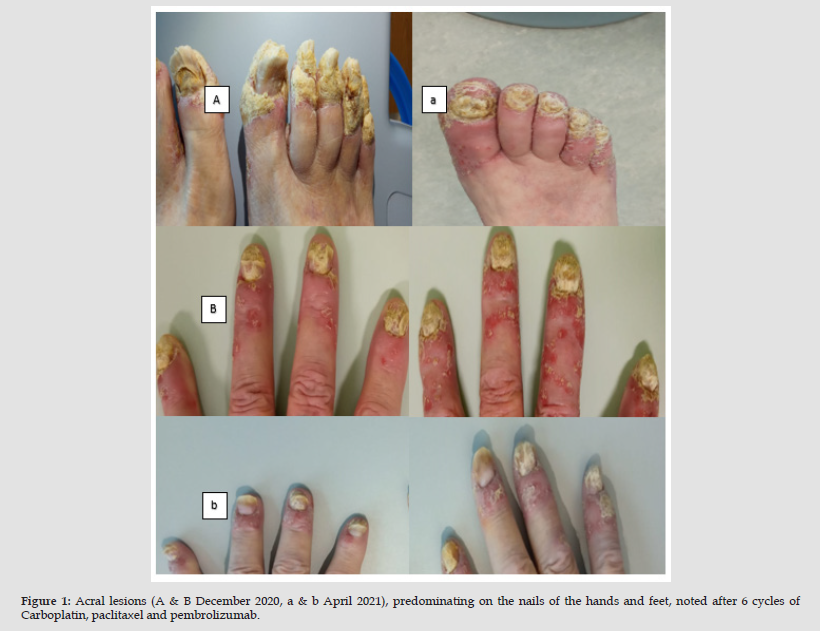
Plaques (pre-treatment) noted on finger nails bi-laterally, crusting and yellow with thickened perioncychium and mild palm erythema bi-laterally.

Toe nails

Equally to fingers, yellow scaling plaques bi-laterally were noted with erythematous cracks on the heels bi-laterally.

Other

Three lesions were noted on the scalp and one on post oracular on the left side.

Treatment

Triple therapy was initialised based on squamous metastatic NSCLC with a PDL-1 of 10%, given Carboplatin, Paclitaxel and Pembrolizumab was administered in four cycles, following which, Pembrolizumab immunotherapy continued as a single agent treatment (Paz-Ares et al. [6]). Radiotherapy 20 grey in 5 fractions was given to reduced paratracheal mass, with continued Pembrolizumab to 10 cycles before progressive disease n mediastinum and superior vena cava obstruction, before patient died of progressive disease. Scans performed every 3 months measured with iRECIST criteria (Persigehl, et al. [7]), with best outcome partial response (PR) to treatment and an overall time to progression of 10 months from start of treatment.

Discussion

Delayed diagnosis of BAK syndrome may prolong ant-cancer treatment leading to diagnosis at a later stage, limiting treatment options for patients, which parallels the current case who waited 6 months from the onset of plaque lesions to diagnosis of lung cancer (Zarzour, et al. [8]) noted death of a small cell lung cancer patient 6 months following diagnosis despite a 2-year history of hyper pigmented rash over forearms and legs, diagnosed as BAK syndrome (Räßler, et al. [1,8]). Similarly, an epidermal growth factor receptor mutation (EGFR) was diagnosed with metastatic bone lesions after a 5 year history of pruritic, acral lesions, suggesting earlier recognition may of allowed lower diagnostic stage (Zhao et al. [8]). The current case noted a 6 month delay pre-treatment, leading to a diagnosis of 3b NSCLC with supraclavicular lymph node spread, meaning an advanced stage of lung cancer untreatable to radical surgery or radiation, giving a poor prognosis with systemic treatment, although the current treatment regime of chemotherapy combined immunotherapy may lead to prolonged survival (Matilla, et al. [5,6]). Psoriatic lesions occurred in the current case on the hands, feet, nose, nails, auricular helices and scalp in the current case, with a lesion on the trunk suggesting advanced carcinoma correlation (Bazex, et al. [9]). Typically the lesions will respond (Table 1) to anti-cancer therapy as was the case here, the individual who failed to respond died within 6 months of diagnosis, and unusually had SCLC (Zarzour, et al. [8]).

Table 1: Table showing similar cases in lung cancer after a search of Pub med and Medline with the search term ‘’ ((Bazex) OR (acrokeratosis)) AND (Title Combined:(lung cancer OR carcinoma))’’ year 2011- 2021, English language. N=No, Y= Yes, M= Male, F-Female, NSCLC= Non-small cell lung cancer, SCLC+ Small cell lung cancer, N/a = Not applicable.

biomedres-openaccess-journal-bjstr

Previous cases have shown symptomatic benefit from adjuvant treatment with acitretin, used to treat severe psoriasis, at 0.25-1mg/ kg body weight (Bazex, et al. [4,10]). The current case has shown how Pembrolizumab combined with chemotherapy therapy in advanced/ metastatic NSCLC (Paz-Ares, et al. [6]), may reduce plaques in BAK syndrome (Figures 1A-a & 1B-b) which is paralleled by (Aoshima, et al. [2]), who showed a improvement in the distal extremities after 7 cycles of Pembrolizumab. Pathophysiology of BAK syndrome may be related to cross reactivity of tumour antigens irritating the skin, growth factors associated with epidermal growth factor and vitamin deficiency such as Zinc and vitamin A (Amanon, et al. [4,11]) Showed serum immunoglobulin e and eosinophil count elevated in an 82 YO SCC of the lung, with reduced levels after tumour removal, suggesting a role of the Th2-type cytokine response leading to an elevated inflammation, which may cross react causing keratin based skin plaques seen in BAK syndrome, although reactive response to the subcutaneous cancer itself could not be ruled out as well as raised inflammation as a result of patients positive smoking status. The current case survived approximately 12 months post treatment with chemotherapy and pembrolizumab, compared to 15.9 months in the literature for NSCLC SCC patients (Paz-Ares, et al [6,12]). Diagnosis in the current case was on observation capacity, failure to resond to anti- psoriatic medication and response to anti-cancer therapy, although none biopsy may be a limitation here.

Further limitations are a lack of tracked biomarkers throughout treatment, with immunoglobulin E, also not detailed, as suggested to be raised in BAK syndrome by (Amanon, et al. [4,13,14]). Take home messages from the current case highlight that BAK syndrome in SCC NSCLC can be successfully treated with combine chemotherapy and immunotherapy, with lesion/plaque regression corresponding to successful anti-cancer treatment, although the patient did die of advanced NSCLC. Plaques in BAK syndrome are not commonly responsive to psoriatic therapy, and a smoker with a resistant history of psoriatic lesion treatment should be considered for an upper digestive or lung cancer diagnosis to rule out an underlying malignancy (Moore, et al. [15]).

Figure 1

biomedres-openaccess-journal-bjstr

Competing Interests

No competing interests.

Ethics Approval

Ethical guidelines were followed, with written consent obtained for images.

De-Identification

All information remains anonymized.

Follow us on: Biomedical Journal Impact Factor: https://biomedres.us

https://scholar.google.com/citations?user=OFtUOZYAAAAJ&hl=en
https://www.base-search.net/Search/Results?lookfor=Biomed+Journal+of+Scientific+%26+Technical+Research&l=en&refid=dcsuggesten
https://citefactor.org/journal/2574-1241/biomedical-journal-of-scientific-technical-research
https://ideas.repec.org/s/abf/journl.html
https://econpapers.repec.org/article/abfjournl/
https://www.ncbi.nlm.nih.gov/nlmcatalog/101723284
https://bjstr.org/
https://bjstr.org/about.php
https://biomedres.us/reprints.php
https://biomedres.net/submit-manuscript.php

Journals on Medical Microbiology |BJSTR

Morbidity and Mortality of Open and Laparoscopic Cholecystectomy in Males. Multicenter Study

Introduction

Male gender has been mentioned as a risk factor in open or minimally invasive gallbladder surgery. In open surgery, some “anatomical difficulties” in men could be the sharpest right costal angle and greater muscle mass compared to women; It is also mentioned that men seek medical attention late due to work issues [1]; However, in other articles, it is mentioned that men undergo emergency surgery more frequently; in addition to age, which is higher in this group [2]. It is also mentioned that the inflammatory reaction is greater in men, a situation that represents a greater risk in minimally invasive surgery, conditioning a conversion rate of 15% [1-5]; therefore, some authors recommend the need for earlier intervention to reduce the risk of complications [5]. Another risk factor is obesity, which in Mexican population, the male gender represents 73.5% and female gender 76.8%, according to ENSANUT reports from 2022 [6]. According to Tokyo International Consensus classification and other publications, the management to be followed was determined, emphasizing on intervention in the acute phase of cholecystitis to avoid complications, of course, depending on the cholecystitis severity, so they recommend early cholecystectomy (in the first 72 hours after the onset of the disease). Laparoscopic surgery was the modality of choice in 20% of cases that come to be intervened [7].

There is still a debate about whether early intervention should be taken to avoid complications due to the inflammatory process [4,8], arguing that acute gallbladder symptoms usually subside after 2 or 3 days, resolving in 85% of cases within a week [9]; however, as mentioned above, only one-fifth of patients in the acute period are candidates for LC. Other authors have proposed LC at one and a half or three months after the acute phase, due to the risks involved in inflammation, being the most important, the anatomy loss among them, which in addition, we know that the bile ducts are the structures with the most anatomical variants, predominating on the cystic in more than 70% of cases [10], increasing the risk of injury to these structures, including the liver vasculature or even large vessels injury by the laparoscopic procedure itself, such as arteries, vena cava or portal vein; However, it has been seen that performing it in a deferred or interval manner (conservative treatment) is accompanied by 26% of failures, having to be urgently operated, and 28.5% of these patients could present complications such as cholangitis, pancreatitis or a biliary peritonitis [11].

According to literature, in women initially there is a greater inflammatory reaction and greater production of antibodies; However, women offer a greater response to antigens, both innate and adaptive. The immune response basically resides on the X chromosome; In addition, hormonal factors, such as estrogen, stimulate the immune response; on the contrary, androgens inhibit it [12]. Bile duct injury in LC have an incidence between 0.2 and 0.8%; in open surgery, it is less than 0.2% [13]. In relation to sex, Shreenath et al do not consider it as a predictor, but report that conversion secondary to difficult cholecystectomy is frequent in patients with history of hospitalization, previous abdominal surgeries, palpable gallbladder, BMI greater than 27.5 kg/m2 and thickened gallbladder wall. Sex, age, and impact calculation were not identified as predictors [14,15]. In summary, the prevalence of cholelithiasis in Mexico is 14.3%, of which 8.5% are men and 20.5% are women; obesity has been reported to be associated with a cholelithiasis elevated risk [16] and as an important factor in the conversion of LC [17,18]. The most used marker to measure the quality of a surgical procedure is the incidence of complications [19]. Andrade Carbo et al., from Ecuador, reported a higher rate of surgical complications in women compared to men (52% vs. 48% respectively) [20].

Corona DJ y cols., in Mexico on 2006, reported 72% of 111 male patients operated urgently of OC, 55 patients presented complications inherent due to cholecystitis severity [21]. Hospital stay was shorter in LC than OC group with an average of two days vs 4 days in 57% and 34.3% of cases respectively [22]. On the other hand, there is an increase bile duct injury incidence, with the increasing use of LC, although other authors report that they have decreased with the learning curve [23] Most articles mention a conversion rate of 4 to 8%, even up to 20%; the current mortality rate for OC is 0.39% and 0.07% for LC, with an average of 0.016% [24]. Some mention that male sex, obesity, age, wall thickness or stage of the disease are the factors that hinder surgery and therefore, conditioning factors for conversion, so in the absence of consensus to categorize a difficult CL, the scoring scale proposed by Ayón et al. has been used that take into account 7 aspects: adhesions presence, gallbladder wall and size, inadvertent calculus or macrocalculus, Calot’s triangle critical view, surgical time, and how vesicular bed hemostasis was achieved [25].

Methods and Materials

From January 2021 to December 2023, an ambispective, descriptive and analytical multicenter study was carried out of the clinical archive from Dr. Darío Fernández Fierro General Hospital (HGDDFF), Hospital General La Villa (HGV), and Hospital Universitario de Puebla (HUP), of the surgeries performed by General Surgery department to determine the morbidity and mortality of OC and LC in men during emergency or scheduled interventions. Data were collected separately by dividing the hospitals into three groups according to the order mentioned above. The following variables were analyzed: sex, age, BMI, time of evolution of the condition before surgery, transoperative bleeding, surgery time, drains presence, postoperative pain, and hospital stay. The statistical analysis was performed with SPSS-27 to perform the univariate analysis of the variables of interest, describing cumulative incidence and prevalence of injuries, relative and absolute frequencies of the categorical variables and measures of central tendency for the quantitative variables according to the data distribution. The study was carried out strictly in accordance with the Ethical principles of patient confidentiality.

Results

HGDDFF (Group 1)

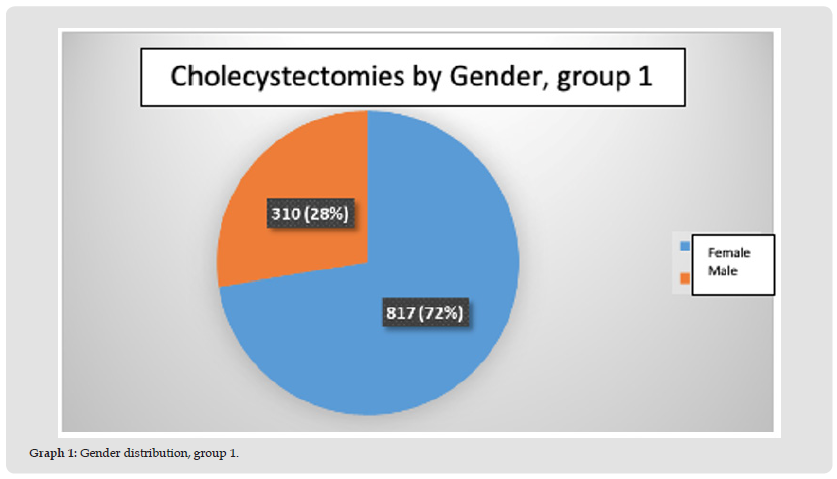
During the 3 years included in the study period, a total of N=1409 cholecystectomies were carried out, 80% (n = 1127) met the selection criteria, of which 72.49% were female (817/1127) with an average age of 54 years (± 16.6), ranging from 18 to 94 years; 27.5% (310/1127) were male (Graph 1), being more frequent between 30 and 50 years, with an average age of 40 years in 65% of the cases; 15% from 51 to 60 and 20% from 71 to 80 years. In 80.9% of all patients (n=912) were between the ages of 36 and 57 years and in 31%, the most common comorbidities were systemic arterial hypertension (SAH) in 55%, diabetes mellitus (DM2) 45%, hypothyroidism 16%; elective surgeries accounted for 50.57% (570/1127) and 49.43% (557/1127) of emergency surgeries; OC in 4.34% (49) and LC in 96.65% (1078/1127). Average time of 2 h in 53.23% (600/1127). In OC, the surgical time was 90 minutes; in LC 70 minutes on average, with an interval of 30 to 180 minutes. Less than one hour 7%; Minimal bleeding (bleeding defined and calculated by the anesthesiology service ≤ 90 ml) in 92.25% of males, with no statistically significant difference with respect to females (p= 0.509482).

Graph 1

biomedres-openaccess-journal-bjstr

Complications in LC

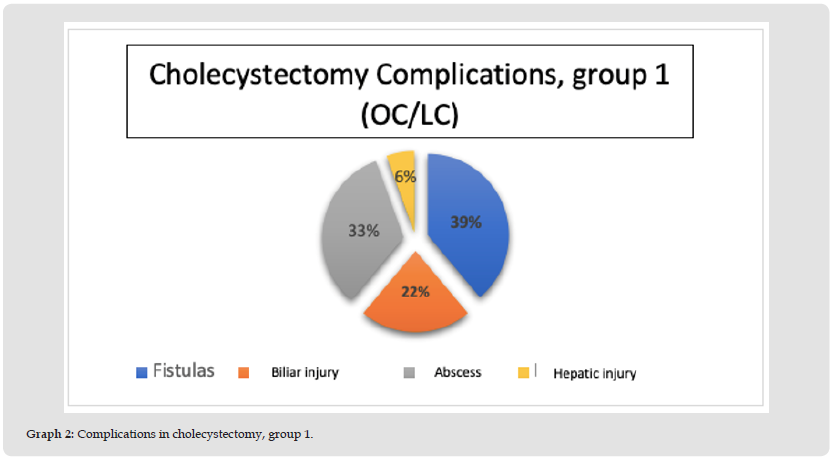
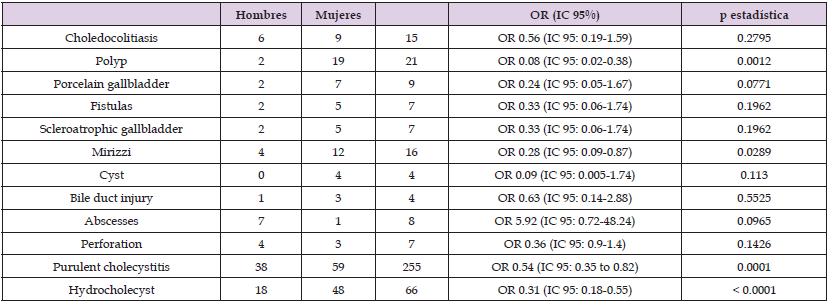
Cystic artery bleeding occurred in 5%, controlled by laparoscopy; bleeding from the surgical site in 1 case; liver thermal injury due to defects in the thermal insulation of the electrocautery. Mortality in 11 patients (0.97%), with a Porta vein injury, which initially due to the urgency, was managed by a general surgeon and caused a late intervention of the vascular surgeon with disastrous results. (Graph 2). In 0.92% (10/1078) of the LC, STC was performed, especially in acute cases. In OC, 6.12% (3/49). Cystic duct leaks occurred in 3 cases, identified and resolved by ERCP. There were 5 bile duct injuries, 4 referred to a fourth level of medical care; 1 was repaired by a surgical oncologist at the time of injury with open Y Roux’s surgery (Strasberg E2 type) (Table 1). In-hospital stay ranged from one to six days; 77% less than 2 days; 3 days in 18%, with the main reason being drainage monitoring. 4 days in 11%, for pain or drainage surveillance in 63%, and in 1 patient, 6 days for choledocholithiasis.

Graph 2

biomedres-openaccess-journal-bjstr

Table 1: Transoperative Findings. group 1.

biomedres-openaccess-journal-bjstr

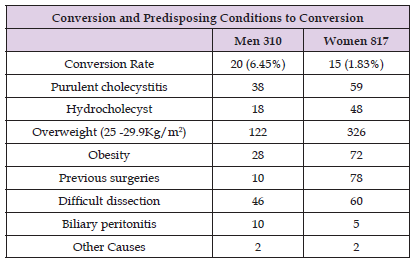
The conversion rate for males was 6.45% (20/310) and 1.83% (15/817) for females. Elective surgeries were dominated by women. Regarding the age group, on 31 patients’ conversion predominated between 41 and 55 years old, and a probability of conversion of 3.1 (OR). According to BMI, CL conversion, especially in emergency cases, was more frequent in 28 patients (43.75%) classified as overweight (25.1 to 30 kg/m2), followed by 16 patients (25%) classified as grade I obesity (30 to 34.9 kg/m2). (Table 2) There was a predominance in symptomatic Cholecystitis (76.56%); which is the most associated condition to conversion in urgent surgery in 28 cases (43.75%) with an OR= 2.45 conversion probability.

Table 2: Group 1, Conversion and Conversion Factors.

biomedres-openaccess-journal-bjstr

HGV (Group 2)

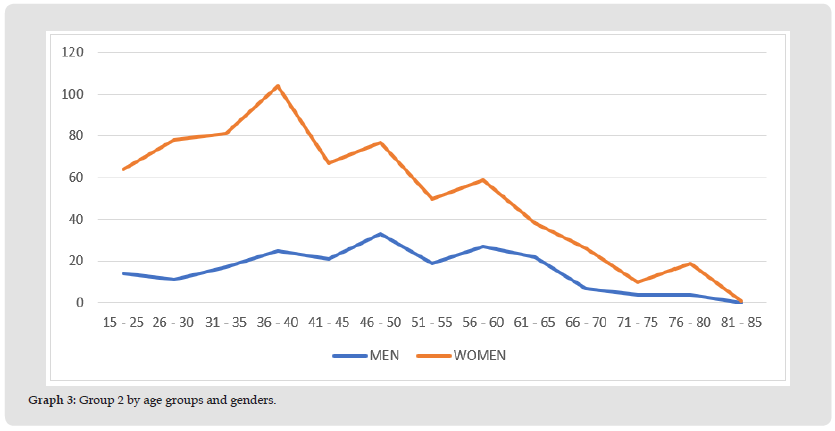
This hospital serves the population without medical services, in which 674 cholecystectomies were performed, 71.06% (479) women and 28.93% (195) men; of the total, 55.93% were OC (377/674) and 44.06% LC (297/674); 92.43% (623/674) were intervened due to emergency and 7.56% (51/674) were an elective procedure, from which 44 were women and 7 men. Minimum and maximum age in women 16 to 86 years, with a maximum peak between 36 and 40 years; In men, minimum and maximum age 18 to 82 years, with two peaks between 46 and 50 and 56 to 60 years (Graph 3). Among the findings we have a 1.92% conversion rate (6 men and 7 women). In 14 patients (2.07%) STC was performed (9 men, 5 women); There were 3 injuries (2 bile duct and 1 duodenum injury); A biliodigestive fistula was evidenced and resolved in the same surgery; in 72 patients (10.68%) a purulent cholecystitis was found (21 men and 51 women); Biliary peritonitis in 9 patients (6 men, 3 women); hydrocholecyst in 35 (11 males, 24 females); cholangitis 5 (2 men, 3 women-one with septic shock) and Mirizzi syndrome in 4 patients (3 women). The average surgery time in 90% of LC was less than 2 hours.

Graph 3

biomedres-openaccess-journal-bjstr

HUP (Group 3)

For reasons beyond our control, we do not have current data, only reports from 2009 to 2014 period, in which 78 CL were performed per year, of which the female gender represented more than 70% of the cases with a mean age of 44.4 ±17.2 years, with two conversions (Pérez Ayala, Thesis 2014) and that currently in the ISSSTE Regional Hospital, of the same Federal Entity to transpolate the data, approximately 200 surgeries are performed per year, reported by Dr. Dávila Esparza, a total of 1190 cases, of which 78.9% were female and 21.1% male, with an age range of 18 to 94 years and an average age of 51 years (F:M relation 3.73:1). Average hospital stay was 3.4 days and surgery duration averaged 93 minutes. A conversion rate of 4.8% and bile duct injury at 0.08%. (Dávila Esparza, Thesis 2021)

Discussion

Acute cholecystitis is the second leading cause of consultation in abdominal surgical emergencies; In Mexico, it is estimated that between 200 and 300 thousand LC are performed annually, according to the lecture given at the “12th Mexican Association of Endoscopic Surgery Regional Meeting” at the New Civil Hospital of Guadalajara “Dr. Juan I. Menchaca”, by Dr. Adolfo Cuendis, Gea González General Hospital MD of Endoscopic Surgery Division in Mexico City [26]. Gallbladder problems mainly affect young women between the ages of 20 and 40, who are multi-pregnant or overweight. In men is more associated with eating problems and low fluid intake. From all gallbladder surgeries, 80% are due to gallstone problems. In Mexico, 10 to 20% of the population has gallstones and 30% will develop acute cholecystitis [27,28]. LC is currently the first-line technique for the surgical treatment of gallbladder pathology, with less time spent in hospitalization and convalescence; reduced postoperative pain and operative site infection, and better aesthetic results; However, LC is not without disadvantages, such as a higher percentage of iatrogenic bile duct injury and more challenging controlling profuse bleeding difficulty degree [24,29].

In our study, we found an F:M ratio higher than that reported in the international literature with respect to sex, being 3.34:1, in relation to the reports of 2:1 respectively, perhaps due to the place we occupy in obesity, overweight, DM2, and the fact that our female population is larger, which translates on the necessity to investigate an ethnic factor. Either way, the Puebla ISSSTE Hospital with different economic status employees, F:M was 3.73:1 and HGV, which attends low resources population, was similar from the relation reported in international literature (F:M 2.4:1); We insist, this could be associated due to the predominant obesity on bureaucrats. In terms of surgical time, we are in the average time with the report of Jarkín et al. (9), of 71 minutes in boarding with three laparoscopic ports, and above the results of Manoj Kumar et al. 47 minutes [18].

Recent meta-analyses have shown that early urgent LC provides a benefit in terms of hospital stay, but not in terms of conversion rates and perioperative complications [28]. Currently the LC is the election procedure. There is no standardized management of early-stage LC in our institution, and some articles even contraindicate it in the acute phase [28].

According to some publications, there is no statistically significant difference in the complications of an early and delayed LC; It is recommended to perform it in the first 3 days of the onset of the clinical presentation being urgent surgery more common in men [21]. There is the unknown or assertion if surgery in men is more difficult or presents more complications, perhaps because the inflammatory process is greater or because they present themselves to seek medical attention earlier than women, associated to less pain tolerance or due to work reasons, a situation that favors an intervention during the acute process. This increases the risk of injuries and technical difficulties in surgery, and not necessarily because surgery is more difficult in men, which remains to be clarified with larger studies. Zhu et al. proposed the term 72 golden hours from the onset of the disease to perform LC [4]. In addition to the factors mentioned above that can lead to conversion, we have symptomatic gallstones (biliary colic) and DM2 as predominant factors. Elective surgery is more often in female sex [29,30].

In our study, we found that there was no statistically significant difference between men and women in the minimum bleeding present in 95.92% on the male group (p= 0.509482).

1.76% (n=19) were converted to open surgery, in contrast to what has been reported in the international literature, which reaches figures of up to 20%. Surgical time was obviously longer in acute inflammatory processes. Complications with an OR greater than 1.0 were abscesses with 5 cases in men and 1 in women (OR of 4.23, 95 CI: 0.49-36.29) and liver injury in 1 case in men with an OR of 2.53 (95 CI: 0.10 – 62.41). According to the above, it could be said that more than the male sex being a risk factor, obesity, the stage in which patients are intervened, inflammatory grade and age are predominant factors for a difficult cholecystitis, and it would be necessary to clarify if the inflammatory reaction is greater in men as mentioned by some authors and not the stage of the disease in which they are intervened (acute phase). In relation to the inflammatory reaction and antibodies production, it is mentioned that in women, it is initially bigger, with a greater immune innate and adaptative response to antigens, which is described to be reside in the X chromosome and the hormonal factors (estrogens) that stimulate the immune response, as opposed to androgens that inhibit it [12].

Hayama et al. mention that the risk factors for conversion depend on the stage at which surgery is performed in acute cholecystitis (early surgery less than 240 hours vs late surgery after 240 hours). Necrotizing cholecystitis was a difficulty risk factor in early surgery, while higher white blood cell count, and older age are risk factors in late surgery [31]. It is relevant on these situations to know if we have the possibility of predicting the conversion rate as mentioned by Rothman et al., who give importance to the gallbladder wall thickness (>5 mm), contracted gallbladder, > 65 years of age, male sex, and acute cholecystitis [32]. Other publications list DM, chronic kidney disease, choledocholithiasis and Mirizzi syndrome as risk factors for conversion; patients with jaundice, cholangitis, or pancreatitis [33]. However, we must not forget that the conversion to open surgery is considered an alternative resource for resolution and it is necessary to know how to make the decision on time. Percentages range from 0.08% to 18% [34]. Regarding sex, Shreenath et al. mention that conversion in difficult cholecystectomy is frequent in patients with hospitalization history, previous abdominal surgeries, palpable gallbladder, BMI >27.5 kg/m2 and thickened gallbladder wall.

Variables such as age, sex, and impacted stones were not found to be significant predictors. However, they mention that in the case of men they may outperform women, due to sociocultural factors that predispose a late attendance to medical centers [35]. In addition, Chávez Segura stated the results of studies in relation to sex should be considered inconclusive, because most of the population that goes to hospitals are mostly female [36], which we take as a reservation because it is more frequent in women. It is stated that male sex is a difficult risk factor for LC, although there are no statistically significant results, as there is a criteria diversity [37]. Age is identified as a risk factor for mortality, postoperative complications, and intraoperative conversions to OC, since the older the age, the greater the number of associated diseases and complications [37]. Obesity is a disease associated with acute cholecystitis and surgical modality conversion and is considered as a significant factor. Campos Guzmán et al. consider that overweight and obesity are a risk factor, not only for conversion, but also for the appearance of postoperative complications, prolonged hospital stay and, therefore, higher economic expenditure [37,38].

García Álvarez et al. also mention that the presence of associated diseases, such as biliary colic, obesity, and SAH, increase the risk of conversion [39]. In our investigation, on group 1, 8 conditions that complicate cholecystectomy were detected, in which the male factor has statistical significance (p = 0.003685) when all parameters are compared; when analyzing them individually it can be inferred that the male factor is protective when comparing the same complications in the female gender with a p < 0.0001 statistically significant, in cases of hydrocholecyst OR 0.31 (95 CI: 0.18-0.55); biliary peritonitis OR 0.84 (95 CI: 0.24-2.93). It is noteworthy in the Emergency Hospital that serves the general population without medical services, as expected, OC was performed in most cases (55.93%) and F:M ratio 2.4:1. The aim of this study was to determine whether the male sex factor is associated with a higher risk of surgery and complications in OC and LC in emergency or elective procedures and, as such, in LC, associated with conversion. However, perhaps due to the number of cases, we could not give an adequate answer to the research question, although according to our results, when comparing complications in women and men, the male factor was found to be protective. The important thing is to know when convert to open surgery and resort to related specialties.

Conclusion

Obesity, stage of the disease and age aggravate morbidity and mortality in cholecystectomy. According to our study, sex is not a condition of conversion. Bile duct lesions in our study were within the range reported in the universal literature of 0.2 to 0.8%.

Special Thanks

For Your Technical Assistance to Doctors
Karen Monserrat Guznay Matute
Pedro Sánchez Román.

Conflicts of Interest

The authors declare that there are no conflicts of interest related to this article. They agree to open access publication in accordance with the journal’s policy.

Follow us on: Biomedical Journal Impact Factor: https://biomedres.us

https://scholar.google.com/citations?user=OFtUOZYAAAAJ&hl=en
https://www.base-search.net/Search/Results?lookfor=Biomed+Journal+of+Scientific+%26+Technical+Research&l=en&refid=dcsuggesten
https://citefactor.org/journal/2574-1241/biomedical-journal-of-scientific-technical-research
https://ideas.repec.org/s/abf/journl.html
https://econpapers.repec.org/article/abfjournl/
https://www.ncbi.nlm.nih.gov/nlmcatalog/101723284
https://bjstr.org/
https://bjstr.org/about.php
https://biomedres.us/reprints.php
https://biomedres.net/submit-manuscript.php

Journals on Biomedical Imaging |BJSTR

Solar Alpha Particle Radiation Increases Human Mortality – An Example from the Malignant Melanoma Mortality in the Europe and Mediterranean

Introduction

In a series of publications [1-20], a dangerous phenomenon of cosmic origin for humanity was described – the presence of a high correlation between the flows of positively charged particles with high kinetic energy recorded from satellites in the Earth orbit and mortality on the Earth’s surface from many diseases. The main focus of the mentioned publications was on the effect of solar alpha radiation on mortality from diseases, killer number one of mankind – those of the circulatory system. The harmful effects of solar alpha radiation are also observed on many other organs and systems in the human organism, turning this invisible effect into one of the main causes of death for humanity. The mentioned dangerous phenomenon of cosmic origin is unevenly spread on the planet’s surface. Europe and the Mediterranean are among the most affected. However, in [1-20] are described many examples, where this phenomenon is also observable in several countries from the Northern Hemisphere – Asia, America, and even Africa. The European Union has a tradition of maintaining reliable mortality statistics, in which the discussed multifaceted influence of solar alpha radiation on mortality stands out clearly.

Below, based on data from mortality statistics in the European Union, the unexpected association between solar alpha radiation and mortality from malignant melanoma of the skin is shown. According to [21,22], 90% of recorded cases of the deadliest skin cancer, melanoma, are caused by excessive exposure of the skin to ultraviolet radiation, mainly of solar origin. Statistical data show a drastic disparity in the incidence of the three types of skin cancer – basal cell carcinoma, squamous carcinoma, and melanoma, which is strange if it is assumed that all three types of cancer are caused by the same cause – ultraviolet radiation. Melanoma cases in the US are only 2% of all reported skin cancer cases [23]. This fact is probably related to different mechanisms of occurrence of melanoma compared to other types of skin cancer. In support of this statement are the results of 13 studies involving 7,700 cases of melanoma in people of color [24]. Research findings question the occurrence of melanoma as a result of exposure to ultraviolet radiation in individuals of color. Below are the results of a study that reveals a new unsuspected cause of melanoma – highenergy solar corpuscular alpha radiation. The nature of the alpha radiation is different from that of ultraviolet radiation. The processes that alpha radiation can induce in the human body are more intensive than those induced by UV radiation. In addition, the high-energy alpha radiation can also ionize the atoms in the living organism, which drastically worsens the normal metabolism in living cells. This type of radiation may be the leading external cause of melanoma disease.

Methods and Materials

Mortality Data

The analysis below is based on an authoritative source of health data – EUROSTAT [25]. In the study, the parameter annual mortality rate – number of deaths per 100,000 inhabitants was used as a characteristic of mortality. EUROSTAT offers free access to data on mortality rate from causes in the countries of the European Union, the European Economic Area, and the candidate countries for membership in the union. Geographically, these countries occupy Europe and the Mediterranean. Data are grouped by NUTS (Nomenclature Des Unités Territoriales Statistiques in French, the nomenclature of territorial units for statistics). In the study, were used mortality data from the EUROSTAT shortlist in which mortality rates are grouped by causes of death into 92 groups, mostly diseases. The groups are related to the classes in the International Disease Classifier ICD-10, (10th revision). The shortlist contains mortality data for EU countries (NUTS-1) and EU regions (NUTS-2, smaller areas of the larger NUTS-1 countries). Currently (2023) the shortlist includes mortality rate data for the interval 2011 – 2020. Annual mortality rate data were extracted for 353 European regions (NUTS-2) separately from each of the shortlist groups for the interval 2011 – 2019 (the last pre-pandemic year).

Satellite Data

Satellite data on corpuscular radiation – protons and alpha particles recorded by the satellites of the series GOES (Geostationary Operational Environmental Satellites) were obtained from an NOAA site [26]. The satellites of the GOES series fly in geostationary orbit (above the Earth’s equator), at an altitude of 36,000 kilometers above the Earth’s surface, make one lap in 24 hours, that is, they “hang” over a certain point on the Earth’s surface and are not shade by the Earth at their circumference around it. Data on alpha-particle and proton fluxes (unit: (number of particles) cm-2.s-1.sr-1.MeV-1) with energies of the range 3.8 – 21.3 MeV were used. The fluxes were recorded by the satellite high-energy particle detectors: 1. Energetic Particles Sensor (EPS), and 2. Energetic Proton, Electron, and Alpha Detector (EPEAD). The data are available averaged over a 5-minute interval, during which there are up to 25 reports of the instrument.

Data Processing

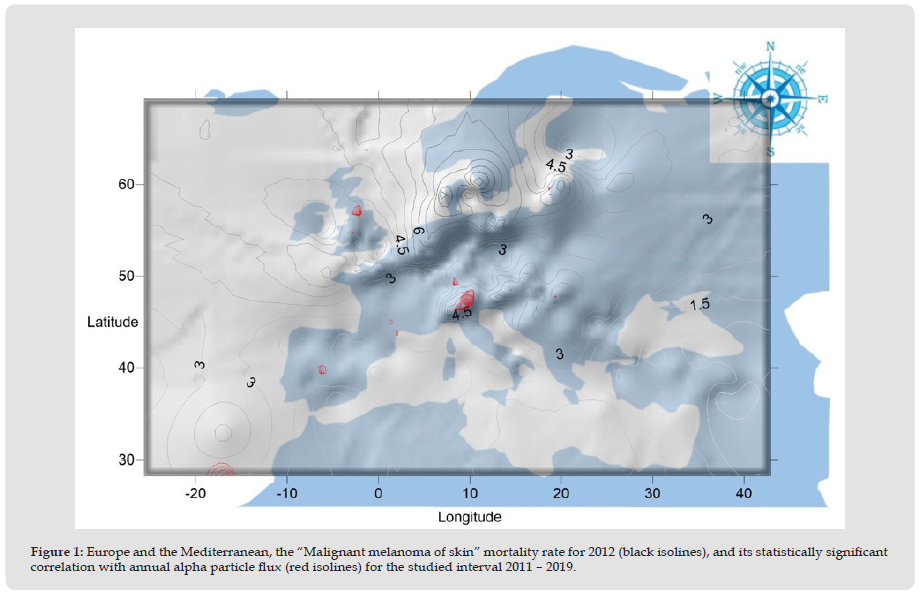
The correlation coefficients [27] between the annual averaged alpha radiation flux and the annual mortality rate were calculated. A map was created showing (with black isolines) the distribution of the annual mortality for 353 NUTS-2 European regions from the EUROSTAT shortlist death cause: “Malignant melanoma of skin” (EUROSTAT mortality shortlist number 18), for 2012, the year with the highest solar activity in the studied time interval 2011 – 2019. With red isolines, the map shows the distribution across the territory of Europe and the Mediterranean of the correlation coefficient between the annual mortality rate from “Malignant melanoma of skin” with the annually averaged alpha particle flux for the time interval 2011 – 2019. Data on the coordinates, latitude, and longitude [Google Earth] of the centroids of the NUTS-2 regions included in the study were used in the map. Mapping was performed with Golden Software Surfer10. The kriging interpolation procedure was selected. In mathematical statistics, the level of statistical significance [27] is a parameter, indicating the degree of reliability of the calculated correlation coefficient. The smaller the number of this parameter, the more reliably the correlation coefficient is established, i.e. the more reliably a causeand- effect relationship has been established, in the case between the annual flux of solar alpha radiation and mortality from a cause of “Malignant melanoma of skin”. The correlation coefficient and the level of statistical significance are related.

For the 9 years included in the study, a minimum correlation coefficient of 0.668 corresponds to a statistical significance level of 0.05 [27]. In scientific studies, a level of statistical significance no greater than 0.05 is accepted as a criterion for the reliability of the correlation coefficient. The red isolines on the correlation coefficient distribution in the map enclose the regions with statistically significant values of the correlation coefficients around and up to a significance level of 0.05. Correlation coefficients with a significance level above 0.05 are of high reliability (the higher the number, the lower the significance level) i.e. the existence of a causal relationship between cosmic alpha radiation and mortality from the cause “Malignant melanoma of skin” can be considered reliably established in the mentioned areas enclosed by red isolines on the correlation coefficient. If there is a coincidence for some of the maxima for mortality rate and correlation coefficients, then in the region of these maxima, the impact of alpha radiation contributes noticeably to the mortality from “Malignant melanoma of skin”. To the extent that the hypothetical mechanism proposed below explaining the observed phenomenon assumes that charged particles of high energy pass through the atmosphere and reach the Earth’s surface, the energy required for this was calculated from databases and calculators PSTAR and ASTAR [28,29]. Geomagnetic field data were obtained from the INTERMAGNET site [30].

Results

The described dangerous phenomenon is observed in the form of dependence between the annual average flux of radiation from positively charged particles (protons and alpha particles) with high kinetic energy, recorded by satellites in orbit around the Earth, and the annual mortality rate in the statistics of several countries from all continents in the Northern Hemisphere. The countries in whose mortality statistics the phenomenon is observed are located in a band parallel to the equator with approximate boundaries along the parallels of 30° and 60° north latitudes. It is observed in the annual mortality statistics of small countries. It is not noticeable in the statistics of large countries in the same band. It can be inferred that the impact on the Earth’s surface is short-lived and over a limited area the size of a small country, but is masked in large country statistics because it does not affect the entire area of the large country at the same time. This conclusion is confirmed for the USA, for which there is data on mortality in individual states [10]. The mortality statistic of the European Union is suitable for the study because it is based on statistical regions, smaller than a country, but still big enough, to include a statistically sufficient number of inhabitants.

This phenomenon would be expected to influence mortality in countries south of the Equator, but mortality statistics for them are scarce, unreliable, or absent, preventing reliable inferences about such an influence in the Southern Hemisphere. For particle energies of the order of 3.8 – 21.3 MeV, the year-averaged fluxes of protons and alpha particles are highly correlated, i.e. the studied phenomenon of lethality is noticeable in both the mean proton flux and the mean alpha particle flux data. For the reason explained below, only the average flux of high-energy alpha particles is included as the incident radiation in the examples below. Figure 1 shows for the Europe and Mediterranean the distribution of the mortality rate for EUROSTAT shortlist deaths cause: „Malignant melanoma of skin” for 2012, the year of maximum solar activity for the studied interval, and alpha particle flux maximum (black isolines), and the distribution of the statistically significant correlation coefficient between solar alpha particle fluxes and the mortality rate for “Malignant melanoma of skin” (red isolines). The statistically significant influence of alpha radiation on mortality from malignant melanoma of skin is limited to a band parallel to the Equator with approximate dimensions between 40° and 60° north latitude. Not all high mortality areas in the study region fall into it. Over Denmark and Sweden, there is an area of high mortality from malignant melanoma of the skin in which the contribution of alpha radiation to mortality is not noticeable.

Figure 1

biomedres-openaccess-journal-bjstr

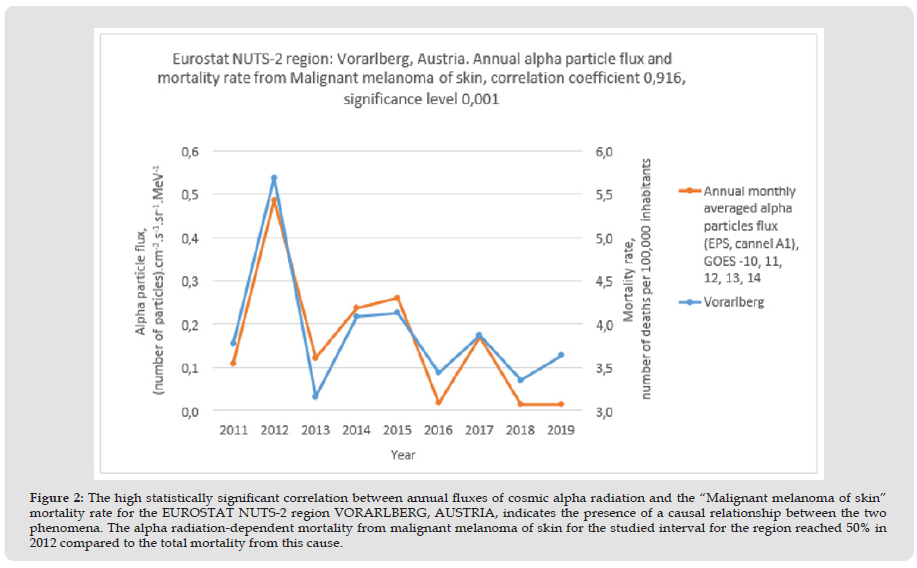
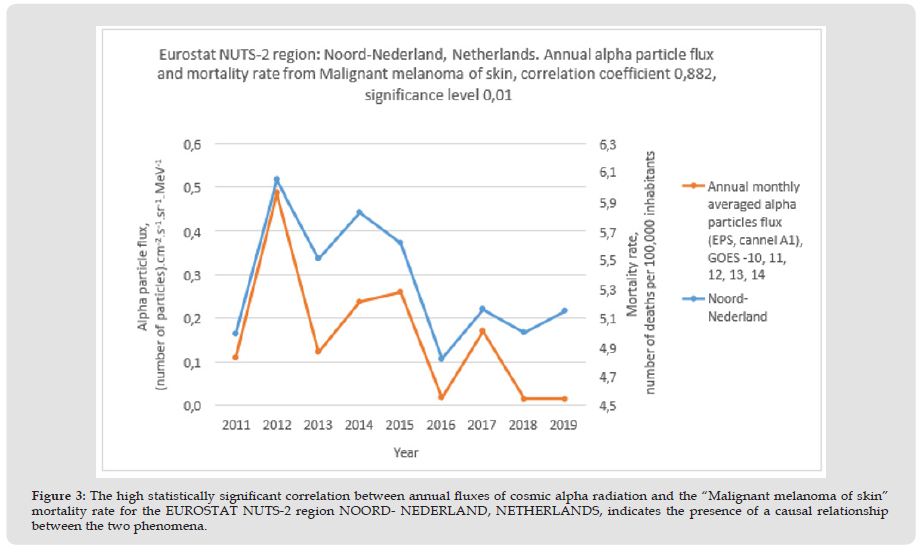
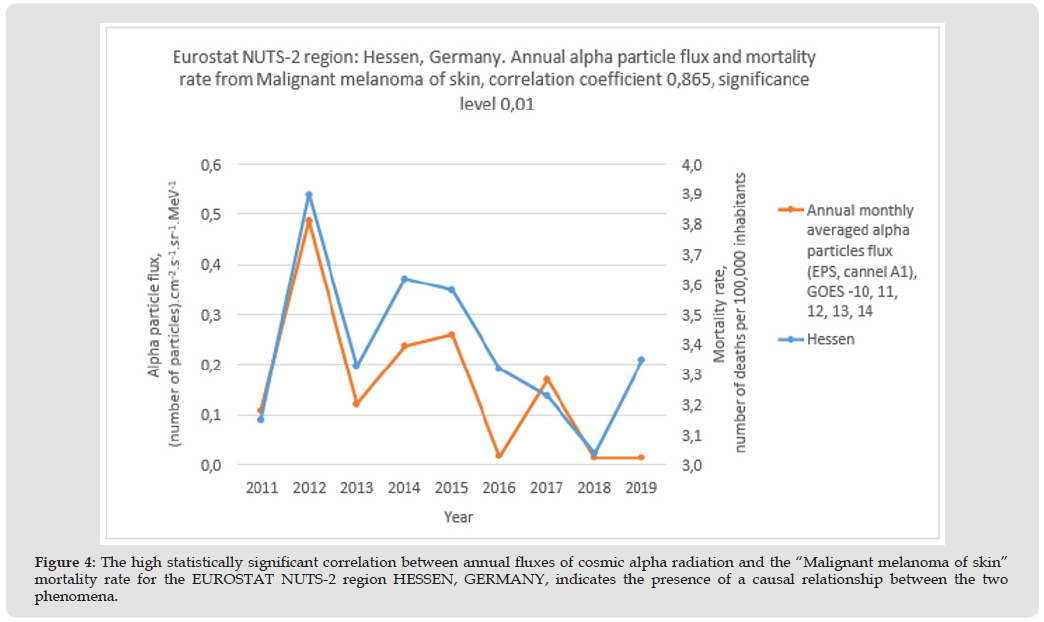
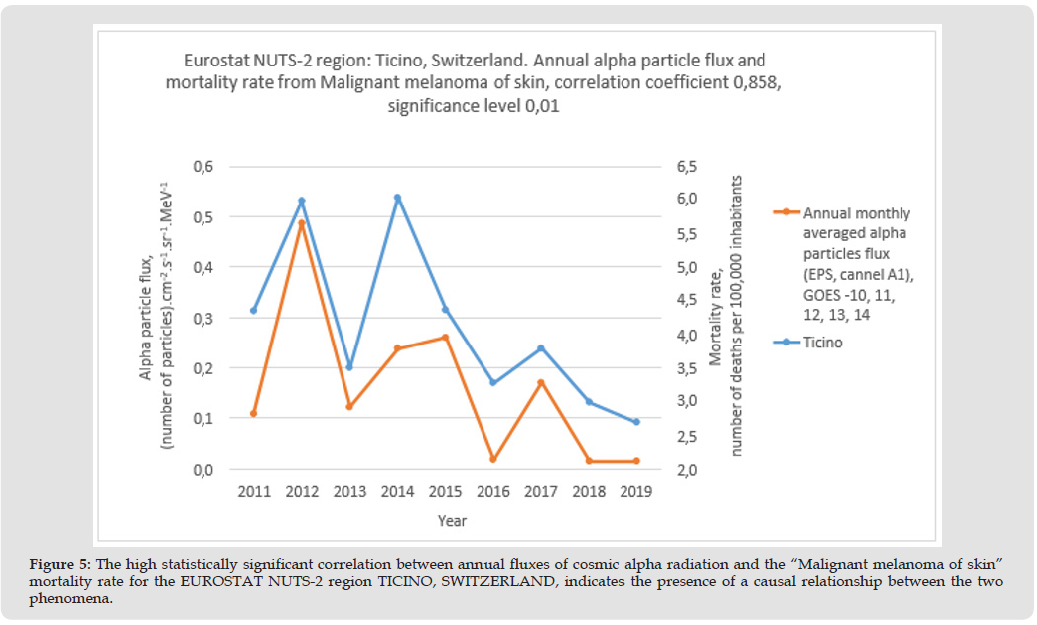
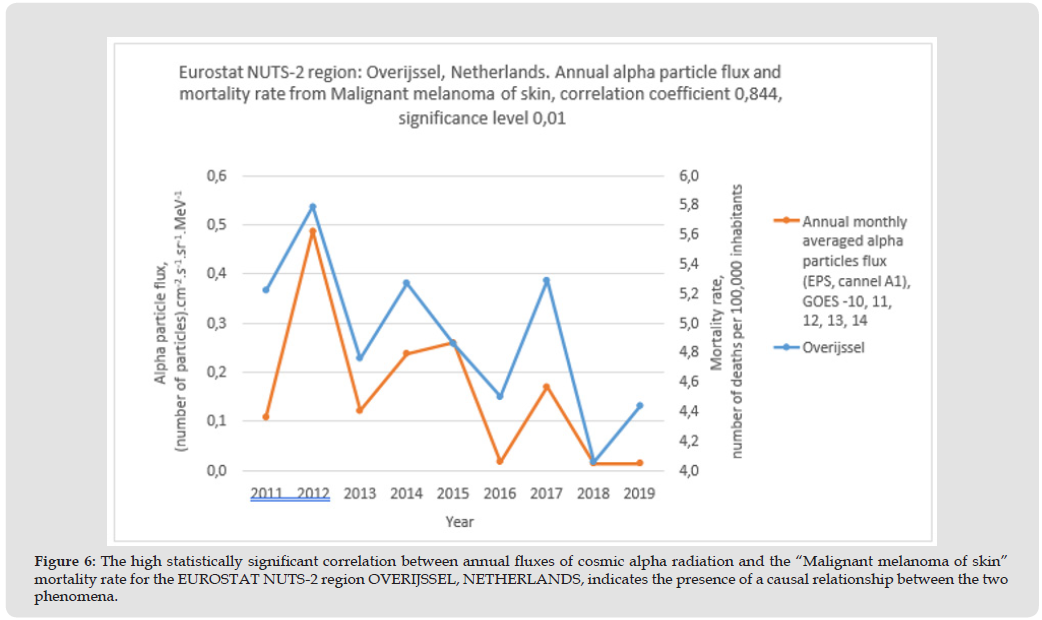
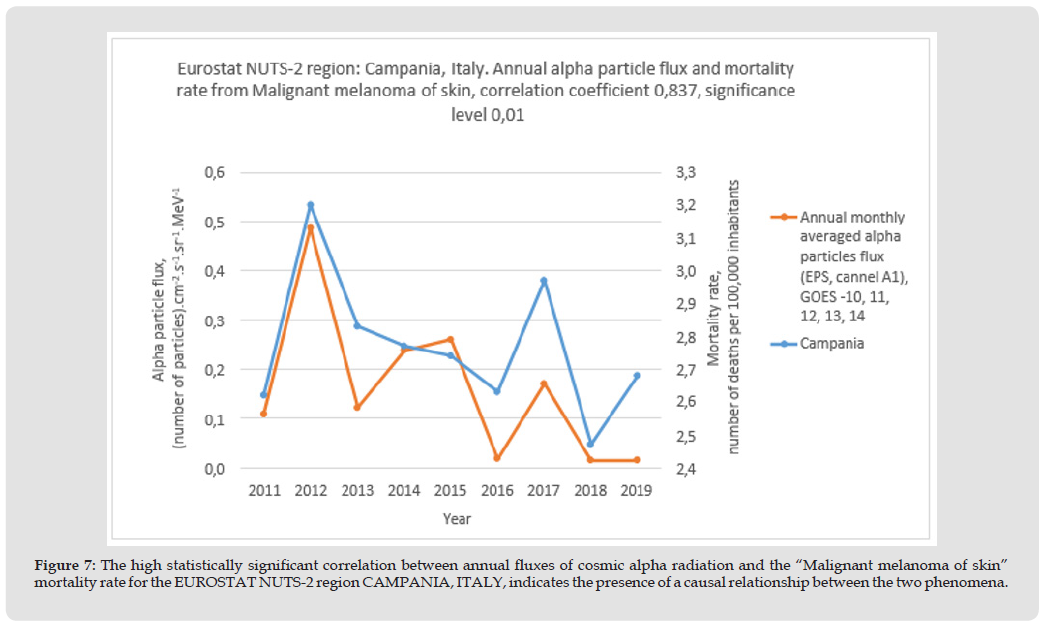
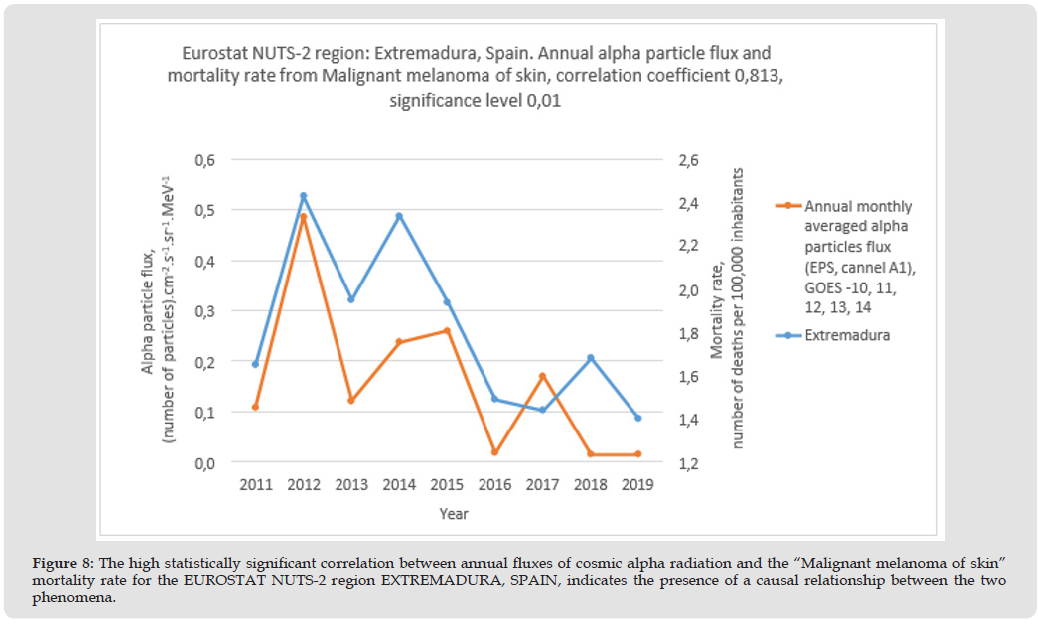
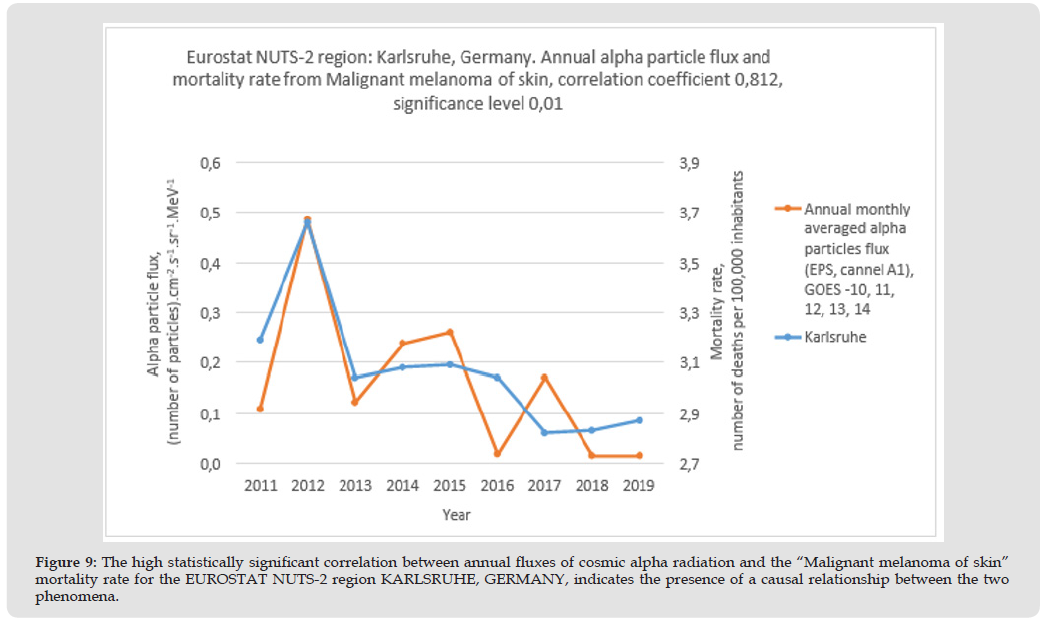
The impact of alpha radiation on mortality in the mentioned band does not continuously cover the entire band but is of the nature of limited spots in it, covering mainly mountainous areas. A pronounced effect – a statistically significant coincidence between areas with increased annual malignant melanoma of skin mortality and its correlation with annual alpha radiation flux is observed for the Alpine region (Italy, Austria, Switzerland), the Carpathians, the Pyrenees, and the Baltic countries. Central Spain and the Central United Kingdom are affected too. Figures 2-9 show the correlated changes in malignant melanoma of skin mortality with alpha radiation flux for these areas.

Figures 2-9 show the time dependence in the interval 2011 – 2019 of two numerical sequences:

• Of the recorded annual fluxes of alpha particles from satellites of the GOES series – 10, 11, 12, 13, and 14, and,
• Of the “Malignant melanoma of skin” annual mortality rate for some of the NUTS-2 regions of the European Union.
The high correlation between the two numerical sequences can be seen, indicating the existence of a causal relationship between them.

Figure 2

biomedres-openaccess-journal-bjstr

Figure 3

biomedres-openaccess-journal-bjstr

Figure 4

biomedres-openaccess-journal-bjstr

Figure 5

biomedres-openaccess-journal-bjstr

Figure 6

biomedres-openaccess-journal-bjstr

Figure 7

biomedres-openaccess-journal-bjstr

Figure 8

biomedres-openaccess-journal-bjstr

Figure 9

biomedres-openaccess-journal-bjstr

Discussion

The given examples convincingly prove the existence of an influence of cosmic radiation flux on malignant melanoma mortality. The problem of the mechanism of the described influence remains unclear. A hypothesized mechanism of this influence is outlined below, answering many of the questions that arise.

1) An observed phenomenon – mortality from many diseases in the statistics of many countries located mainly in the 30°N – 60°N band, is strongly correlated with fluxes of positively charged particles with energy of the order of 4 – 21 MeV, recorded by the GOES series satellites in Earth orbit.

2) The recorded alpha particle flows are mostly pulses with a duration of less than 5 minutes (the averaging interval of the recording device).

3) Proposed hypothesis – positively charged particles with high energy penetrate through the Earth’s atmosphere to the Earth’s surface and damage human health, causing death mainly in elderly people.

4) As the average altitude of the affected countries increases, the particle flux- correlated mortality shows an increasing trend [4,10]. It is probably due to the more intense radiation flux penetrating the thinner atmosphere over the mountainous region of Earth’s surface – an argument favoring the hypothesis.

5) The source of the flows of positively charged particles is the Sun – mortality increases with observable processes on the Sun – from Solar Mass Ejections directed to Earth (a phenomenon on the solar surface that could be observed with other astronomical means) [4,8]. The Alpha Magnetic Spectrometer (AMS-02) on the International Space Station measures cosmic rays, excluding those of solar origin (when shielded from the Sun by the station’s solar panels). In particular, it measures the flow of 3He and 4He (alpha particles) in cosmic rays. The measurements show [31] increasing annual flux of alpha particles in cosmic rays for the interval of years from 2011 to 2017 (last available data), while the flux of GOES registered (solar?) alpha particles for the same interval of years is decreasing (Figures 2-9). Indirect evidence for the Sun as a source of high-energy alpha particles is that this assumption convincingly explains the downstream processes that ultimately lead to death.

6) Positively charged solar particles capable of penetrating through the Earth’s atmosphere to the Earth’s surface are high-energy alpha particles. Calculators PSTAR [28] and ASTAR [29] calculate the penetration parameters of protons, respectively alpha particles in different substances, in particular in air. Calculations with data for a homogeneous atmosphere – an atmospheric model with constant density, temperature, and pressure decreasing with height [4] show that only particles whose energy is above 2.4 GeV for protons and over 6.2 GeV for alpha particles can penetrate the Earth’s atmosphere to the surface. There are no registered by GOES satellites protons above 0.7 GeV, but there are registered alpha particles with energy above 3.4 GeV, hypothetically also those with energy above 6.2 GeV [4,10,12], i.e. the particles that penetrate to the Earth’s surface are probably high-energy alpha particles. Only fluxes of alpha particles with a magnitude of at least (1000 particles).cm 2. s-1. MeV-1 is correlated with the mortality of the Earth’s surface.

7) It is assumed that the alpha particles recorded by the satellites were emitted simultaneously with the hypothetical fast alpha particles in a common explosive process (flares?) on the solar surface. It can be calculated that particles with an energy of 7 GeV need 8.87 min to reach the Earth’s surface from the Sun’s surface and registered by satellites particles with energies of 5 – 10 MeV travel about 2 hours. The registered alpha particles do not have enough energy to penetrate the atmosphere, unlike the hypothetical Fast alpha particles that reach the surface of the Earth in minutes from the center of the solar disk. However, the registered alpha particles are an indicator that two hours earlier there was an irradiation of the Earth’s surface with fast (unregistered) alpha particles.

8) Although alpha particle streams irradiate the entire illuminated part of the atmosphere, penetration of fast alpha particles to the surface occurs only in a limited area of the surface (death spot), for which two conditions favoring penetration are combined:

a) The Sun is culminating for the center of the death spot,

b) For the center of the death spot, a coincidence is in effect – the direction of the geomagnetic vector coincides with the direction of the alpha particle intrusion – the alpha particle movement is not affected by the deflecting magnetic force. Such a coincidence occurs twice a year for latitudes in the band from 28°N to 48°N [4]. For latitudes outside this band, such a coincidence is impossible, the fast alpha particles do not reach the Earth’s surface, or their flux on the surface decreases fast with their moving away from the band.

9) During the year, the apparent position of the Sun relative to the point of observation shifts, so that the maximum angle of elevation of the Sun’s disk above the horizon (solar culmination) changes depending on the date.

The latitude and longitude of a point on the Earth’s surface where the solar disk is at its culmination at that moment of registration of the incoming alpha particle flow – the point of registration, can be determined from the date (latitude), and the hours and minutes of registration (longitude). The center of the dead spot can be calculated – it is approximately 30° east of the registration point [10]. The Earth’s angular velocity is 15° per hour. The moment of occurrence of a flow of fast alpha particles cannot be predicted, but the dates of increased risk for a given point on the Earth’s surface between 30°N – 50°N can be calculated by the latitude of the location [10]. For example, for the EUROSTAT NUTS-2 region Vorarlberg, Austria See (Figure 2), with latitude 47°N, the dates with maximum risk are around May 24 and July 20. On these dates, the inclination (63.6°) of the geomagnetic vector for Austria is close in magnitude to or coincides with the culmination of the Sun (the Earth’s atmosphere is thinnest at the moment of the Sun’s culmination, and there is no deflecting magnetic force for alpha particles if they intrude at this time from the Sun). The increased risk of health incidents outdoors around local noon is a further argument for the healthfulness of the indoor midday break (‘siesta’) practiced in Mediterranean countries. The arguments given above reveal a new, previously unsuspected cosmic cause of melanoma mortality – solar corpuscular alpha radiation. This type of radiation may be the leading external cause of melanoma disease. The risk, in particular for melanoma, is highest for inhabitants in the mountainous regions, in ours around local noon.

The risk is also increased during certain days of the year (depending on the latitude of the observation point) during which the solar culmination coincides with the angle of the geomagnetic vector (inclination). If a stream of high-energy solar alpha particles were to hit the Earth at this time, there would be no deflecting magnetic force on them, making it easier for them to reach the Earth’s surface. The predominant part of the recorded pulses of alpha particles forms unnatural series with fixed periods and relatively constant magnitudes, which allows the hypothesis of their artificial origin [12]. The creams and oils that are used to protect the skin from ultraviolet radiation are useless in protecting the human body from the penetration of alpha particles with high enough energy, capable of overcoming the resistance of the atmosphere and reaching the Earth’s surface. The predominant part of the recorded pulses of alpha particles forms unnatural series with fixed periods and relatively constant magnitudes, which allows the hypothesis of their artificial origin [12].

Follow us on: Biomedical Journal Impact Factor: https://biomedres.us

https://scholar.google.com/citations?user=OFtUOZYAAAAJ&hl=en
https://www.base-search.net/Search/Results?lookfor=Biomed+Journal+of+Scientific+%26+Technical+Research&l=en&refid=dcsuggesten
https://citefactor.org/journal/2574-1241/biomedical-journal-of-scientific-technical-research
https://ideas.repec.org/s/abf/journl.html
https://econpapers.repec.org/article/abfjournl/
https://www.ncbi.nlm.nih.gov/nlmcatalog/101723284
https://bjstr.org/
https://bjstr.org/about.php
https://biomedres.us/reprints.php
https://biomedres.net/submit-manuscript.php

medical journal in usa |BJSTR

Polymorphisms of Aryl Hydrocarbon Receptor (AHR) Gene in a China Population: Associated with Risk of Acute Coronary Syndrome

Introduction

Acute coronary syndrome (ACS) is the leading cause of morbidity and mortality globally. Acute coronary syndrome (ACS) ranges from ST-segment elevation myocardial infarction (STEMI), non-ST-segment elevation myocardial infarction (NSTEMI) and unstable angina (UA). Many studies have demonstrated that polycyclic aromatic hydrocarbons (PHAs), which are major constituents of cigarette tobacco tar, are strongly involved in the pathogenesis of the cardiovascular disease (CVD) [1]. Knowing that PAH-induced toxicities are mediated by the activation of a cytosolic receptor, aryl hydrocarbon receptor (AhR), which regulates the expression of a group of xenobiotic metabolizing enzymes (XMEs), suggests a direct link between AhR-regulated XMEs and CVD [2,3]. More recently, the functions of AhR expression levels and functional AhR polymorphisms appear to affect the susceptibility and progression of CVD, which increases our understanding of the mechanism by which dioxin pollution and cigarette smoke trigger CVD [4]. In the past, it is well established that these results provide a AhR and polymorphisms is new potential factor in the targeted treatment of CVD.

However, little is known about the role of AhR in ACS. So, investigation of the potential correlation between AhR polymorphisms and ACS susceptibility would hence provide a valuable insight into the role of AhR in ACS. The AhR belongs to the family of basic-helix-loop-helix transcription factors [5]. It is known that polymorphisms of the AhR gene have negative effects on the affinity and sensitivity of the AhR proteins and activation of the AhR signaling pathway. Among the previous reports on single nucleotide polymorphisms (SNPs) of the AhR gene, rs2066853 has attracted considerable attention for its association with the risk [6]. However, no association between AhR polymorphisms and ACS has yet been determined. Therefore, based on a cohort study of 938 incident CVD cases, we identified AhR as a novel ACS susceptibility gene.

Method

Study Population

Informed written consent was obtained from all CAD and the study protocol was approved by the Institutional Ethics Committee of the Affiliated hospital of Guangdong Medical College. All experimental methods applied in this study were carried out according to approved guidelines. A total of 939 patients with CAD were recruited from the Affiliated Hospital of Guangdong Medical College (Zhanjiang, China) between May 2011 and August 2013. The clinical diagnosis of CAD was performed as follows: existing myocardial infarction, treated by percutaneous coronary intervention or coronary artery bypass graft, more than 50% stenosis in at least one of the main coronary arteries demonstrated angiographically, together with physiological examination including increased hs-TnI, MYO, CK and CK-MB. According to the degree of severity and clinical pathological characteristics, the CAD group was divided into too subgroups: ACS and stable angina (SA), based on the American College of Cardiology/American Heart Association Task Force on Practice Guidelines [7,8]. Those with acute or chronic infections, systemic inflammatory diseases, autoimmune diseases, blood diseases, severe liver or renal function defects, malignant tumors, heart failure, arrhythmia, cardiomyopathies, and hematologic disorders were excluded from the study.

Genotyping

Human genomic DNA was isolated from peripheral blood using the TIAN amp Blood DNA Kit (Tiangen Biotech, Beijing, China), according to the manufacturer’s instruction. Direct sequencing was used for genotyping analysis. A total of 10 ng of genomic DNA from each subject was used as a template to PCR-amplify DNA fragments of 150–250 bp containing AhR rs2066853 using the following primers: forward, 59-GATTGATTTTGAAGACCTCA-39 and reverse, 59-CTGAAGGTA TGAAGGGAG-39. After purification and precipitation by polyethylene glycol electrophoresis, the DNA fragment underwent direct sequencing on an ABI 3130XL DNA sequence detector with the Big DyeH Terminator v3.1 Kit (Applied Biosystems, Foster City, CA, USA). The result was documented and analyzed by the Gene Mapper 4.0 system (Applied Biosystems).

Statistical Analysis

All data were shown as means ±standard errors or percentage frequencies. Statistical analyses were performed using SPSS (ver. 12.0, IBM, New York, NY, USA) software. Allele frequencies of AhR were calculated based on subject genotypes, and differences in allele and genotype distributions between ACS and SA groups were analyzed by binary logistic regression or the chi-squared test. Multiple comparison corrections were performed with a one-way ANOVA using Bonferroni correction. Two-tailed P values, odds ratios, and 95% confidence intervals are presented for all association tests. A value of P< 0.05 was considered statistically significant.

Results

Patients

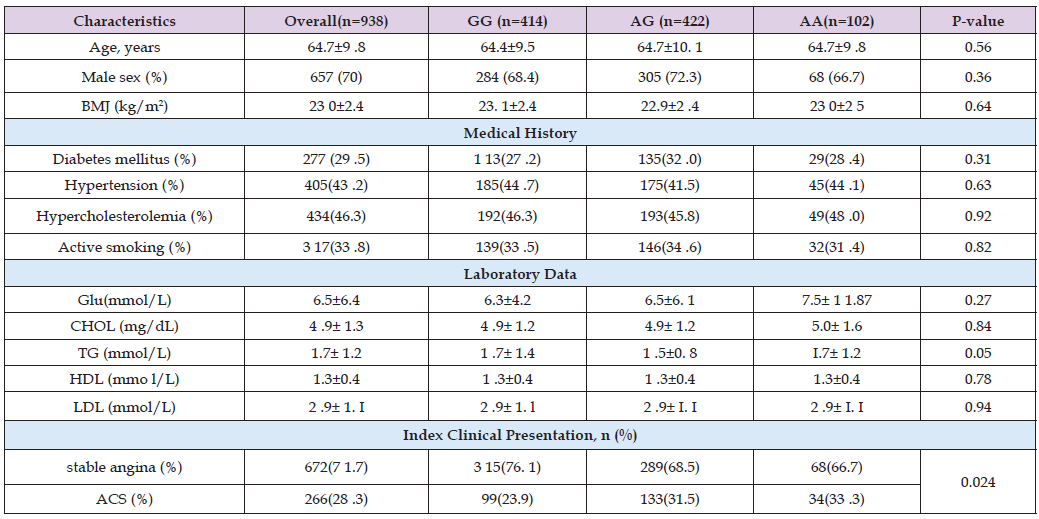
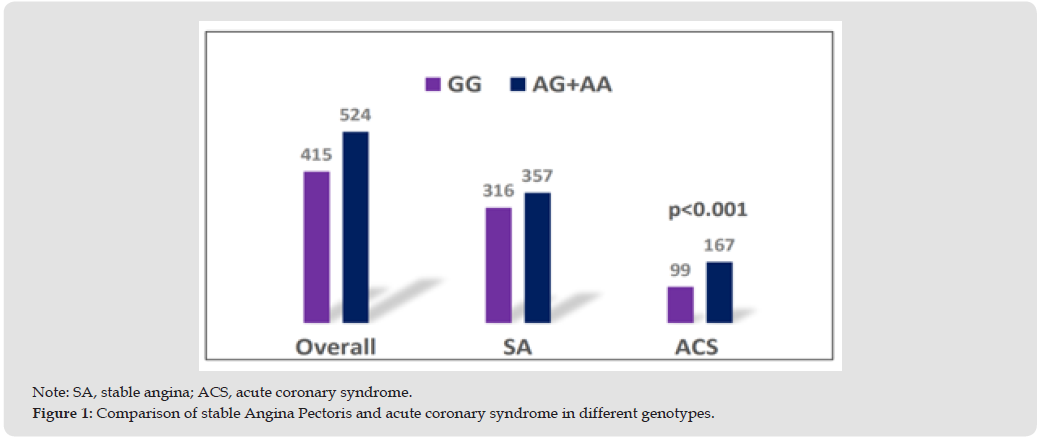
A total of 938 CAD patients, which contained 672 stable angina and 266 ACS. Baseline characteristics were well match across the AhR phenotype are summarized in Table 1. The distribution of the AhR genotypes were 414 (44.1%), 422 (45.0%) and 102 (10.9%) for GG, AG and AA, respectively. Thus, 524 (55.9%) patients were combined (AG+AA) genotype. According to genotypes were increased significantly in ACS patients compared with the SA groups P<0.05, Figure 1. These results suggested that AhR polymorphisms were related to ACS pathogenesis.

Table 1: Clinical, laboratory, and procedural characteristics of the study population.

biomedres-openaccess-journal-bjstr

Note: Continuous data are shown as mean ±S D. Dichotomous data are shown as n (%). BMI, body mass index; Glu, glucose; CHOL, cholesterol; TG, triglyceride; HDL, Hight density lipoprotein; LDL, low density lipoprotein. ACS, acute coronary syndrome.

Figure 1

biomedres-openaccess-journal-bjstr

Logistic Regression Analysis for Prediction of ACS

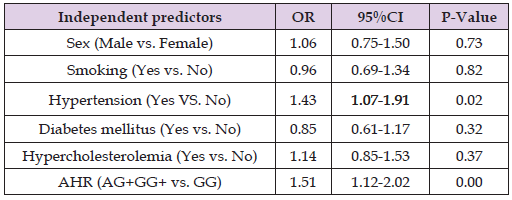
To determine predictors of ACS, a univariate regression analysis was performed to evaluate. The impact of sex, hypertension, smoking, diabetes mellitus, hype-rcholesterolemia and AhR phenotype (Table 2). We found that the ACS risk associated with the variant genotype of AhR, and hypertension increased significantly. The combined (AG+AA) genotype allele (OR: 1.51, 95%CI: 1.12-2.02, p<0.001) and hypertension (OR:1.43, 95% CI:1.07-1.91, p<0.05) were significant predictors of ACS.

Table 2: Logistic regression analysis of independent risk factors of ACS.

biomedres-openaccess-journal-bjstr

Note: The combined (AG+AA) genotype allele: OR: 1.51. 95% CI: 1 .12-2.02. p<0.001. hypertension: OR:1.43, 95% Cl:1.07-1.91, p<0.05.

Discussion

This study is the first to compare the data AhR phenotype for ACS status in coronary artery disease patients. Recently, the incidence of cardiovascular disease has been on the rise in the environmentally exposed population. As a critical transducer for contaminant dioxin, a mass of evidence has indicated AhR plays a role in the pathogenesis of CAD 3.4. [9-11]. A recent study showed that AhR contributed to plaque vulnerability and promoted atherosclerosis by inducing vascular inflammation [11]. Based on this hospital case research, we investigated the associations between AhR genotype and the risk of ACS. Activating the AhR signaling pathway induces vascular inflammation and promotes atherosclerosis, thereby increasing the occurrence and development of CAD [12]. AhR is bound up with various pathogenic factors of ACS, despite it is not clear whether AhR directly led to the development of ACS, there has been no previous research on the role of AhR variants in the risk of ACS. In this study, we surveyed the relationship between AhR rs2066853 and ACS susceptibility. Our current research shows significant correlation the relationship between AhR phenotype and the risk of ACS in the Chinese population. The rs2066853 G >A missense mutation site is in the exon 10 of AhR, which also causes the arginine in the transcription activation domain of AhR protein to become lysine [13].

Therefore, the hereditary stability of AhR rs2066853 has a strong influence on the structure and function of the protein encoded. So, it explains the individual susceptibility of certain diseases [14-17]. Former research about rs2066853 that mainly focused on cancer, but their verdicts were quite contradictory and disputable. Huang [3] et al, showed that the AhR expression level and functional AhR polymorphism have a potential impact on the susceptibility and development of Chinese CAD. According to our study, it was found that the significantly increased risk of ACS is related to the A allele of rs2066853. When further studying the combined (AG + AA) genotype of rs2066853, the proportion of (AG + AA) genotypes in patients with ACS was significantly higher than that of (GG) phenotype (Figure 1). All the subjects in this study were patients who had been diagnosed with CAD by coronary angiography. Logistic regression analysis of independent risk factors of ACS (Table 2) showed that hypertension and AHR (AG + AA) were significantly different (P <0.05). Smoking, hypertension, diabetes, and low-density lipoprotein, hypercholesterolemia are all risk factors for CAD, ACS is a subtype of CAD, so considering smoking, cholesterol, low density lipoprotein, hypertension, and diabetes can increase the incidence of ACS [6.7]. Since our study subjects are all diagnosed patients with coronary artery disease, these risk factors for ACS do not show significant differences, except for hypertension. Significant differences in the occurrence of hypertension are considered to be significantly related to poor blood pressure control in patients with CAD who have hypertension.

In conclusion, we provide evidence that the functional polymorphisms of the AhR gene may affect the susceptibility and clinical progress of ACS in the Chinese population, which opens new horizons for the etiology of ACS and may be beneficial for future ACS treatment. However, a larger sample of research may be needed to confirm these findings and further explore its mechanism of action.

Follow us on: Biomedical Journal Impact Factor: https://biomedres.us

https://scholar.google.com/citations?user=OFtUOZYAAAAJ&hl=en
https://www.base-search.net/Search/Results?lookfor=Biomed+Journal+of+Scientific+%26+Technical+Research&l=en&refid=dcsuggesten
https://citefactor.org/journal/2574-1241/biomedical-journal-of-scientific-technical-research
https://ideas.repec.org/s/abf/journl.html
https://econpapers.repec.org/article/abfjournl/
https://www.ncbi.nlm.nih.gov/nlmcatalog/101723284
https://bjstr.org/
https://bjstr.org/about.php
https://biomedres.us/reprints.php
https://biomedres.net/submit-manuscript.php

Journals on Biomedical Science |BJSTR

Alzheimer’s Disease: Nanotherapeutics

Editorial

Nanotherapeutics is forefront of new strategies that is nanotechnology [1] due neurons size of nanotools and devices which fall in the range of a billionth of a meter, are being considered to treat and diagnose neurodegenerative diseases [2,3]. Irregularities in the natural functioning of neurons, initiate brain health disorders. Therefore, to treat these neurons is a very complicated task and even their locations are beyond the common approach. Nanotherapeutics [4] is quite capable to do the aforesaid chore and can be a good choice to be a therapy for neurodegenerative diseases, such as Parkinson’s disease (PD) and Alzheimer’s disease (AD) [5]. Various nanoparticles have been reported that can target brain in-vitro and in-vivo. Recently, the association of microglia, the brain-immune cells and uncontrolled inflammation has been discovered by the researchers of Rutgers University. Microglia tackled pathological changes within the brain to identify the undesired and foreign particles, so that it be cleared in a fast mode. The neurodegenerative disorders are very complex physiological, to resolve this issue, it is not a good approach to solely have a concern with searching therapy for neurons, but there are needs to search the mediators and those should be treated first, like in this case microglia, the mediator of neuron physiology and it be targeted first as this new strategy. This finding is considered as a breakthrough and could be a potential therapeutic target [6]. Such an approach may further reduce brain inflammation.

According to described literature, nanoparticles as a therapy and source of diagnosis of Alzheimer disease can cross the BBB and eliminate the Aß burden [7]. Finally, this therapy can slow the long-term progression of the disorder. The abnormal structure present in the brain of AD patients are senile plaques (deposits of the protein) and neurofibrillary tangles (neuron exposure) and both of them tied with Aß. By removing Aß, these disorders will be healed. It is very unfortunate that no researcher can get success in it. By applying nanotechnology, a few nanoparticles and nanomaterials have been designed that can simultaneously cross over BBB and hit the desired target [8]. Moreover, nanotechnologically developed tools and devices can perform diagnosis and imaging of brain diseases, including brain ischemia, stroke, and inflammation of the nervous system [9]. More interestingly, nano-biosensors have been developed that have a high grade of sensitivity for earlier detection of AD. The synthesis of biologically active HDL-based nanomaterials was reported through a microfluidic technology [10]. Lipid, protein, gold, quantum dot, and iron oxide, are the key components of aforesaid nanoparticles [11] These specifically designed nanoparticles can interact with microglia and this is what required. These interactions will explore new avenue for designing those nanomedicine platforms that can enable targeted delivery with zero toxicity. [12] Nanotherapeutics prescribed for curing Alzheimer’s disease that explores various the applications of nanotechnology in clinical neuroscience for developing innovative therapeutic for treating AD [1].

Nanomedicine-based immunotherapy summarize to be considered for developing nanomedicine-based therapy to overcome the pathways of BBB and that can mimic the innate immune actions [13]. Nanorobotics are automatic molecular machines that can travel and monitor different compounds, and can store that information [14]. Nanotherapeutic that can combat excitotoxicity during stroke, TBI, and hypoxia–ischemia and deal with mitigating oxidative stress, was described [15]. Nanomedicines were reported that can replace or enrich diseased or injured cells and tissue and replenish the local environment or can halt further degeneration and hence capable in dissolve translational challenges for treating neurological disorders [16]. Generally, microglia protect neurons by removing pathological agents, but if a long-term exposure of microglia stimulants initiate neuronal damage because of secretion of pro-inflammatory agents, resulting neuroinflammation and neurodegeneration [17] Designing microglia-targeting nanotherapeutics for the treatment of neurodegenerative disorders was presented [18]. Intranasal delivery of nanotherapeutics and nano biotherapeutics were designed as an engineered nanocarriers as a smart delivery system for treating AD and highlighted as a proficient approach [19]. In order to assess the potential applications of the medicinal plants, their derived components, and Phyto-Therapeutic, nano medicinal strategies have been developed that can transport aforesaid components for treating AD [20].

Flavonoid-based nanomedicines inhibit the accumulation of large aggregates state of amyloid-beta 42 (Aβ42), and hindered the formation of neurofibrillary tangles of hyper-phosphorylated forms of microtubule-associated tau protein, during AD [21]. The stem cell and nano-based therapies were applied as novel therapeutic strategies for treating AD, associated pathogenesis and pathogenic trajectories [22]. Nanomedicine [23] can offer impressive resolutions as a tiny machine for the healthcare that will cure a lot of life threatening diseases [24] Nanocarriers having polysaccharides as a component are remarkable as nanotherapeutics for curing Alzheimer disease and increase the transportation of the desired molecules [25]. Exploring recent advances in nanotherapeutics being tiny molecules of immunotherapeutic have many advantages over biological drugs regarding complexity, tissue penetration, manufacturing cost [26] Extracellular vesicles were also applied to treat neuroinflammation and are very helpful for pathogenesis, diagnosis, and therapy [27] Nanotherapeutics medicine of extracellular vesicles performed as theragnostic platform for biogenesis, membrane trafficking, and oxidative stress [28]. Highly bioactive zeolite imidazole framework-8–capped were applied as nanotherapeutics to suppresses inflammation- and the activation of astrocytes and secretion of proinflammatory cytokines, and notified as neuroprotective therapy. [29] Nanotools can detect the degeneration of amyloid-β peptide (Aβ) oligomers, and act as suppressor of oxidative stress of free radicals. [30].

Advances in personalized nanotherapeutics is a as state-of-theart, that can be applied in various strategies and developed a novel nano-enabling therapeutic schemes to cure and monitor diseases. [31] The emergence of nanotherapeutics from laboratory to clinic comprehensively discussed and the persisted shortcomings for delivery of classical (small) drugs, macromolecular therapeutics, and recombinant vaccine were illustrated. [32,33] Nanomedicine overcome the obstacles and improve diagnostic and therapeutic outcomes in the healing neurodegenerative disorders. [34] Nano neuro medicines can be applied for neuroimaging as well as for therapeutic applications for degenerative, inflammatory and infectious disorders of the nervous system. [35] Small interfering RNAs, displayed remarkable promises and underlined as potential therapeutics option for curing AD. [36] Precision nanomedicine was reported as target-specific agents and are able to bypass the blood-brain barrier rapidly, and ultimately become a novel therapeutic modality to treat neurodegenerative diseases. [37] Potential use of nanomedicine for treating anti-inflammatory neurodegenerative diseases, (AD and PD) was underlined and that have ability of penetration of the BBB to achieve a therapeutic potential in the field of therapy that can be used for healing of neurodegenerative diseases. [38] Macrophage targeted theragnostic as personalized nanomedicine were discovered that can be successful as a theragnostic in macrophage ablation, phenotype modulation and inhibition of their inflammatory activity [39].

Selective targeting capabilities of nanomedicine have been reported that can deal with the pathological permeability of the blood– brain barrier during neurovascular inflammation [40]. Comparatively to conventional formulations, a number of nano formulations were recommended for improving the pharmacodynamics of the encapsulated drug for healing inflammatory diseases that can improve the quality of therapeutic treatment for curing diseases like AD and PDs. [41] Published article covered the promising aspects of ongoing developments in the diagnosis and management of Alzheimer’s disease by applying nanotechnology. [42,43] Emerging role of nanotechnology and different nanoparticle (Gold, quantum dots, polymeric, liposomes, carbon nanotubes, and fullerenes) were highlighted for treating neurological disorders, including AD, PD and Huntington’s disease and has shown great potential to overcome the problems. Phosphorus dendrimers that have potential to fight against cancers, neurodegenerative diseases, and inflammation, both in vitro and in vivo, were described. [44] A book, entitled “Nanomedicine for Inflammatory Diseases” covered different aspects of translational medicine for clinicians and disclosed various aspects for treating inflammatory disease and bridging the gap between the laboratory bench top and the clinical bedside [45].

Acknowledgements

One of the authors, Rajiv Kumar, gratefully acknowledges his younger brother, Bitto.

Consent for Publication

Not Applicable.

Conflict of Interest

The authors declare no conflict of interest, financial or otherwise.

Declaration of Competing Interest

The authors declare that they have no known competing financial interests or personal relationships that could have appeared to influence the work reported in this paper.

Data Availability Statement

Due to the nature of the research, [ethical, legal/commercial] supporting data is not applicable and thus not available.

Follow us on: Biomedical Journal Impact Factor: https://biomedres.us

https://scholar.google.com/citations?user=OFtUOZYAAAAJ&hl=en
https://www.base-search.net/Search/Results?lookfor=Biomed+Journal+of+Scientific+%26+Technical+Research&l=en&refid=dcsuggesten
https://citefactor.org/journal/2574-1241/biomedical-journal-of-scientific-technical-research
https://ideas.repec.org/s/abf/journl.html
https://econpapers.repec.org/article/abfjournl/
https://www.ncbi.nlm.nih.gov/nlmcatalog/101723284
https://bjstr.org/
https://bjstr.org/about.php
https://biomedres.us/reprints.php
https://biomedres.net/submit-manuscript.php

Open access clinical and medical journal |BJSTR

Educating to Generate Self-Learning

Introduction

Universities continue to reject a large number of students who, despite having previously completed the official and necessary school cycles (preschool, primary, secondary and baccalaureate), did not manage to acquire solid and sufficient knowledge in a period of at least sixteen years or more of schooling to pass the evaluations that are applied to them as a requirement to be accepted as new students to higher education. Entering a school becomes, and is seen by the student and society, a mere formality, a matter full of bureaucratic-administrative processes and tasks that take up a lot of time, which at the time is carried out with a superficial character, out of obligation and without conviction or depth, when it should be a procedure for the school authorities, Teachers and parents and the applicants themselves would know their strengths and weaknesses in terms of their knowledge and knowledge and therefore be able to apply themselves to continue strengthening or correct their deficiencies. In addition, learning and consequently the knowledge and knowledge of students is a variable that is almost always taken into account by employers who demand certain competencies from their future employees. This situation is notorious due to the gap between the competencies certified by the professional degree and the real skills of the university graduate, this difference is a serious problem since it is thought that the graduate is less and less prepared to face the new professional and labor standards that are required. On the other hand, the concerns and complaints of students in this regard are also abundant, for them the educational system does not teach them correctly to solve problems, to make decisions, to think and to learn how to self-learn.

Most teachers are expert information processors, however they are primarily concerned with the results they must achieve, as well as the number of topics they have to cover in tight periods of time and more concerned with teaching than with student learning; To be able to decipher why the teacher, even in these times, continues to think that teaching is more of a priority than learning is very difficult because his thinking and that of the student is a black box, an enigma that is difficult to unravel. The presentation of the contents of a topic in higher education should not depend mainly on the erudition capacity of the teacher, since this situation does not ensure that the group follows it and understands the explanation, these classes can provide in general terms to the group of students congruent, structured and valuable information in general and particular, But there will always be students who are not able to understand and assimilate the information because they do not have the knowledge, nor the level of understanding that the teacher has reached around them, all of which determines that the information presented is not internalized and amalgamated with the information they already have, the information received is dispersed in a series of unconnected data, isolated, fragments of information, unrelated to previous knowledge or situations of daily or professional life. In terms of learning, it is still tied to intuitive practices of common sense, to the old popular affirmations and beliefs about the process of teaching and learning, that it is the obligation of the teacher to teach and the student to learn from him, rigid strategies and tactics are used and formats as old as the rote and arbitrary reception of reading by the student and relying on memory for an evaluation or a In addition, the student trusts in his ability and ability to copy and the teacher in silencing his conscience by making him see nothing, all this and more is in part what irremediably condemns what he has learned to oblivion, although in these cases that is not the important thing, what matters is to obtain a passing grade (Granados López H, et al. [1]).

Self-learning, which, unlike teacher-conditioned learning, can lead the student to move towards academic independence and thus be in the future a better professional who really contributes to the solution not only of the problems of society in general, but also of his, for this the teaching of study strategies in students is a primary factor to achieve better learning based on self-learning and thus facilitate their school transition and increase the chances of academic success.

Educating to Stop Self-Learning

Experimental studies and achievements in the fields of artificial intelligence and cognitive psychology of learning have made it possible to formulate new perspectives and redefine the laws that regulate human learning, which change the logic of education. When we talk about difficulties at school, we immediately think of bad grades, long and tedious class sessions, failed exams, threats of expulsion, failure, stress, depression, etc., school demands are a fact that we can only accept exist; If the student does not comply in the way that the teacher expects or the institution demands, then other means are resorted to make him work harder, even if the parents, teachers or coordinators and/or those responsible for his education do not seek the remedy directly on what produces the problem. Rather, they act on the causes that originate the problem, with this the students remain subject to the set of obligations established by the educational system, within which studying to learn and know in a more satisfactory and broader way, represents for the student one of the most punitive and most volitional obligations. It would be interesting to ask ourselves about what educational demands cost the student and how much guilt and responsibility teachers have in the fatigue, instability, anxiety, blockage, deception and repudiation of study originated in the student; This consideration is not only about asking simple and plain questions, without foundation, that provoke reactions of indifference, it is about creating a current situation that gives rise to situations and the establishment of a link between education or teaching and educational research, where the action of students, teachers and parents improve the conceptions that are held in this regard, intending in the end to qualitatively sensitize the student about the importance of learning and knowledge for the achievement of each student’s particular life project.

When talking about strategies, techniques and study habits and their effect on learning, it is common to start by rescuing that motivation is an essential factor to achieve academic success as a result of the effort of study strategies and learning as an inherent instrument to achieve the proposed goals, the strengthening of self-esteem and confidence in one’s own competence as essential traits to obtain a good school performance and to be able to face the social commitment that the student contracts when being educated, giving society as a professional all the accumulation of knowledge and skills as homogeneous as heterogeneous that were achieved through their course through school institutions. Nowadays it is not enough to learn to read, write and solve simple calculations, it is also important to analyze and address in a timely manner those aspects that determine many of the problems related to high failure rates and low terminal efficiency. It is known that motivation is an essential and necessary factor for satisfactory academic achievement, for the orientation towards success and in the valuation of effort and skills as an inherent instrument to achieve the proposed goals, as well as the strengthening of self-esteem and confidence in one’s own competence as essential traits. The quality of education depends, to some extent, on the knowledge and skills it fosters corresponding to what the student requires and what their environment demands, for this it is necessary to strengthen self-learning thanks to study or learning strategies. Study strategies are currently considered as any behavior or thought that facilitates coding in such a way that it improves the integration and retrieval of knowledge; More specifically, these thoughts and behaviors constitute organized plans of action designed to achieve a goal.

From the new cognitive conceptualization of study strategies, new research began to be carried out with a different approach, since previously studies on human learning were dominated by the behaviorist school of thought, this resulted in a total dependence on the effects of external events as determinants of what was learned. With the increase in interest in organizational mental processes and in the transformation of information that takes place within the student, interest was refocused on what was known as the black box of the human mind (Barca Lozano A, et al. [2]). At the end of the 20th century, there was a reassessment of the role of educational systems, investment in human resources, in more and better training of professionals and citizens has once again been considered a primary and priority objective to promote development and social and individual progress.

These new approaches are due to the fact that in the last thirty years the changes, trends and professional, labor and social demands advance at a dizzying pace, being the most important trends that have had the greatest impact on the educational, professional and labor world the following: The internationalization of the economy that is transforming social relations, the dominant culture and values according to the rules of the market economy; the globalization of communication and information, with increasingly agile and powerful systems displacing traditional media; The information society is already a fact in which progress is made day by day with innumerable consequences in social life, in the advancement of knowledge and in the organization of work; scientific and technological development, which extends to all areas of knowledge and has a decisive influence on the social field, which poses significant challenges to the structure of curricular content and its development; the disappearance of barriers between nations and the attractiveness of developing countries are producing migratory movements with enormous impacts; cultural, religious and ethnic integration, avoiding cultural assimilation, is one of the most important challenges for national education systems; demographic and family changes, among which four main trends can be highlighted: the ageing of the population, the relative ageing of employed workers as the recruitment of young people is reduced, the increase in single-parent families posing new responsibilities for educational establishments that care for children at an early age, and the increasing incorporation of women into the world of work, However, there is still significant gender inequality in the labour market. The diversification of employment where the time of stable and long-term work at the end of studies has ended, the present situation is characterized by the difficulty of finding employment, by part-time work, by the increase in self-employment and by the need for constant changes in work according to new demands. the continuation of unemployment or underemployment, where there is no reasonable prospect that it will fall in the immediate future and where the most affected groups are those who cannot obtain a job due to their limited qualifications or because of the difficulties in accessing the specialization required by the new jobs; the ideological and moral pluralism of society, where the changes that are taking place in society as a whole are separating the consensus around the values to be transmitted; There is a risk that the fragmentation of values will lead only to pragmatic criteria, which will serve as a reference point for human behaviour.

It is possible that a new society has been taking shape for some time, a society saturated with information and knowledge, impregnated with science and technology, open to the world, a society characterized by the situation of the various individual situations, marked by the variety of their rhythms, a society eager for capacities in perpetual renewal, a society that could also be called a society of education or training, and for this new society it is necessary to The emergence of a new educational system based on self-learning and meta-learning, where students are taught the importance and value of knowledge and the impact that educational convictions and study strategies can have on success or failure, not only at school, but also professionally. If the purpose is for the student to learn how to learn, to be able to generate his own style of self-learning, that is, to be the manager of his own learning, to be active, participatory, dynamic expository, creative, innovative and transformative of his own reality, it is necessary that he be taught, guided and educated how to get there, and for that obviously a competitive teaching staff is required. active, participatory, dynamic, expository, creative, innovative and transformative of their own reality. Undoubtedly, if it is necessary to really have a student who becomes a student, it is necessary to teach him how to be one and for this the strategies are vast and diverse, both to be used by the teacher and by the student.

The use of strategies in students is handled as a constructivist conception of learning, where the arguments that support the way of teaching are illustrated, in this regard it can be said that it is the idea that the individual maintains in cognitive and social aspects of behavior, as well as in affective aspects where it is not the product of the environment or the results of his internal dispositions. rather, it refers to the reconstruction that takes place day by day (Castillo Claure Víctor, et al. [3]). The human being builds his own knowledge where he uses the schemes he already has, to then relate it to the new knowledge that at a certain moment provokes a conflict to then establish a balance; In order for the construction process to be developed, it is necessary to point out two fundamental aspects: What previous knowledge the student has regarding the new information or the activity or task to be solved and what external activities or activities are carried out. must be carried out by the student. Constructivism in school learning seeks the idea of fulfilling the purpose of the education provided by the school, that of promoting the processes of personal growth of the learner. The characteristics of students’ prior knowledge differ from one subject to another, some knowledge is more conceptual and others more procedural; some are more descriptive, others more explanatory; some more general, others more specific, etc., the student must be provided with general knowledge to help him modify his previous ideas, it is necessary that the presentation of school knowledge is based on situations of daily life, this so that the student takes more interest in the effort made in the school (Diaz Barriga Arceo F, et al.[4]).

Influence of the Cognitive Approach

The main interest of the cognitive approach has been focused on describing and analyzing various processes, such as perception, attention, comprehension, thinking, knowledge representation, memory, problem solving, among others, based on the human information processing approach, which currently constitutes the central current of thought in both psychology and education. The emphasis is located on the study of mental processes and on the examination of the structures of knowledge that can be deduced from the different and varied forms of human behavior, this current of thought has tried to explain some aspects that were not studied by associationist approaches, such as the effects of the characteristics of the learner on learning, its role as a processing organism, the ways of thinking at a high level, what it processes during a learning situation, the consequences of certain forms of processing, and the way learning outcomes are measured. Consequently, it can be said that the cognitive approach has influenced the theory and research on human learning in a significant way, regarding this approach the following can be said: It conceives learning as an active and constructive process, emphasizes the presence of high-level processes in learning, points out that learning is a cumulative process in which prior knowledge plays a fundamental role. In other words, learning is a process that consists of the accumulation of information which is organized in our cognitive structures or schemas in such a way that they are enriched and structured until they reach levels of refinement that are characteristic of expert subjects, this approach tries to determine the way or ways in which knowledge is represented and organized in memory. Some say that representation is in the form of images, but others say that it is in the form of verbal propositions or statements and point out that the organization is hierarchical and others that it is in the form of networks (Serrano González Tejero J M, et al. [5]).

Learn to Build

Learning contributes to development to the extent that learning is not copying or reproducing reality; For the constructivist conception, learning occurs when one is able to elaborate a personal representation about an object of reality or content that one intends to learn. This elaboration implies approaching the object or content in order to apprehend it; It is not an empty approach, from nothing, but of the previous experiences, interests and knowledge that one has, we could say that with the meanings that have been constructed one comes into contact with a new aspect that only sometimes seems new, but that in reality can be interpreted perfectly with the meanings that one already possesses. while at other times it will be a challenge to which an attempt will be made to respond by modifying the meanings already provided in such a way as to account for the new content, phenomenon or situation. In this process, not only is the known modified, but the new is also interpreted in a peculiar way, so that it is registered and made one’s own; when this process occurs, it is said that one learns meaningfully, constructing one’s own personal meaning for an object of knowledge that objectively exists (Erausquin C, et al. [6]).

Effective Study and Learning Strategies

Studying is a process that consists mainly of activities carried out by students in order to prepare themselves to take tests, exams or other types of tasks, with the purpose of passing academic courses in educational institutions. Many students finish their high school studies with no or very few study strategies, so universities and other higher education institutions have found it necessary to offer training programs in this type of strategy, with a remedial or compensatory perspective. The area of study strategies was once known as study habits. This name was mainly due to the preponderance of associationist and behaviorist models of learning, which pointed out that in order to learn something it was necessary to internalize it, through repetition and practice creating habits. It could be pointed out, then, that such positions promoted study habits related mainly to external aspects of the student such as: organizing and establishing a study schedule, choosing a place to study, among others; With the change of orientation in the approach to learning processes from an associationist and/ or behaviorist perspective to a cognitive perspective, study began to be conceived as a set of internal and external processes carried out by students to acquire knowledge and develop skills and abilities that allow them to pass academic courses in the educational institutions of the educational system. It is important, in order to understand the difference between habit and strategy, to distinguish between studying and other forms of learning, depending on the purposes and context, learning is not the same as studying; Learning can be the result of a set of processes that can occur anywhere, we can learn in the street, watching television, reading a book, visiting a museum or exercising in a gym, but we also learn in educational institutions called schools, being that the difference between one type of learning and another is that in schools it is academic learning and in other places it is everyday learning.

Carrying out one or more study strategies implies the performance of a set of explicit or implicit operations that students perform during the study process, it basically refers to all those activities that allow them to learn the information contained in materials or texts in the form of prose; To do this, the strategies can be diverse, such as copying the material, taking notes, underlining or highlighting the important parts of the material and summarizing the information, among others. The purpose of study strategies is to help the student pay attention to the important aspects of the study material, to make sure to transfer the material to the working memory because as we know if this information is elaborated, that is, worked, we can store it in our permanent memory system or else it will be lost. The influence that these strategies can have on the study can be as follows:

They direct the student’s attention to certain relevant parts of the information contained in the text, limit the amount of attention the student pays to the information in the text, stimulate the condition by allowing the reader to add information to the information already stored in his or her memory system, allow the establishment of internal relationships, forcing the student to construct an outline or give a coherent organization to the material, and allow the construction of information in the text. external relations, encouraging the student to add his/her comments or reactions to the information contained in the text (Mauri T, et al [7]).There are general strategies, such as broad activities related tocific skills or resources we use when performing a task. On the other hand, there are strategies of repetition, elaboration, organization, regulation and affective, considering each of them in basic learning tasks and in complex learning tasks. Most of them can be considered as micro or macro learning strategies; Micro strategies are more specific to each task, are more related to specific knowledge and skills and can be taught, macro learning strategies aim at the knowledge and understanding of the subject’s own learning mechanisms, have a high degree of transfer and are difficult to teach.

reasoning and thinking, and mediation strategies, which are the specific skills or resources we use when performing a task. On the other hand, there are strategies of repetition, elaboration, organization, regulation and affective, considering each of them in basic learning tasks and in complex learning tasks. Most of them can be considered as micro or macro learning strategies; Micro strategies are more specific to each task, are more related to specific knowledge and skills and can be taught, macro learning strategies aim at the knowledge and understanding of the subject’s own learning mechanisms, have a high degree of transfer and are difficult to teach.

Micro Strategies

A) Repetition strategies (require a minimum degree of cognitive control), operate on the memorization of data and aim to select and acquire units of information for transfer to working memory. Repetition strategies in complex learning tasks help students to pay attention to the most valuable aspects of a lesson and transfer that material to working memory for later study: we could cite recording practices, copying, repetition, etc.
B) Elaboration strategies (they favor the connections between the knowledge previously learned by the student and the new contents, the level of cognitive control would still be low).
• Elaboration strategies in basic learning tasks which intervene in the coding processes for the construction of associations in the materials to be learned.
• Elaboration strategies in complex learning tasks serve to complete previous knowledge with new information. This group would include note-taking and notes, diagrams and summaries, concept maps, etc.

Macro Strategies

Go to

A) Organizational strategies (they look for an internal structure or organization in the learning material that gives it a meaning of its own). Hierarchy and classification would be clear examples of organizational strategies, but also thinking and problem-solving skills could be included in this category. Cognitive control is superior.
• Organizational strategies for basic learning tasks, which help the student to organize the materials in such a way as to facilitate further learning, require the student to be able to group or categorize the contents.
• Organizational strategies for complex learning tasks, these strategies would be responsible for the selection of information to be transferred to working memory and the construction of relationships between ideas in that memory.

Regulatory Strategies

They are applied by the student when he sets goals in his learning and assesses the degree to which he has achieved those goals. It would encompass the use of metacognitive skills: meta attention, meta comprehension and meta memory (Meza A, et al. [8]).

Meta-Cognition

Regarding meta-cognition, since 1976 it has been defined and described as the knowledge of oneself and concerning one’s own cognitive processes and products to everything related to it. Metacognition indicates, among other things, the active examination and consequent regulation and organization of these processes in relation to the cognitive objects they deal with, usually in the service of some specific end or object. Within meta-cognition there are affect-motivational strategies which are related to the control that the student exercises over his or her learning environment, they are strategic used consciously it is a personal style of learning, these strategies demand a high level of control. Macro strategies based on meta-knowledge are responsible for re-establishing the parameters of a task, locating errors, determining the most appropriate intervention techniques and methods, controlling their application and making decisions based on the results obtained, although the direct resolution of the task corresponds to micro strategies through specific operations or procedures. They are classified into four broad types of basic or primary strategies for learning: acquisition, retention, recovery, and support. There are so-called support strategies that favor study and are precisely those that should be taught to the student; Among them is the planning of study time, attitude in class, how to develop a topic, study conditions, differentiated study by subjects, methods, etc. All strategies involve a lot of information at different levels, so there are also different types of classifications, for example: Linguistic strategies that are those that involve superficial structures such as texts or sentences with their underlying semantic representations; cognitive strategies that involve the use of knowledge about the world and other types of episodic and cognitive information such as attitudes, beliefs, aspirations, etc.

All strategies are flexible, operate at different levels of analysis at the same time, operate with different types of input data, can be executed even when the information processed is incomplete and can combine data-driven processes, are context-sensitive depending on the student’s interest, attention, goals, beliefs, and attitudes, are non-deterministic, and tend to produce a large number of options that vary in plausibility. There are hierarchical relationships between strategies, where some dominate the others, those that work with global information act as top-down processing strategies in the understanding of local information; there may be local-level strategies, which place constraints on subsequent meanings, as well as retroactive strategies, which explain the meaning of expressions to which only a partial interpretation has been assigned; There are those to use knowledge, such as retrieval and interpretation, which allow us to obtain the relevant information in each state or point, leaving the more general information at the level of a general control scheme. There are preoperative strategies, even before having read or heard the learning material, they are communicative and contextualizing; they specify purposes, tasks, difficulties in materials, etc., determining the subsequent choice of more local or global strategies, they are anticipatory and have a determining role in learning (Bonilla Traña M, et al. [9]). A cognitive strategy is also the set of procedures that a learner can use to acquire, retain, and retrieve different kinds of performance and knowledge, these cognitive strategies include the learner’s ability to represent (drawing, writing, imagining), selection ability (attention and intention), and self-direction ability (self-programming and self-monitoring).

With this conception, it is assumed that the composition of a cognitive strategy is a guiding cognitive task (a method for inducing the student to perform certain kinds of operations) and a capacity for selection, representation and self-direction. On other occasions, it is necessary to provide a specific guiding task to induce the use of the relevant learning strategies, as would be the case of elaboration strategies that add color to a given representation, which improves its recall, or organizational strategies that undress the representation of any external referent but that structure the information to be learned. in such a way that they integrate its various components, improving their comprehension and memorability. According to this point of view, an instructional sequence is designed to help students develop and organize internal mediation processes, it is about teaching them, in addition to the assistance of cognitive strategies, an appropriate use of them, so it would facilitate the acquisition, retention, integration and recovery of what has been learned (Córdoba Urbano D L, et al. [10]).

Conclusion

The simple transit through higher education schools in an inertial, passive way, with disinterest and without intrinsic and extrinsic motivations does not guarantee professional, economic and social success, on the contrary it practically condemns the student during his stay in these institutions to an endless number of problematic situations, stress, sanctions and even delay in graduation or desertion and for those who manage to graduate practically condemn themselves to underemployment or unemployment. accompanied by frustrations and waste of time. That is why it is important that from the first educational levels the student begins to be taught the importance of studying, what study strategies are and what they are for, so that they have the basic foundations in this regard and that they are gradually strengthened and enriched as they advance in the educational levels, until they achieve self-learning and metacognition.

Follow us on: Biomedical Journal Impact Factor: https://biomedres.us

https://scholar.google.com/citations?user=OFtUOZYAAAAJ&hl=en
https://www.base-search.net/Search/Results?lookfor=Biomed+Journal+of+Scientific+%26+Technical+Research&l=en&refid=dcsuggesten
https://citefactor.org/journal/2574-1241/biomedical-journal-of-scientific-technical-research
https://ideas.repec.org/s/abf/journl.html
https://econpapers.repec.org/article/abfjournl/
https://www.ncbi.nlm.nih.gov/nlmcatalog/101723284
https://bjstr.org/
https://bjstr.org/about.php
https://biomedres.us/reprints.php
https://biomedres.net/submit-manuscript.php

American medical journal |BJSTR

Generalization of the Law of Wave Refraction at the Interface of Mobile Environments

Introduction

Waves are the most common physical process. Almost all natural processes take place with the participation of waves of various natures, the basic properties of which are largely similar [1]. During the interaction of waves propagating in media at the interfaces, reflection and refraction of waves arise – a fundamental phenomenon of physics, which has found great application in various fields of technology and in natural processes. Wave reflection occurs when waves are reflected from the interface between media, propagate in the same medium and change their direction without changing the parameters of the medium [2]. In this case, the angle of reflection is equal to the angle of incidence, the incident and reflected rays lie in the same plane with the normal to the surface. Wave refraction occurs when waves move from one medium to another with different parameters and at the same time change their speed and direction. According to the law of refraction, the wave vector of the refracted wave lies in the same plane with the wave vector of the incident wave and the normal to the interface drawn at the point of incidence. The ratio of the sine of the angle of incidence to the sine of the angle of refraction is equal to the ratio of the velocities of sound waves in the first and second media c1 and c2 (Snell’s law). When a wave passes from a medium with a higher density (lower speed of wave propagation) to a medium with a lower density (accordingly, with a higher speed of wave propagation at a certain angle of incidence, it may not pass into the second medium and be completely reflected from the interface between the media. This effect is called total internal reflection and is widely used in optical technology for channeling optical radiation. The laws of reflection and refraction are well studied for stationary parameters of contacting media [3,4]. In the nonstationary state of the parameters of the adjacent media, there are features of the laws of reflection and refraction that must be taken into account in measuring technology [5-7]. This paper examines the influence of the motion of adjacent media parallel to the interface between media on the laws of reflection and refraction.

Simulation

The passage of waves through the interface of two media moving along the interface 0z (for simplicity, we assume that 0 ) (Figure 1) in the general case with different velocities u1 and u2 is considered. The speed of propagation of waves in the first stationary

The solution for the incident, reflected and transmitted waves in each of the regions is sought in the form of functions:

where in the general case, the wave numbers of the forward and backward waves in the first medium and the forward wave in the second semi-infinite medium differ due to the difference in the velocities of these waves, which is created by the movement of the media: where in the general case, the wave numbers of the forward and backward waves in the first medium and the forward wave in the second semi-infinite medium differ due to the difference in the velocities of these waves, which is created by the movement of the media:

Main Results and Discussion

Substitution of the field components into the boundary conditions for Ey leads to the relation:

where z – components of wave numbers are determined by the relations:

since the boundary conditions must be satisfied at any point z, then.

The angle of refraction is determined through the angle of incidence by the relation.

which in the absence of mutual displacement of the adjacent media ( u1 = u2 ) transforms into the known relation [1-3]:

Thus, the law of reflection does not change, but the law of refraction is transformed, which is associated with a change in the ratio of wave velocities in media during their relative motion. Figure 2 shows the dependence of the angle of refraction on the angle of incidence for various ratios of media parameters.

Figure 2

biomedres-openaccess-journal-bjstr

When a wave passes an interface from a denser medium to a less dense one (for example, from moving water into air), the critical angle of total internal reflection at is determined by the relation.

and depends on the relative difference in the velocities of the media to the wave speed c1.2 in a denser layer (in Figure 3). An increase in the angles of total internal reflection is observed when the direction of motion of the medium changes. The movement of the adjacent media also affects the polarization effect upon reflection. The angle of total polarization (Brewster angle from the condition T 0 2 π ) is determined from the equation.

A change in the Brewster angle due to the movement of media is observed when the difference in media velocities changes. For example, changing from -0.2 to 0.2 changes the Brewster angle from 1.05 to 1.15 rad.

Figure 3

biomedres-openaccess-journal-bjstr

Conclusion

The movement of media adjacent to the interface does not lead to a change in the law of wave reflection, but significantly changes the law of refraction, the angle of total internal reflection and the Brewster angle, which can be used to control these parameters or to measure the velocities of media.

Follow us on: Biomedical Journal Impact Factor: https://biomedres.us

https://scholar.google.com/citations?user=OFtUOZYAAAAJ&hl=en
https://www.base-search.net/Search/Results?lookfor=Biomed+Journal+of+Scientific+%26+Technical+Research&l=en&refid=dcsuggesten
https://citefactor.org/journal/2574-1241/biomedical-journal-of-scientific-technical-research
https://ideas.repec.org/s/abf/journl.html
https://econpapers.repec.org/article/abfjournl/
https://www.ncbi.nlm.nih.gov/nlmcatalog/101723284
https://bjstr.org/
https://bjstr.org/about.php
https://biomedres.us/reprints.php
https://biomedres.net/submit-manuscript.php

Top medical open access journal |BJSTR

Acidic and Basic Proteins from Spider Latrodectus Pallidus Venom that Induce Formation of Non-Bilayer Phase and Increase Proton Capacity in Model Myelin Membranes Feature High Sequence Homology to Isoforms of Myelin Basic Protein: Pharmacological Relevance

Introduction

Spiders evolved over 300 million years ago, and through their long evolutionary history, spiders developed into animals with wellequipped venoms comprising a great variety of biochemical compounds designed to paralyze and/or kill their prey, rendering spiders the most successful venomous creatures in evolution [1]. Proteins constitute a major portion of spider venoms that display diverse pharmacological activities, representing vast evolutionary-edited natural pharmacopoeias that attract research efforts leading to the potential development of novel pharmaceuticals [2,3]. A few spider venom protein toxins have been used as invaluable ligands targeting various pharmacological targets. Some of these venom protein toxins are now undergoing preclinical and clinical studies for the treatment of multiple sclerosis, diabetes, and cardiovascular pathologies [4]. Spider venom proteins are also used in fundamental studies as crucial tools for probing electrophysiological processes in biological membranes [2]. For example, hanatoxins from Grammostola rosea and agatoxins from Agelenopsis aperta have been used as specific ligands of voltage-gated potassium and calcium channels [5,6]. In addition, spider venoms comprise a variety of stable small proteins with strong insecticidal activity that cause paralysis and/or lethality of insects by affecting ion channels, receptors, and enzymes [7]. This kind of research on the insecticidal activity of spider venom proteins holds high potential for the development of novel bioinsecticides, which are finding applications in green agricultural biotechnology [8,9].

The venoms of Latrodectus widow spiders, a genus of spiders in the family Theridiidae erected by Charles Athanase Walckenaer in 1805 [10], are probably the most studied spider venoms due to their extraordinary potent neurotoxins [11,12], which draw not only medical interest but also the general interest of scholars who use Latrodectus neurotoxins in studies of molecular mechanisms in neurobiology and pharmaceutical research [13]. The spiders of the Latrodectus genus comprise 32 species spread around the globe [14-16], with most of the species found in South and North Americas [10,17]. The most potent Latrodectus neurotoxin is α-latrotoxin, which targets the vertebrate central nervous system by attacking the presynaptic membrane of neurons, leading to increased intracellular Ca2+ concentration that triggers elevated exocytosis of neurotransmitters in the intermembrane synaptic cleft [13,18]. The less potent Latrodectus neurotoxins are α, β, γ, δ, ε-latroinsectotoxins, which bind to specific receptors on the presynaptic membrane of neuronal cells of insects, and α-latrocrustatoxin, which attacks the presynaptic membrane of crustaceans [18].

Overall, the neurotoxic activity of ‘latro-insecto-crusta-toxins’ is based on the binding of toxins to neuronal cells, which promotes the release of neurotransmitters either via stimulating exocytosis or through the formation of transmembrane tetrameric pores promoting specific Ca2+ permeability [18]. Noteworthy, it has been reported earlier that α-latroinsectotoxin from Latrodectus mactans venom promotes the conductivity of bilayer lipid membranes in the ion channel manner for divalent cations in the following order of decreasing permeability Ba2+ > Ca2+ > Mg2+ > Cd2+ > Zn2+ [19]. Besides the neurotoxins, Latrodectus venoms have been reported to contain metalloproteases, serine proteases, chitinases, hyaluronidases, venom allergen antigen 5-like proteins, etc. [13]. In addition, cationic proteins with antibacterial activity have been detected in Latrodectus geometricus venom [20]. In a recent study, the chromosome-level genome assembly of Latrodectus elegans spider venom with 55 identified toxin genes has been reported [21], which is more than the number of different types of venom proteins identified in all studied species of the Latrodectus genus. This finding suggests that there are still more unknown proteins to be identified in the venom of spiders of the Latrodectus genus.

The venom of Latrodectus pallidus, the white widow spider, which inhabits the deserts of Central Asia, is the least studied venom among species of the Latrodectus genus [22]. In 2014, the venom from Latrodectus pallidus was fractionated to reveal that, in addition to the types of proteins commonly found in venoms of the Latrodectus genus, such as α-latrotoxin, latrodectin, latroinsectotoxin, phospholipase D, hyaluronidase, and serine protease, there are two proteins, one acidic and another basic, both of 18.5 kDa, in the Latrodectus pallidus venom. These proteins have amino acid sequences which are not homologous to the amino acid sequences of proteins previously identified in venoms of the Latrodectus genus [22]. Interestingly, the amino acid sequences of the two proteins of 18.5 kDa from the Latrodectus pallidus venom are highly homologous to the sequences of myelin basic protein isoforms. In the present study, we used the Latrodectus pallidus venom acidic and basic proteins of 18.5 kDa as the protein component of the model myelin membrane, which included, as the lipid component, the major phospholipids of the myelin membrane, such as sphingomyelin, phosphatidylethanolamine, phosphatidylserine, phosphatidylinositol, and phosphatidylcholine, to examine the proton absorbing capacity and the polymorphic phospholipid transitions in the model myelin membrane. The results obtained in the present study support the innovative proposal that outlines the novel biological function of the myelin membrane related to the accumulation of protons on the myelin membrane surface to serve a function of proton capacitor, a novel concept suggested by Professor Alessandro M. Morelli [23]. The results of the present study also propose new tentative physiological roles for phospholipids and acidic and basic proteins of the myelin membrane.

Materials and Methods

Chromatography

The lyophilized venom from the Central Asian white widow spider Latrodectus pallidus was a gift from Prof. L. Ya. Yukelson (Institute of Biochemistry, Uzbekistan Academy of Sciences). The venom (200 mg) was dissolved in 1.5 ml of 5.0 mM Tris-HCl, pH 8.0 buffer and applied onto the cation-exchange CM Sephadex C-50 (Nanjing Duly Biotech Co. Ltd, Nanjing, China) borosilicate column (1.5 × 35 cm) equilibrated overnight in 5.0 mM Tris-HCl, pH 8.0 buffer at 25°C. The KCl gradient in the same buffer was administered as shown in Figure 1. Acidic protein was collected from the shaded area of F1 peak (Figure 1), then dialyzed against water in 1.0 kDa cutoff dialysis tube (Sigma Aldrich, Saint Louis, USA) and lyophilized on the vacuum freeze-drying lyophilizing machine YTLG-10 (Shanghai Yetuo Co., Ltd., China) at 2 Pa and –60°C for 12 hours. A sample from shaded area in F7 peak (Figure 1) was dialyzed and lyophilized as described above and then sub-fractionated by cation-exchange HPLC in a Syn- Chropak S300 column. A 20 mg/ml sample was dissolved in 0.02 M Bis-Tris, pH 7.3 and injected into a SynChropak S300 column and a linear gradient was established with 0.5 M HCl buffer 5 min after the sample was injected. Basic protein was collected after 17 min elution time as shown by shaded area in Figure 2. The basic protein was dialyzed and lyophilized as described above.

Electrophoresis

SDS-polyacrylamide gel electrophoresis was carried out on the Mini-PROTEAN Tetra Vertical Electrophoresis Cell using Mini-PROTEAN TGX precast 12% density gels (Bio-Rad Laboratories Co., Ltd., Shanghai, China). Protein samples were dissolved in 20mM Tris-HCl pH 7.0 buffer with 2 mM EDTA, 5% SDS, 10% DDT, 0.01% Bromophenol Blue, 2% glycerol at a final protein concentration 2 mg/ml and boiled for 10 min. A 15 μl portion of each protein sample and low molecular weight markers for SDS-PAGE (Thermo Fisher Scientific Inc., Shanghai, China) were applied into wells of the precast 12% density gel. The running buffer was 500 ml 1×TAE (Tris-acetate-EDTA) pH 7.0 including 7.2 g glycine and 0.2 g SDS. Electrophoresis proceeded for 50 minutes at 100 V. Isoelectric focusing (IEF) was carried out on the horizontal plate Isoelectric Focusing apparatus DYCP-37B (Beijing Liuyi Biotechnology Co., Ltd., China) using the Ready Gel Precast Gel with ampholyte of pH range 3–10.5 and the protein markers for IEF with pI range of 4.65–10.6 (Shanghai Yeyuan Biotechnology Co., Ltd., China). The pH gradient in the precast IEF gel was adjected by running electric power at 75 V for 30 minutes after which 5 μl of each protein sample (1mg/1ml H2O) and IEF protein markers were applied onto the precast IEF gel and the power of 90 V was run for 120 minutes. Amino acid residues sequencing: The detailed protocol for resolving the sequences of amino acid residues of acidic and basic proteins purified from the Central Asian white widow spider Latrodectus pallidus was described previously [22]. Briefly, the amino acid composition of proteins was determined with the High-Speed Amino Acid Analyzer LA8080 AminoSAAYA (Hitachi High-Tech, Shanghai Co., Ltd., China). Reduction and carboxymethylation of proteins were conducted as previously described [24]. Proteins were hydrolyzed for 5 hours at 37°C with trypsin at 1:50 w/w protein to trypsin ratio. The carboxymethylated protein hydrolysate was chromatographed on Chromo- Beads resin (Koram Biotech Corp., Seul, Korea) and then further purified by paper electrophoresis and chromatography. The amino acid sequence of the protein fragments was determined as described previously [25]. The carboxymethylated proteins were incubated for 20 hours at 25°C in 70% formic acid. The cyanogen bromide cleavage was done using a 100-fold excess of reagent. The products of the carboxymethylation and cyanogen bromide cleavage were purified on Sephadex G-25 in 0.1 M NH4–HCO3 buffer. Paper chromatography was used to isolate the chymotryptic peptides of the cyanogen bromide fragment of proteins.

The N-terminal sequences of carboxymethylated proteins and the cyanogen bromide fragment forming the C-terminus of the original proteins were resolved on a Beckman model 890C sequencer (Beckman Instruments Inc., Fullerton, CA, USA) and the C-terminus sequence was resolved by means of carboxypeptidase A. Total lipid extract isolation and purification: Wistar rat liver was homogenized in a Warning Blender 700G for 3 minutes in 300 ml chloroform and 200 ml methanol, then100 ml of methanol and 200 ml dd-H2O was added and the mixture was blended for another 5 minutes. Homogenate was centrifuged at 200 g for 20 minutes and aqueous layer of methanol and dd-H2O was discarded. The chloroform phase with lipids was washed with 300 ml saline and centrifuged at 200 g for 15 minutes after which saline layer was discarded, and the chloroform phase was washed two more times. The lipids in chloroform were filtrated through the Whatman No.1 filter paper and the lipids were washed from the filter paper with 30 ml methanol.

Preparation of phospholipid specific polyvalent antibodies: Polyvalent antibodies specific for the selected phospholipids were developed using adult male Wistar rats. The adjuvant-primed animals received injections of the synthetic polar heads of phospholipids: one animal was injected with one type of phospholipid polar head. The synthetic polar heads of phosphatidylethanolamine, phosphatidylcholine, phosphatidylinositol, phosphatidylserine and sphingomyelin were from NOF America Co., White Plains, USA. Ascites fluids were collected from the peritoneal cavity of animals two weeks after injection. The polyvalent antibodies from ascites fluids were purified on a Protein-A-Sepharose column (Pharmacia, Uppsala, Sweden). Purification of individual phospholipids by immunoaffinity chromatography: The borosilicate columns for immunoaffinity chromatography were loaded with the Sephadex G-25 resin containing covalently linked antibodies specific to the polar heads of either phosphatidylserine, sphingomyelin, phosphatidylinositol, phosphatidylcholine or phosphatidylethanolamine with each column containing only one type of antibodies, so overall five different immunoaffinity columns were prepared.

The antibodies were covalently linked to the Sephadex G-25 resin using Pierce™ Traut’s Reagent 2-iminothiolane Kit and N-succinimidyl 3-(2-pyridyldithio)propionate Kit (Thermo Fisher Scientific Inc., Shanghai, China) according to the manufacture’s protocol. The Sephadex G-25 resin with linked antibodies was equilibrated in 1.0 mM Tris-HCl, pH 7.0 buffer at 25°C for three hours. A 5 ml portion of the concentrated total lipid extract in methanol was applied into each of five immunoaffinity columns and the individual phospholipid fractions eluted from the columns were pulled into tubes with 15 ml chloroform and centrifuged at 200 g for 15 minutes to discard aqueous layer. Chloroform from the tubes was removed by drying with vacuum pump for one hour. The mass of phospholipid obtained was determined as the different in mass between the tube with dry phospholipid and the same empty tube. The concentration of stock solutions of phospholipids in chloroform of 0.1 M was prepared assuming molecular masses of phospholipids: 716 g/mol for phosphatidylethanolamine, 887 g/mol for phosphatidylinositol, 768 g/mol for phosphatidylcholine, 792 g/mol for phosphatidylserine and 734 g/ mol for sphingomyelin.

Preparation of unilamellar liposomes: The unilamellar phospholipid liposomes for the studies of ability of liposomal membrane to absorb protons, that is to serve as protons capacitor, were prepared by the treatment of aqueous lipid dispersions with ultrasonic wavelength frequency. Aliquots of phospholipids in chloroform containing molar ratio 4 to1 of phosphatidylcholine and either phosphatidylethanolamine, phosphatidylserine, sphingomyelin or phosphatidylinositol were dried with vacuum pump for 5 hours at 25°C for complete removal of chloroform, that is until the chloroform free phospholipid films were formed. Phospholipid films were then hydrated with dd- H2O pH 7.0 at phospholipid concentration 10–5 M and the resulted phospholipid dispersion was sonicated with the Ultrasonic Dispenser Yt-JY96-IIN (Shanghai Yetuo Technology Co., Ltd., China) at 22 kHz in helium atmosphere for 15 minutes at 4°C. Liposomes were then incubated for 15 hours at 15°C. The unilamellar phospholipid liposomes modified by acidic and basic proteins were prepared by adding equal molar amounts of acidic and basic proteins into the liposome sample at a total protein concentration 2×10⁻⁷ M.

To prevent electrostatic interaction of acidic and basic proteins in solution, the acidic protein was added first to liposome samples and incubated for 15 minutes with the continuous stirring of liposome solution with the magnetic stirrer JB-3 (Shanghai INESA Scientific Instruments Co. Ltd., China). Then the basic protein was added to the liposomes which were already modified by acidic protein and liposomes were incubated for another 15 minutes. The pH readings were taken in pure dd-H2O, in liposome samples and in liposome samples modified by the acidic and basic proteins. For the sake of uniform pH readings, all liposome samples treated or untreated with the proteins were continuously stirred with the magnetic stirrer. The proton concentration in pure dd-H2O and liposome samples treated or untreated with the proteins were determined from the measured pH values by using the following conversion: [H+] = 10–pH. 1H-NMR studies of unilamellar liposomes: For the 1H-NMR studies 2H2O was used instead of dd-H2O to prepare sonicated unilamellar liposomes according to protocol described above. Phospholipid concentration in liposomes for the 1H-NMR studies was 1.4 × 10⁻² M and protein concentration was 1.75 × 10⁻⁴ M. Liposomes were treated with 10 μl of saturated K3Fe(CN)6 solution per 1 ml of liposomes. 1H-NMR spectra from N+(CH3)3 groups of unilamellar liposomes were recorded using a Varian XL-200 spectrometer (USA) at an operating frequency of 200 MHz at 25°C. The width of the 90° pulse was 8.7 μs, the relaxation delay was 50 μs and the acquisition time for free induction signal was 1 s. The integral intensity of 1H-NMR signals from choline groups was measured in triplicate and variation among triplicate readings was never higher than 6%.

Statistics: For each data point coming from the pH readings of dd-H2O and the liposome samples, they were prepared in triplicate, and the standard deviation between the readings was within 0.09% of the means. The pH readings coming from the four types of liposome samples and from the dd-H2O sample were statistically compared by using an ANOVA test. For statistical comparison of pH readings between liposome samples and liposome samples treated with proteins, the T-test was used. The p-values less than 0.05 were considered as statistically significant differences.

Results

We fractionated the Central Asian spider Latrodectus pallidus venom by the cation-exchange column chromatography to purify acidic and basic proteins. We used one column to purify acidic protein and two columns to purify basic protein. The chromatograms derived from the two column fractionations are shown in Figure 1. Acidic protein was collected from the shaded area of the F1 peak in the chromatogram obtained by fractionation on the CM Sephadex C-50 column (Figure 1A). To isolate the basic protein, a fraction of proteins was collected from the shaded area of the F7 peak (Figure 1A), and this fraction of proteins was then sub-fractionated by cation- exchange HPLC in a SynChropak S300 column. The basic protein was isolated from the shaded area of the fraction shown in Figure 1B. Both the acidic and basic proteins were homogeneous by SDS-PAGE and isoelectric focusing electrophoresis (Figure 2). The molecular mass of both proteins was somewhat below 21.1 kDa, and the pI values were around 4.65 and slightly above 10.6 for the acidic and basic proteins, respectively. The amino acid sequences of the acidic and basic proteins, which were resolved according to the protocol described in the Materials and Methods, are aligned in Figure 3.

Figure 1
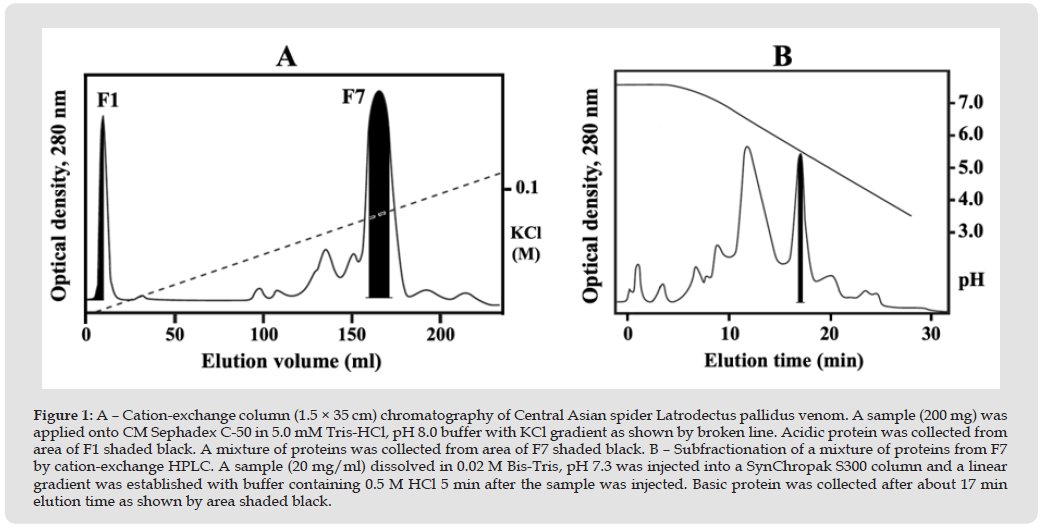
biomedres-openaccess-journal-bjstr

Figure 2

biomedres-openaccess-journal-bjstr

Figure 3

biomedres-openaccess-journal-bjstr

Amino acid sequences of both proteins are highly homologous to the human myelin basic protein isoforms [26]. In addition, both acidic and basic proteins show 100% sequence homology to the myelin basic protein isoforms from various species in the highly conserved amino acid sequence regions [27] (Figure 3). The calculated molecular mass and the isoelectric points of the Latrodectus pallidus venom acidic and basic proteins match exactly the most abundant isoforms in the adult human myelin with molecular mass 18.5 kDa [26]. These findings prompted us to use acidic and basic proteins in the studies of electrophysiological and structural properties of model myelin membrane. We have incorporated acidic and basic proteins from the Latrodectus pallidus venom into the model myelin membrane to investigate whether the model myelin membrane can absorb protons on its surface from the bulk water and undergo polymorphic phospholipid transitions.

The myelin membrane in the vertebrate central nervous system is mostly made of five phospholipids: phosphatidylcholine (PC), phosphatidylethanolamine (PE), phosphatidylserine (PS), phosphatidylinositol (PI), and sphingomyelin (SM) [28-31]. In terms of the protein component of the membrane, the isoforms of myelin basic protein are one of the most abundant components of the myelin membrane, the primary role of which is to maintain a compact myelin sheath [32]. PC is the dominant phospholipid that stabilizes the bilayer structure in most, if not all, biological membranes, including the myelin membrane [32-34]. The role of the other four phospholipids is not clear, but it has been suggested that each of those phospholipids plays a particular purpose in the functional activities of the myelin membrane [32]. In the present work, for the studies of proton absorption by the membrane surface, we have prepared four types of model myelin membranes, each of which includes PC and one of the four phospholipids of a particular function with the molar percentage ratio of 80% for PC and 20% for either PE, PS, PI, or SM, with a total phospholipid concentration of 10–5 M.

For the protein component of the four types of model myelin membrane, the total protein concentration of acidic and basic proteins of an equal molar ratio was 2×10⁻⁷ M. For the studies of polymorphic transitions of phospholipids in the model myelin membranes, we prepared the same four types of myelin membranes with the molar percentage ratio of 80% for PC and 20% for one of the phospholipids of a functional group, but we used different total phospholipid and protein concentrations, which were 1.4 × 10⁻² M for phospholipids and 1.75 × 10⁻⁴ M for proteins. The model membrane system for myelin membranes was unilamellar liposomes, both for the studies of proton absorption by the membrane surface and for the studies of polymorphic phospholipid transitions. To assess the absorbance of protons by the myelin membrane liposomes, we measured the difference between pH values in pure dd-H2O and in dd-H2O solutions of liposomes from four models of myelin membranes, which did not include acidic and basic proteins (Table 1).

Table 1: The pH readings taken in triplicate at 25°C in dd-H2O and in dd-H2O solutions of liposomes made of either phosphatidylcholine (PC) + phosphatidylserine (PS), phosphatidylcholine + phosphatidylinositol (PI), phosphatidylcholine + phosphatidylethanolamine (PE) or phosphatidylcholine + sphingomyelin (SM). The mean values of pH readings, standard deviations (SD) and the ANOVA p-value are also given in the Table 1. The concentration of phospholipids in all samples is 10–5 M.biomedres-openaccess-journal-bjstr
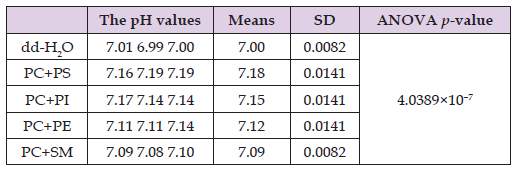
Preparations of liposomes in dd-H2O produced basic pH values (pH above 7.0), which is a result of protein absorption by the surface of the liposomal membrane. As shown in Table 1, the PS-containing membrane (PC+PS) demonstrates the highest change in pH towards basic values (7.18), indicating that the PC+PS membrane is the strongest proton capacitor among the four models of myelin membranes. This is due to the two acidic moieties, carboxyl and phosphate groups, in the PS polar head (Figure 4). Although the other three model myelin membranes each contain one of the ‘functionally-driven’ phospholipids (PI, PE, or SM), all of which have only one acidic moiety (phosphate group) in their polar heads, their proton absorption abilities differ and decrease in the following order: PI – pH 7.15, PE – pH 7.12, and SM – pH 7.09. The highest ability of PI to absorb protons among the three ‘functional’ phospholipids can be explained by the polar hydroxyl groups of the inositol moiety in the polar head of PI (Figure 4), which have the potential to absorb protons via the formation of coordinate bonds with the lone pair of electrons on the oxygen atoms of the hydroxyl groups.

Figure 4
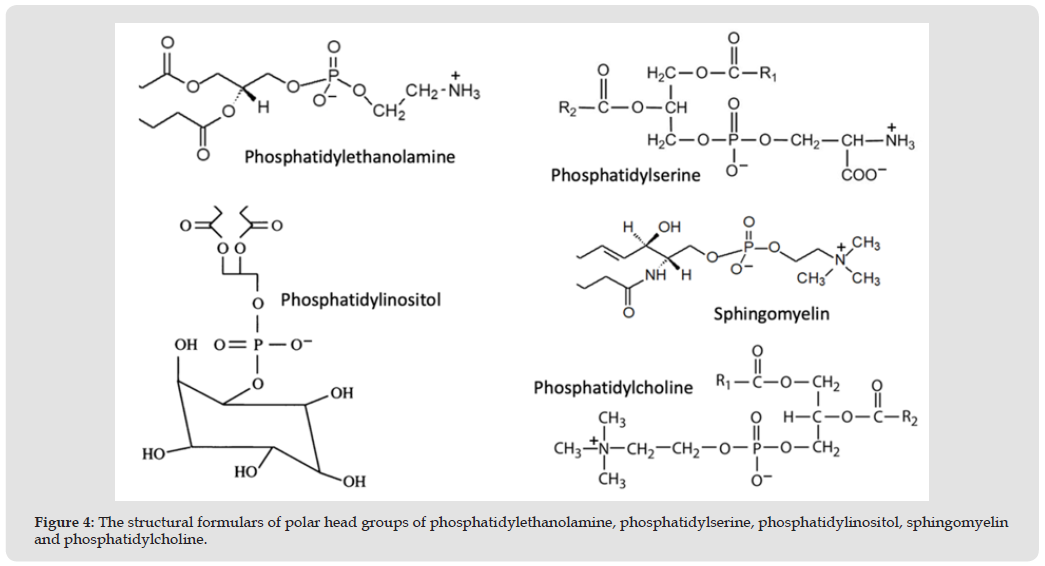
biomedres-openaccess-journal-bjstr

The higher ability of PE to absorb protons compared to SM can be attributed to the larger size of the choline group (–N+(CH3)3) in SM versus the amino group (–N+H3) in PE (Figure 4). The smaller size of the amino group allows better access for protons to the phosphate group of PE than the choline group of SM. It should be noted that the ANOVA p-value for the statistical differences in pH values is very small within the group including pure dd-H2O and dd-H2O solutions of the four models of myelin liposomal membranes, indicating that the differences are statistically significant. The effect of the equimolar mixture of acidic and basic proteins (Pr) incorporated into the four models of myelin liposomal membranes is shown in Table 2. In all four membrane models, the incorporation of Pr resulted in a further increase in pH values, demonstrating that Pr contributes to the proton absorption of the myelin membrane. Thus, Pr enhances the myelin membrane’s ability to act as a proton capacitor. The largest increase in pH value (1.05) triggered by Pr was observed in the PS-containing membrane. The second largest increase in pH value (1.03) was observed in PE-containing membranes.

Table 2: Comparison of pH values in samples of liposomes made of either phosphatidylcholine (PC) + phosphatidylserine (PS), phosphatidylcholine + phosphatidylinositol (PI), phosphatidylcholine + phosphatidylethanolamine (PE) or phosphatidylcholine + sphingomyelin (SM) and the same liposomes treated with a mixture of acidic and basic proteins (Pr). The pH readings mean values, standard deviations (SD) and the T test p-values are also given in the Table 2. The concentrations of phospholipids and Pr are 10–5 M and 2×10⁻⁷ M respectively.biomedres-openaccess-journal-bjstr
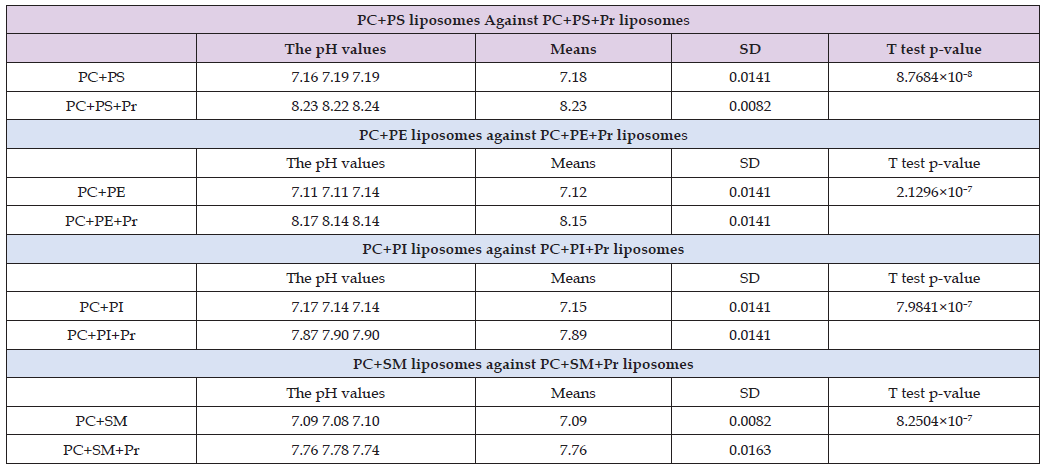
The increase in pH value triggered by Pr in PC+PI and PC+SM was significantly lower, at 0.74 and 0.67, respectively. The very low T-test p-values comparing the statistical differences between pH values in model myelin membranes not containing Pr and those containing Pr confirm that the increases in pH values triggered by Pr are statistically significant. To better present the differences in proton capacitor power between the four models of myelin membranes in the absence and presence of Pr, the concentrations of absorbed protons are shown in Figure 4 as the negative logarithm of [H+] absorbed by the model myelin membranes. It should be noted that the lower the negative logarithm of [H+] value, the higher the concentration of H+ ions absorbed. Thus, by comparing the heights of the bars in Figure 4, one can conclude that the myelin membranes containing Pr exhibit higher proton capacitor power than myelin membranes without Pr. Additionally, one can conclude that among the myelin membranes containing Pr, the PC+PS and PC+PE membranes have a higher proton absorbing capacity than the PC+PI and PC+SM membranes (Table 3).

Table 3: The concentration of H+ ions in dd-H2O (initial H+ concentration), concentration of H+ ions after adition of proteins, liposomes or liposomes modified with proteins to dd-H2O (final H+ concetration) and concentration of H+ ions absorbed by proteins, liposomes or liposomes modified with proteins (absorbed H+ concentration). Concentrations of phospholipids and proteins in liposome samples are 10–5 M and 2 × 10⁻⁷ M respectively. Pr – mixture of acidic and basic proteins, PC – phosphatidylcholine, PS – phosphatidylserine, PE – phosphatidylethanolamine, PI – phosphatidylinositol, SM – sphingomyelin. Column –log [H+] shows negative logarithm values of absorbed [H+].biomedres-openaccess-journal-bjstr
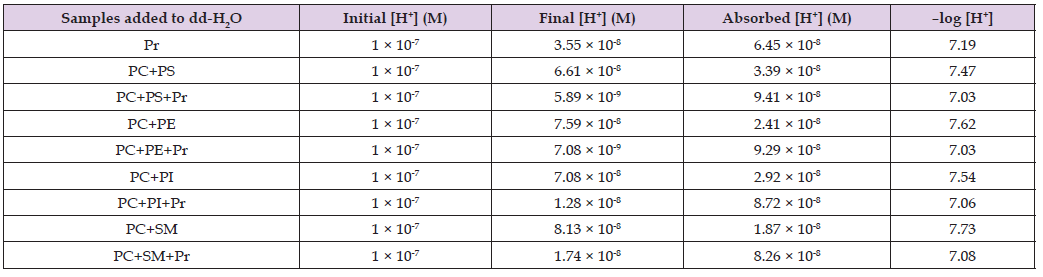
To study the permeability and polymorphic transitions of phospholipids in the four models of myelin membranes in the absence and presence of Pr, we used 1H-NMR spectroscopy of unilamellar liposomes in the presence of K₃[Fe(CN)₆]. The methodology and advantages of unilamellar liposome 1H-NMR spectroscopy with paramagnetic Fe(CN)₆³⁻ ions are described in detail in our previous publications [35-38]. Briefly, Fe(CN)₆³⁻ ions interact with the choline (N+(CH₃)₃) groups of the outer monolayer of the liposomal membrane, shifting the choline signal of the outer monolayer to higher values of the applied magnetic field, while the signal of the choline groups from the inner monolayer remains unchanged. This results in the splitting of 1H-NMR signals from the outer and inner monolayers of the liposomal membrane. Should the liposomal membrane become permeable to Fe(CN)₆³⁻ ions, which would allow interaction with the choline groups of the inner membrane, the signal of the choline groups from the inner monolayer would shift to the field of the outer monolayers, causing the inner monolayer signal to visually disappear.

As shown in Figure 5, all four model myelin liposomal membranes in the absence of Pr were not permeable to Fe(CN)₆³⁻ ions. The higher intensity of the 1H-NMR signals in the PC+SM liposomes compared to the other three types of liposomes is due to both PC and SM having a choline group in their polar heads, while in the other three types of liposomes, only PC has a choline group. The addition of Pr to the liposome samples resulted in the broadening of 1H-NMR signals due to the restriction of molecular mobility of lipids by Pr. However, the addition of Pr did not make the membrane in any of the four liposome samples permeable to Fe(CN)₆³⁻ ions, as the signals from the inner monolayers remained intact. Notably, in the PC+PS+Pr and PC+PE+Pr liposomes, a small signal appeared in the higher field from the signal of the outer monolayer (Figure 5). This signal originated from the formation of a non-bilayer lipid phase [35-38] and was more pronounced in the PC+PE+Pr membrane. The formation of the non-bilayer lipid phase in model membranes containing PS and PE, triggered by interaction with basic proteins, was observed previously [35,38-41]. It is evident that the non-bilayer lipid phase in model myelin membranes containing PS or PE was induced by the basic protein from the white widow spider venom (Figures 5 & 6).

Figure 5
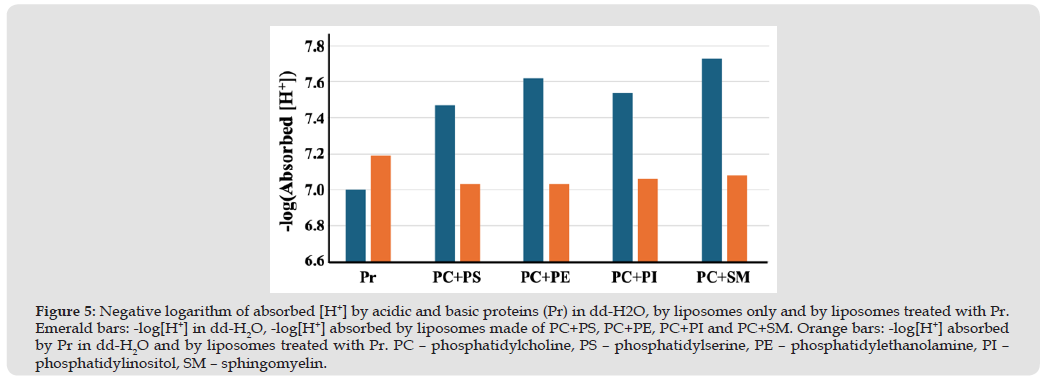
biomedres-openaccess-journal-bjstr

Figure 6

biomedres-openaccess-journal-bjstr

Discussion

It has been suggested that physiologically active proteins in animal venom have evolved by mimicking the structure and functions of body proteins with important functional activity [42]. For example, many phospholipases isolated from snake and insect venoms resemble structurally and functionally the phospholipases that regulate inflammatory processes and lipid metabolism in biological membranes [42,43]. Rattlesnake venom metalloproteinases have been reported to act similarly to body metalloproteinases involved in controlling the homeostasis of blood and intercellular fluids [42,44]. Cationic proteins isolated from cobra venom have been shown to phenocopy the membranotropic activities of the C-8 protein from the Fo sector of ATP synthase [45-47]. In this research study, we present acidic and basic proteins isolated from the venom of the white widow spider Latrodectus pallidus, with amino acid sequences highly homologous to the isoforms of myelin basic proteins of the vertebrate central nervous system [25,26]. It is therefore reasonable to assume that the physiological activities of these acidic and basic proteins from Latrodectus pallidus venom resemble those of the myelin basic proteins of the vertebrate central nervous system.

Myelin basic proteins exist as isoforms that differ in size and charge [48]. The size isoforms are produced by alternative splicing of an mRNA transcript [49], while the charge isoforms result from post-translational modifications that decrease the basic charge, affecting the functional activities of the myelin basic proteins [26]. The size isoforms of human myelin basic proteins include proteins of 17.2, 18.5, 20.2, and 21.5 kDa, with the 18.5 kDa isoform being the most abundant and the most studied [26,49]. There are eight charge isoforms of the 18.5 kDa myelin basic protein, termed C1–C8. The C1 isoform has the highest positive charge and is the least modified after post-translational modification [26]. The charge isoforms C2–C6 are modified by phosphorylation, deamidation, and deamination, while C8 is predominantly modified by peptidyl arginine deiminase, which converts positively charged arginine to neutral citrulline. This conversion can involve up to 11 arginine residues, leading to an overall loss of positive charge of +11 [50]. The isoelectric points of the 18.5 kDa isoforms range from 4.5 for C8 to 11 for C1 [26], which is very similar to the isoelectric points of acidic and basic proteins of 18.5 kDa from the venom of the Latrodectus pallidus spider. This suggests that acidic and basic proteins from spider venom may phenocopy the functions of the C1 and C8 isoforms of the 18.5 kDa myelin basic protein. The myelin sheath is a repetitive multilayer of tightly packed myelin membrane bilayers held together by proteins in myelin membranes [26]. The most long-lived proteins in the body are myelin basic proteins [51,52]. This suggests the importance of myelin basic proteins in the stability of the supramolecular structure of the myelin sheath [26]. It is believed that the C1 isoform functions by tightly attaching to acidic phospholipids of myelin bilayer membranes, stabilizing the tight packing of the myelin sheath [26]. Overall, C1, C2, and C3 are most likely responsible for myelin stability [26], while C8, which is abundant in childhood and scarce in adults, seems to play a role in development and is important in the formation of myelin rather than its stability [50]. However, the exact molecular mechanism of the functional role of C8 is not understood. Notably, the pathogenesis of multiple sclerosis (MS) is linked to abnormal changes in the 18.5 kDa isoform composition caused by an abnormal increase in the activity of peptidyl arginine deiminases, leading to the loosening of the tight packing of the myelin sheath [26,53-56].

The common explanation of the role of the myelin sheath is that it serves as an insulator of neuronal axons to promote rapid and saltatory conduction of nerve impulses [26,57]. However, nerve impulses are not transmitted through nerve fibers in the same way electrons move through a metal wire [57]. It is not clear how myelin insulates neurotransmission or what the insulation of nerve impulses means. It is obvious that even if myelin serves as an insulator in some way, it is far more than just an insulator [57]. A breakthrough discovery revealed aerobic ATP synthesis in the myelin sheath, which was unexpected as myelin is devoid of mitochondria [58-61]. However, oligomycin titration experiments have determined the presence of F1 subunits of ATP synthase in myelin [59], and the presence of respiratory complexes in lipid rafts of myelin was also established [62,63]. These discoveries suggest a way for delivering mitochondrial respiratory components to the lipid rafts in myelin.

Professor Alessandro Morelli of Genoa University proposed that mitochondria, which have their own DNA for respiratory complexes and ATP synthase to drive oxidative phosphorylation, deliver all the protein complexes necessary for ATP synthesis to the myelin sheath with the help of the endoplasmic reticulum (ER) [64], with which mitochondria are closely associated in cytoplasmic space and function [65,66]. It has been determined that mitochondria produce necessary vesicles providing the ER with the necessary oxidative phosphorylation complexes [67,68]. Aerobic ATP synthesis has also been observed in structures devoid of mitochondria such as rod outer segment discs [69-72], platelets [73], cell plasma membranes [74-78], exosomes, and microvesicles [79], strongly implying that the oxidative phosphorylation machinery is transferred to these extra-mitochondrial sites via the ER [80].

It has been shown by freeze-fracture X-ray crystallography that particles of 8.6 nm, the dehydrated F1 subunits of ATP synthases, are exposed on both sides of the myelin sheath [81,82]. This bi-faced orientation of F1 subunits in the myelin sheath does not agree with Mitchell’s concept of delocalized proton coupling, where the gradient of proton concentrations in bulk water across the inner mitochondrial membrane drives the proton movement through ATP synthases with the F1 subunits exposed only on the matrix side. However, the orientation of F1 subunits on both sides of the myelin sheath agrees with the concept of localized coupling, where protons are absorbed and move along the surface on both sides of the myelin membrane, establishing a proton circuit built entirely inside a major dense line of myelin [80]. Professor Morelli suggests that extra-mitochondrial synthesis of ATP can take place on any single membrane as long as the membrane surface can localize (absorb) protons to act as a ‘proton capacitor’, so the accumulated positive charge can support a proton circuit in which protons move along the membrane surface by the Grotthuss mechanism [83].

From the respiratory complexes to the F1 subunit of ATP synthase, and in the middle of the F1 subunit, protons turn to the hydrophobic center of the membrane through which protons move back to the respiratory complexes [23]. Thus, the proton circuit, taking place entirely inside a single membrane, couples respiration with ATP synthesis [23,64,80]. In our view, the experimental evidence described above supports localized proton coupling, which is based on the membrane’s ability to absorb protons on its surface. However, we note that protons cannot move as charge through the low dielectric environment in the center of the membrane, and there must be a vehicle to transfer protons through the hydrophobic environment to the respiratory complexes.

The experimental results of our study on model myelin membranes with acidic and basic spider proteins, acting as isoforms of myelin basic proteins, showed that these membranes absorb protons on the membrane surface.

The protons are absorbed by both the phospholipid polar heads and the spider proteins, primarily by acidic proteins rather than basic ones. The ability of phospholipids to absorb protons differs depending on the physical-chemical properties of the phospholipid polar head. Additionally, we observed the formation of a non-bilayer phase in model myelin membranes made of PC+PS+Pr and PC+PE+Pr. We have previously observed the formation of a non-bilayer phase through the interaction of PS with basic proteins. The non-bilayer propensity of PE was also described previously, and it is strongly enhanced by interaction with basic proteins. Therefore, we can conclude that the non-bilayer phase in model myelin membranes was triggered by the interaction of spider basic protein, but not by spider acidic protein, with PS and PE. It should be noted that the highest ability to absorb protons was observed in PC+PS+Pr and PC+PE+Pr membranes, which contain the non-bilayer phase. In our previous studies, we have demonstrated that the non-bilayer phase in the inner mitochondrial membrane, triggered by basic proteins, stabilizes the intermembrane association between adjacent crista membranes, facilitating higher activity of ATP synthase [35,46,84,85].

One of the mechanisms for enhancing ATP synthase activity facilitated by the non-bilayer phase was recently proposed by us, in which inverted micelles transfer protons across the hydrophobic environment of the crista membrane in the inner aqueous volume of inverted micelles [35,86]. The non-bilayer phase observed in our study in model myelin membranes likely exists in the form of inverted micelles, which transport protons in the myelin membrane’s hydrophobic environment, not across the membrane but through the membrane center from the F1 subunit to the respiratory complexes to complete the proton circuit inside a single membrane, as proposed by Professor Morelli [64,80].

Conclusion

The experimental results of our study support the new concept of the physiological role of the myelin sheath, related to the accumulation of energy through membrane action as a proton capacitor, as proposed by Professor A.M. Morelli. The stored energy is utilized for the production of ATP synthase through localized proton circuits that couple respiratory complexes with ATP synthases. According to Professor A.M. Morelli’s proposal, the generated ATP molecules in the myelin sheath could be used by ionic pumps in neuronal axons for the rapid transmission of nerve impulses. Our results suggest that the acidic isoforms, but not the basic isoforms, of myelin basic proteins, along with phospholipid polar heads, are responsible for the absorption of protons on the membrane surface. Additionally, our results indicate that basic isoforms of myelin proteins interact with acidic PS and neutral PE to promote the formation of a non-bilayer phase. The non-bilayer phase may promote the tight association of adjacent myelin membranes and facilitate the transport of protons through the hydrophobic environment in the center of the myelin membrane to couple respiratory complexes with ATP synthase.

The results obtained in this study warrant further investigation of acidic and basic proteins from the Latrodectus pallidus spider venom in model myelin membrane systems. This research could lead to a better understanding of the molecular mechanisms of neurotransmission and neurodegeneration, as well as the potential development of novel pharmaceutical products that may alleviate or halt the process of myelin sheath degradation in aging and diseases.

Acknowledgement

Dr. Anwaar S Chaudary is grateful to Prof. L. Ya. Yukelson of the Institute of Biochemistry, Uzbekistan Academy of Sciences for Latrodectus pallidus spider venom given as a gift. The research project was supported by the start-up grant from the Beijing Chaoyang Kaiwen Academy to the STEM Research Center.

Follow us on: Biomedical Journal Impact Factor: https://biomedres.us

https://scholar.google.com/citations?user=OFtUOZYAAAAJ&hl=en
https://www.base-search.net/Search/Results?lookfor=Biomed+Journal+of+Scientific+%26+Technical+Research&l=en&refid=dcsuggesten
https://citefactor.org/journal/2574-1241/biomedical-journal-of-scientific-technical-research
https://ideas.repec.org/s/abf/journl.html
https://econpapers.repec.org/article/abfjournl/
https://www.ncbi.nlm.nih.gov/nlmcatalog/101723284
https://bjstr.org/
https://bjstr.org/about.php
https://biomedres.us/reprints.php
https://biomedres.net/submit-manuscript.php

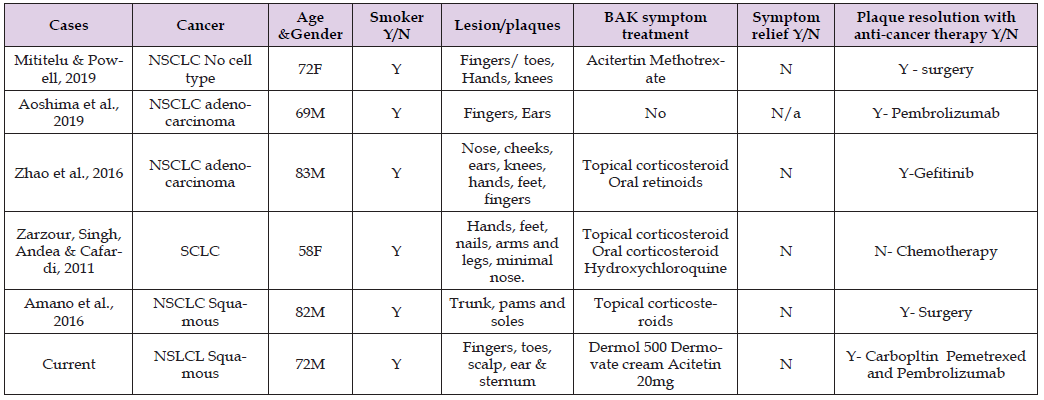
Journals on Medical drug and theraputics |BJSTR

Systematization of the Types of Adaptations Requested in Pedestrian Routes: Human Strategies in Sport, Tourism and other Critical Situations

Introduction

Man moves, using the same instruments and strategies and even the same models of action, adapting to the different problems faced in different journeys. It is always the same man and, of course, the same individuality.

It is the ‘self’, its identity, that is called into question, a ‘self’ that has adapted itself in its evolutionary process, where it has been transformed and built (in its morphology, in its physiology, in its psyche, etc.) gaining functionality in the actions it undertakes, see Gordon Childe (1947) in his work, already a classic, of “Man makes himself”. They may seem to be mere one-off arrangements (we only see what we are capable of perceiving) but it is, permanently, the expression of a whole that we must try to understand and not lose the details (important, no doubt, but which it is essential to situate) that hide the overall vision and the ability to relate, namely by the “tunnel effect”, and the ability to relate (let’s not forget what culture it is, today, the ability to find bridges and relationships in a world of dialectics). Thus, for example, a pedestrian route can be considered a mere muscular exercise, a simple activation of cardiopulmonary function, going in search of new smells or (more or less) spectacular views, a form of socialization with a group, a subjection to local or more universal fashions and customs, an occasion to take photographs, to review stories (or even history), …, and so many other things and pretexts that, being there, we can (consciously or unconsciously) have the opportunity to live or that may not even serve for more than ‘telling friends’ on nights of pleasant talks or bragging about ‘adventures’.

However, to enjoy circumstances is always to build culture (the possibility of understanding and exercising relationships) which, paradoxically, always passes through the capacity of the ‘culture’ that we already possess (a virtuous circle) that enriches (more or less, according to the cultural tool we have) the experiences and amplifies (more or less) the value obtained from what is experienced. In this way, we can situate a pedestrian route as a privileged situation where we leave the habits and vices of everyday life, which, due to the change of context, the rhythm and hurry of ‘normal’ life and the vulgar conditioning where we are integrated. A situation, therefore, that disposes (it may even predispose, if we are capable) to reflection and that sharpens sensitivity (it is known that a repeated stimulus loses the ability to generate sensations), creating development potentials for those who experience it.

To understand the Pedestrian Route

The transition from an understanding/explanation mode, which we have tried to frame above in an accessible way , to an operational mode, implies making choices and options in order to select the variables and parameters that can be more efficient in a cost/benefit relation according to the resources and intentions in question. We must also not forget that when we move from the orientation of an activity, whatever it may be, sport, tourist, etc., to a structure in which the simple transmission of techniques considered useful and based on experience, fundamentally by imitation, is made to the management of existing functionalities, as we implicitly defend here, it is a profound structural rupture. This rupture that we propose consists in following, predominantly, a strategy in which we confront contradictory evolutionary tendencies in the search for the most favourable balances that we can, in an expeditious way, categorize as a passage from a casuistic empiricism to science, which it is not up to us to explain here, but has marked implications that we should not ignore. In this way, we will frame and explain the operational strategy, which we will later show how to operationalize through decision trees. The most common classifications of the difficulty of pedestrian routes, given the frame of reference on which they are based, are fundamentally on variables inherent to the context, such as distance, unevenness, altitude, duration, among other factors essentially focused on morphological, geographical and physical characteristics of the terrain itself [1-3].

This type of characterization is important, but it is not enough for it to be possible to integrate these variables into models that consider the characteristics of the individual who performs the activity and define the difficulty that the chosen route will have for the individual or choose the training/experience that best fits with his objectives. In a previous work, we proposed as a way to overcome this type of difficulties the characterization of pedestrian routes based on the adaptations they require from the individual who performs them [4]. The advantages of this type of characterization is that it makes it possible to broaden the understanding and explanation of the phenomenon, restructuring the frame of reference used in such a way that, in addition to the attributes of the context, it allows us to face the whole process that is triggered in the individual to achieve his or her path, that is, the cycle “aggression » reaction » adaptation » transformation (ARAT)” [5]. In this way, a change is made in the ‘knowledge’ tool used, giving new dimensions and increasing the possibilities of efficiency, and even the dimension of what we can achieve with the use of a more accurate and precise reference framework. In this line we will delve into some examples of adaptations, such as the uneven terrain and the sloping terrain (downhill), identifying in the context, in the situation, and in the individual, the main variables to be taken into account and, subsequently, how to frame them in a Sports or Tourism perspective.

Uneven Terrain

The terrain with irregularities, whether stones, vegetation, sinuosity’s of the terrain or other types of obstacles, can prevent a regular displacement (which may have its advantages when we focus attention on the modification of the individual, on his training, but which will certainly have more costs in the displacement itself – a proof of the new capabilities of the new reference framework of the knowledge tool used) (Figure 1), modifying, in particular, the rhythm, the distance between steps, the cadence of the pace, the times of the pace, the direction of the route, among other variations that can be caused by these characteristics. There is a consensus in the literature that the variation in the gait pattern leads to an increase in the energy cost necessary to carry out a given route [6-9]. According to O’Connor, Xu, & Kuo [9] the energy cost increase is mainly due to two reasons, for one hand, active movement corrections require a muscular effect, on the other hand steps variability (width) is less energy-efficient. All these constraints will imply that the individual is permanently reading the terrain, making decisions about where to place the steps and the best strategy to carry it out, as well as the necessary motor adjustments to carry out the displacement.

Figure 1

biomedres-openaccess-journal-bjstr

This constant adaptation has energy costs at the motor level, but also at the nervous level [7]. In these circumstances, it is important to identify the possibilities that arise to overcome the irregularities of the terrain in order to systematize not only the decisions that the individual can make, but also to understand what type of adjustments are possible to provoke (Figure 2), that is, the inherent demands. Concretizing the choices that are made at the time we move, if an irregularity is identified in the terrain in the place where we would naturally place the next step, it can be solved by: changing the direction of the step, deviating and/or bypassing it; change the pace length to overlap it (when the height of this irregularity does not disturb the normal pace height); change the height of the pace in order to vertically contour the irregularity; perform the step on the irregularity by adjusting the way the support is placed to the characteristics of the irregularity and the effects we expect it to have on it (we may have to increase the stability of the joints if the deformation of the tread is expected, we may have to adjust the direction of the force in order to maximize the compression force and minimize the slip force, If a decrease in friction is expected, we may have to change the characteristics such as direction, length, height, among other possibilities). The decisions to be made must be considered according to the conditions of the context, but also to the characteristics of each individual, in order to opt for that situation in which he is more proficient and consequently will have less change in his performance regarding the circumstances.

We highlight that in some situations we can have options that happen simultaneously, for example, the change in the direction of the step can happen together with the change in the length of the pace, thus “adding” the effects that each of these changes will have and, of course, understanding the interactions that can be established between the variables in question. As mentioned by Wong, Selinger & Donelan [6] several parameters can influence the gait “… it may not only have a different step frequency and speed but also a different step width, toe clearance, and maximum knee angle. In addition, at the muscle level, the new step may be accomplished with muscle and motor unit activity patterns that differ in many ways from the average step. Some of these changes to coordination, if performed in isolation, may increase energetic cost, while others may decrease it.”. To define which are the most profitable options, it is necessary to consider how each one of them influences the cycle and rhythm of the pace, the path of the Center of Mass (CM), knowing that there may be options that have higher energy costs than others and that there are differentiated energy costs (with incidence at the nervous or motor level, but not only). In addition to the effects at the motor level, it is also important to understand that the energy sources used in movement (anaerobic alactic, lactic and aerobic system) have different regeneration timings and the decisions made can influence their alternations as well as the need to use each of them. It is also essential to understand the framework of this set of variables in the whole of the journey to be taken, since, depending on its total duration, the point where we are and the demands that are still expected, there are options that may be more appropriate than others taking into account the circumstances of the moment we are facing.

Figure 2

biomedres-openaccess-journal-bjstr

Sloped Terrain (Downhill)

Routes on sloping terrain, in the case of descents, allow a part of the force of gravity to be used to generate the movement of displacement itself. Knowing how to use this force in an efficient, systematic and less flawed way (as opposed to a more empirical process made up of mere experiential situations) implies understanding the variables inherent to movement, but also being able to operationalize the appropriate techniques so that the benefits are greater than the costs of their use in displacement. Several difficulties in moving downhill are mentioned, which often overlap with the search for energy efficiency that the descent of a slope can provide, namely, the constant braking of movement and impacts on joints [10-12] and the search for stability to the detriment of gravity [13]. The need to adapt to the context and situation is fundamental to achieve the desired objectives in a cost-effective way [11]. Thus, knowing how to consider the possible strategies for displacement and what are the expected implications in the decisions we make is essential to manage the activity. AS mentioned by Wong, Selinger, & Donelan [14] it is necessary to have a global notion of the problem and of the interactions that different variables establish between themselves “Furthermore, whether a particular change in coordination will gain an energetic benefit depends on the walking task: decreasing step frequency, for example, may be beneficial when walking downhill but not when walking on the level.

The task to be solved by the nervous system when initiating optimization is to determine which of these many candidate changes to coordination are responsible for sensed reductions in energetic cost and in which contexts.”. Controlling the changes that a slope implies in the individual’s displacement involves first of all, within the constraints of the context itself, making decisions by choosing the slope that we intend to face through the selected path (Figure 3). The path can be in the direction of the slope, thus subjecting us to the existing slope, or we can opt for an oblique path in relation to the slope, which the farther it is from the direction of the slope, the lower the slope will have (a relationship involving the effort – slope/space covered – similar to what happens in a lever in the relationship between the dimensions of the force arms/force intensities). This choice of trajectory in relation to the slope has, of course, implications for the space that will need to be covered to get from one point to the other, and these two variables have contradictory evolutionary trends, and as such, the greater the slope, the smaller the space to be covered. The costs of each option depend not only on the strategy chosen (leading to the choice of the route), but also on the individual’s ability and mastery of the technique used (the individual’s potential and the way to use them).

Figure 3

biomedres-openaccess-journal-bjstr

In the case of lateral sliding, usually used in terrain with little friction and deformable, such as snow, small stone or sand floors, the individual, in order to control the pressure exerted on the ground (ratio between the force exerted / area) regulates the position of the supports on the slope, by adjusting the dimension (in some cases using equipment that facilitates this type of strategy such as skis) in order to slide down the slope while maintaining the projection vertical of its Center of Mass within the boundaries of the Support Base. A sudden braking of the supports by not keeping them in the position that allows them to slide, will lead to the individual being projected (by the action of the existing inertia) towards the slope downwards. On the other hand, reactions such as fear, which are associated with a defensive strategy such as the retreat of the pelvis and/or the search for protective positions such as the approach of the body to the slope, lead to an increase in the weight component that acts on “the slip” and, consequently, to a reduction in the compressive force on the slope. This can result in an uncontrolled slippage where the very position of contact with the ground makes the situation difficult. The frontal progression (in addition to the slope of the terrain) also implies a control of the position of the Center of Mass, which must necessarily be balanced with the positioning of the steps in the pace (through the frequency of the steps and amplitude). When the individual cannot keep up with the speed “that the CM gains” with his stride, which can result in losing balance, due to not being able to adjust the position of the CM in relation to the support base. The difficulties in regulating this set of variables can have repercussions on the joints or, conversely, if there is not a sufficient advance of the Center of Mass to enhance the use of the Force of gravity in the displacement, the energy expenditure of the descent can be equal to or greater than that of the ascent.

From Sport to Tourism

If in Sport the immediate objective is to maximize the performance of the athlete, in Tourism the challenge is to provide the best possible experience to the tourist, through the activity that is offered [12,13], being (and should be), however, the mediate objective, in both situations, the transformation of Man (that is, the same general objective through different means). To train and evolve, the individual has to approach his performance to his limits, without, however, exceeding them (which would cause injuries) because only in this way is it possible to transform himself (see ARAT), the management of contradictory evolutionary tendencies mentioned above. The same happens (should happen) in tourism, if only so that we don’t have boring situations that don’t motivate (whatever the purpose, immediate objective – take a picture, integrate into the group … as we indicated before) and where there are still challenges to face (even if it’s just to tell in friends talk nights…).

However, in the orientation of activities of this nature, where we focused on the displacement of man, there are specific differences between these two aspects. In sport, it becomes possible to plan continuously to provide a “training effect”. In a “touristic activity” we must create motivations and ‘ways of selling’, also according to the intended objectives and in a personalized way, but where the imaginaries pursued by the customer follow, namely, other “models to imitate”, in a different framework and with different time constraints. A reflection to be carried out, a debate to be held and the search for new answers, which, in order to be efficient, must integrate the new possibilities and resources that are available to us today. As we can see, as we stated at the beginning of this work, in order for this intervention to happen successfully, it is necessary not only to understand the stimuli we intend to provide, but also the processes of adaptation to these stimuli and the transformations that can result from them. We would also like to make a few notes in this regard. We must also consider that in the “sports training” facet, it usually happens that there is a continuity of contact between the coach and the athlete. This generates the possibility of an in-depth knowledge of the athlete, his personal characteristics, limitations and potentialities. A continuous work that is being permanently adjusted to the evolution of the athlete and to the stipulated goals.

On the other hand, in sports activities framed in Tourism, the contact between the advisor and the tourist is usually more fortuitous, and it is frequent that they only establish a first contact already in the activity. These circumstances mean that the diagnosis has to be much faster than in a “normal” training situation. Being able to interpret some indicators, even before the activity, is fundamental and essential to be able to have a quality intervention. Sometimes, looking at the equipment they use is enough to get a first impression of their mastery of the context, it is not uncommon to see people who present themselves with shoes that are totally inappropriate for the walk that awaits them, but we also have the opposite, such as people with an elite equipment, but too new not to denounce that it has never been used before. It is in this balance of indicators that the manager must seek to situate himself in order to prepare for orientation. Also, in terms of intervention, it is necessary to understand that in a tourism situation,

Where the individual is only expected to perform one activity, the prescription will have to be based on variables that we can act on and have almost immediate effects, that is, in a period compatible with that foreseen for our intervention with the individual. In a training context, the mentality has to be different, we can sometimes opt for prescription solutions that will only have effects in the medium/long term, but that may be more advantageous in the evolution of the individual. In short, in the same frames of reference, but in different contexts, it is necessary to break with the traditional ways of looking at these activities, so that the resources we have today (knowledge, equipment, communication facilities, conceptual, etc.) can be optimized. This implies structural, normative, methodological, and organizational changes, among others. It is not enough to make mere oneoff arrangements, it is essential to find the new coherences, which are already possible today. Evolution, let us even say the enrichment of man, requires more, much more than simple changes in appearances and speeches.

Final Reflection

Understanding the movement of Man on a pedestrian route or in any other context is a complex process. It is necessary to have a comprehensive view not only of the motivations inherent to this activity, but also of the various conditionings that can influence this process. The strategies of action and the instruments used for displacement imply a global vision of the individual, conditioned by the evolutionary process of the human species itself and which involves the profitability of a set of structures (nervous, muscular, energetic, technical, psychological, cultural, etc.) and that it is necessary to understand this amplitude in order to be able to act. In this work, we sought to define a comprehensive and integrative frame of reference for the various aspects of human displacement, but at the same time, to exemplify through the decision trees presented, how it is possible to create models to understand the adaptations that are placed on the individual during a journey. We exemplified through two types of adaptations, Uneven Terrain and Sloped terrain (downhill) how it is possible to unfold some of the variables that we consider fundamental to understand this phenomenon, to structure future research, where several options are quantified that allow us to understand the evolutionary trends of the variables and their interactions, but also to be able to act coherently with the intended objectives both in the sport and tourism.

Follow us on: Biomedical Journal Impact Factor: https://biomedres.us

https://scholar.google.com/citations?user=OFtUOZYAAAAJ&hl=en
https://www.base-search.net/Search/Results?lookfor=Biomed+Journal+of+Scientific+%26+Technical+Research&l=en&refid=dcsuggesten
https://citefactor.org/journal/2574-1241/biomedical-journal-of-scientific-technical-research
https://ideas.repec.org/s/abf/journl.html
https://econpapers.repec.org/article/abfjournl/
https://www.ncbi.nlm.nih.gov/nlmcatalog/101723284
https://bjstr.org/
https://bjstr.org/about.php
https://biomedres.us/reprints.php
https://biomedres.net/submit-manuscript.php