Open Access Journals on Microbiology Research

Dental Arch Dimensions in a Matched Pairs Study of Hypodontia Patients and Controls

Introduction

Hypodontia is a common variation of tooth number in the population. In the permanent dentition approximately 25% of individuals have 1 or more congenitally missing third molars and some 3.5% to 7% of the population have hypodontia of other permanent teeth [1-6]. The condition is more frequent in females and approximately 90% of affected patients have less than 4 permanent teeth, other than third molars, congenitally absent. The condition can present challenges requiring careful long term treatment planning and care involving general practice, paediatric dentistry, orthodontics and restorative dentistry. Variations in tooth size and shape are well established in patients with congenitally missing teeth and may also occur in other components of the stomatognathic system [7-9]. As part of an international collaboration investigating the aetiology and clinical implications of hypodontia, this paper explores dental arch morphology in mild or moderate hypodontia. The dental arches and the dentition are two closely related components of the stomatognathic system, which develop in anatomical proximity over an extended time period from early in utero to early adulthood. The dental arches and the dentition are both complex systems, whose development is determined by multiple interactions between genetic, epigenetic, and environmental factors [10-12]. Interactions continue as development progresses through cellular, soft tissue and mineralisation stages to the emergence of the mature phenotype [9]. Hypodontia is an outcome of these complex interactions [13].
Similarly, in addition to genetic factors, the dimensions and shape of the dental arch are influenced by the configuration of the underlying basal bone and the actions of prenatal and postnatal environmental factors [14-17]. Postnatal environmental factors that have been identified include: the intraoral and circumoral musculature [18,19], sucking habits [20], postural and breathing patterns [21] and early loss of primary teeth [22]. There have been varying results in previous studies of dental arch morphology in patients with hypodontia. Woodsworth, et al. [23] found no significant differences in hypodontia patients compared to controls, Paulino, et al. [24] found greater intercanine and intermolar distances in the permanent dentition of adolescent and young adult men than in women, while Nelson, et al. [7] and Higgins [25] report the upper arch depth and chords were significantly reduced. They found greater differences in severe hypodontia. Sex differences are present in arch dimensions [26] and the degree of change in hypodontia may vary between male and female patients. Moreover, the differences may be greater in the upper arch than the lower [27] and may be influenced by the location of the congenitally missing teeth [7]. The aim of the present study is to investigate dental arch dimensions using a well validated 2D image analysis system [7,28,29] in a sample of hypodontia patients and matched controls to determine if there are any differences and, if so, how these relate to the sex of the patient, the location of the congenitally missing teeth and the upper and lower arches.

Materials and Methods

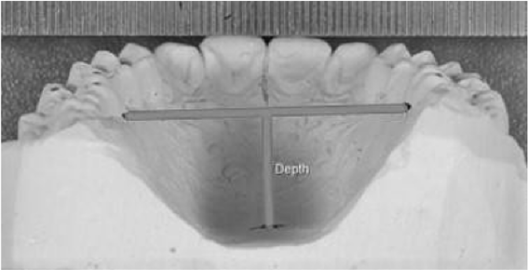
This study was approved by the Ethics Committee of the Scientific Research of the George Emil Palade University of Medicine, Pharmacy, Science and Technology of Tirgu-Mures (Approval no. 60/07.03.2018). The participants gave their written informed consent. Sixty patients with hypodontia, 40 females and 20 males, having a mean age of 15.40±2.85 years were included. The criteria for inclusion were the congenital absence of one to five permanent teeth, excluding third molars and that the formed permanent teeth were fully erupted. Diagnosis was based on dental history, clinical examination and orthopantomograms. Exclusion criteria were the presence of any other congenital conditions, syndromes, or a history of orthodontic treatment or tooth extraction. The same number of controls with complete permanent dentitions, matched for sex, age, ethnicity and exclusion criteria were also studied. Mean age in the control group was 15.48±2.87 years. In order to examine the possible influence of location of the congenitally missing teeth anterior (26 cases) and posterior (31 cases) hypodontia subgroups were formed. Anterior hypodontia was defined as missing upper and lower incisors and/or canines. Posterior hypodontia was defined as missing upper and lower premolars and/or molars, excluding third molars. For these subgroups age- and sex- matched controls were selected from the control group (Figure 1).
biomedres-openaccess-journal-bjstr

Figure 1: Image of measuring the depth of the palatal vault.
biomedres-openaccess-journal-bjstr

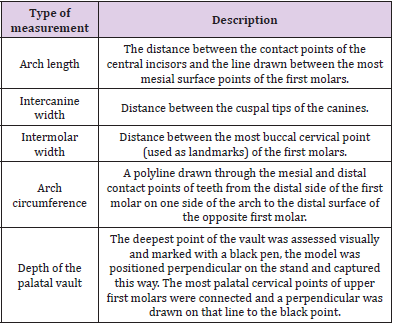
Table 1: Definition of measured parameters.

Alginate impressions (Ypeen Premium, SpofaDental) were taken for each individual from the upper and the lower arch. Study models were made from dental stone (FujiRock, GC). Images of the study models were taken with a digital camera (Nikon D3100, Nikon Corporation, Japan) and macro lens (Tamron SP AF-S 90 mm f/2.8). The camera was fixed above the dental cast, on an adjustable stand (Kaiser 5360, Kaiser Fototechnik, Germany) with two fixed led bulbs providing standard lighting conditions. Images of the dental arches were transferred using View NX2 (Nikon Corporation) and processed by the Image Pro Insight 9.3 software (Media Cybernetics, USA). Each image taken included a ten-millimeter scale for calibration and the measurements were made directly on the images. The 2D measurements of the dental arches were the arch circumference, arch length, intercanine width, intermolar width and the depth of the palatal vault. The definitions used for these measurements are given in (Table 1). The measurements were all carried out by the first author. Intraoperator and interoperator reproducibility was determined using the upper and lower models of 8 individuals. Three trained operators carried out the procedures separately, including image capture, calibration and measurement of selected dimensions, on 2 occasions, 2 weeks apart. Statistical analysis was performed using MedCalc (MedCalc Software Ltd). After excluding outliers, normal distribution of the data was confirmed (Shapiro-Wilk test of normality). Intraclass Correlation Coefficients (ICC) were determined to assess reproducibility of measurements. Correlations were also calculated between the number of missing teeth and the arch parameters. Significance of the differences was assessed using one-way ANOVA test, two-way ANOVA test with Bonferroni correction and Pearson’s correlation coefficient. The significance level was set to 0.05.

Results

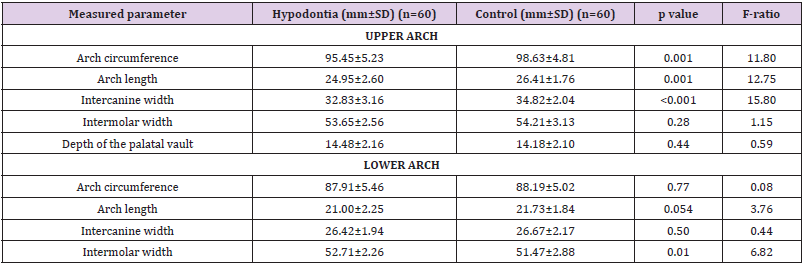
The intra-operator and inter-operator reproducibility was excellent, with all ICC values being higher than 0.9. (Table 2).In the overall hypodontia group there were 29 patients with one congenitally absent tooth, 23 with two, 2 with three and 6 patients with four congenitally absent teeth. Lower second premolars were the most often missing teeth, followed by the upper lateral incisors, upper second premolars, lower first incisors and lower second molars. In the subgroups, for anterior hypodontia 13 female and 13 male cases were found, with upper lateral and lower central incisors missing. For posterior hypodontia 24 female and 7 male cases were found, with upper and lower second premolars and lower second molars missing. Three cases had both anterior and posterior congenitally missing teeth and were not included in either subgroup. When all hypodontia cases were compared to matched controls, significant differences were detected both in upper and lower arch parameters. Arch circumference, arch length and intercanine width values were significantly smaller in the hypodontia group for the upper arch than in controls. The more teeth that were missing, the lower the upper arch circumference was. In the lower arch intermolar width values were significantly higher in the hypodontia group than in controls (Table 3). More significant differences were seen in male patients than in female patients in the upper arch, although the interaction between the sources of variation was not significant in every case.

biomedres-openaccess-journal-bjstr

Table 2: Intraclass correlation coefficients.
biomedres-openaccess-journal-bjstr

Table 3: Mean values of measured parameters for all hypodontia patients compared with matched controls for both upper and lower arches; SD=Standard Deviation.

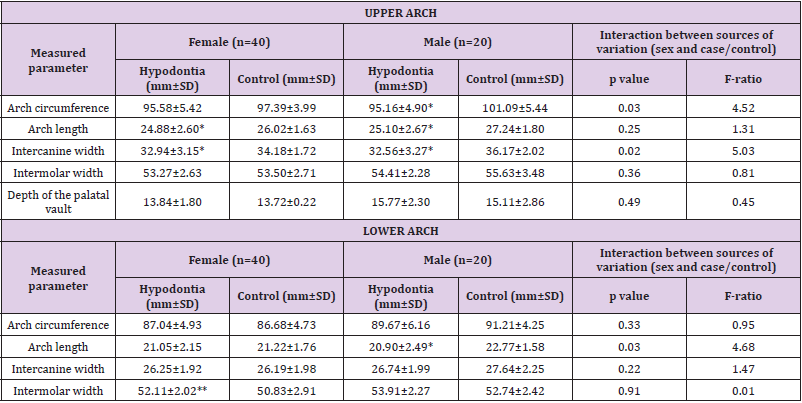
Intermolar width differences were significant in women (p=0.02), while in men arch length differences (p=0.008) were significant in the lower arch (Table 4). For the anterior hypodontia subgroup in the upper arch statistically significant smaller arch circumference, arch length and intercanine widths values were found in the hypodontia patients (Table 5). In the lower arch significantly greater intermolar width values were seen in the posterior hypodontia subgroup than in matched controls (Table 6). The analysis of variance highlighted differences also between the anterior and posterior case subgroups. The upper arch circumference and the upper intercanine widths was significantly lower in the anterior subgroup than in the posterior subgroup for hypodontia cases (p<0.001).Significant negative correlations were detected between the number of missing teeth and other parameters. All statistically significant results are shown in (Table 7). When correlating the upper arch parameters for all cases with the number of missing teeth, significant negative correlations with the intermolar width were seen. The higher the number of missing teeth, the lower the upper intermolar width was. On the other hand, when looking for correlations based on sex, strong negative correlations were detected only in men and only in the upper arch (Table 7). Regarding the anterior hypodontia subgroup, both the upper and lower arches showed significant correlations between the number of congenitally missing teeth and some of the parameters (Table 7).
biomedres-openaccess-journal-bjstr

Table 4: Mean values of measured parameters for females and males with hypodontia compared to matched controls; *significantly lower than values from the control group, when interpreting separately.

**significantly higher than values from the control group, when interpreting separately; SD=Standard Deviation.
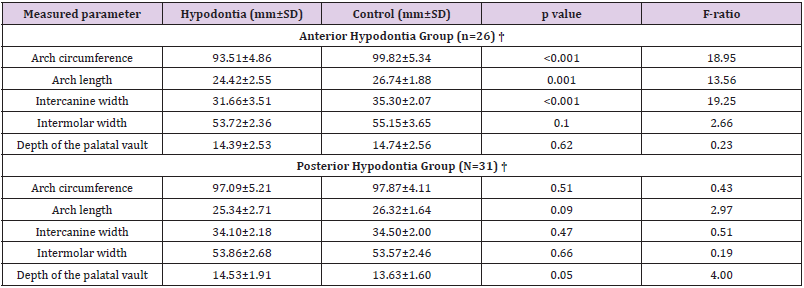
biomedres-openaccess-journal-bjstr

Table 5: Mean values of measured parameters in upper arch for anterior and posterior hypodontia subgroups and matched controls; †3 patients were excluded from this section as they had both anterior and posterior hypodontia; SD=Standard Deviation.
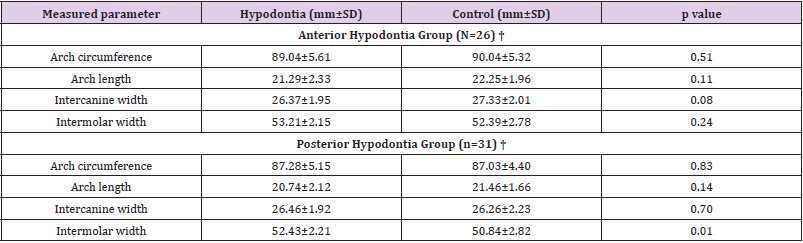
biomedres-openaccess-journal-bjstr

Table 6: Mean values of measured parameters in lower arch for anterior and posterior hypodontia subgroups and matched controls; †3 patients were excluded from this section as they had both anterior and posterior hypodontia; SD=Standard Deviation.
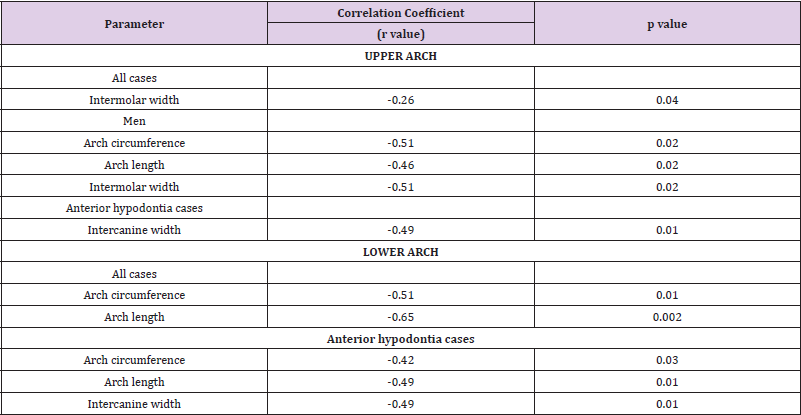
biomedres-openaccess-journal-bjstr

Table 7: Statistically significant negative correlations between the number of missing teeth and different parameters.

No significant correlations were found for the posterior hypodontia subgroup.

Discussion

The validity of the study can be examining the nature and structure of the sample, the study design, the pattern of hypodontia in the subjects, the measurement techniques, the reproducibility found and the raw data. The sample is derived from a single ethnic group and is of a Dental Age [30] where the dental arches have developed to maturity in width and length [31,32]. The sample size is satisfactory as determined by power calculations [7] and the controls are matched for age, sex, and ethnicity. The matched pairs design and the pattern of congenitally missing teeth accords with previous studies [1,6,33]. The accuracy and validity of the 2D image analysis system used here has been established over a series of studies [7,12,28,33].The hypodontia patients included in the present study had significantly smaller arch circumference, arch length and intercanine width in the upper arch than controls. This agrees with the findings of Nelson et al. [7] for their mild/moderate hypodontia group; in their severe hypodontia group the differences were greater. Bu, et al. [26] report similar results.In the present study the only significant difference in the lower arch was a larger intermolar width in the hypodontia group. This has previously been reported by Hobkirk, et al. [34], but not by Fekonja [27] and Higgins [25]. These contrasting findings could have arisen from difference in measurement techniques.
A possible explanation for a larger lower intermolar width could be increased tongue pressure in the lower molar region arising from the position of the tongue in response to the narrower upper arch [34]. Moreover, if the lower second premolars are congenitally absent, the lower second primary molars may be retained, preventing the forward movement of the first permanent molars, and holding them back in a wider arch. Arch dimensions in females and males were investigated separately because differences had been suggested by Berwig, et al. [35]. The present study also showed sex differences, with greater reductions in males compared to their control group. In the upper arch the male hypodontia patients had highly significant reductions in arch circumference, arch length, and intercanine width, while females had less difference in these three parameters from their controls. The location of the congenitally missing teeth had significant impact on the dental arch parameters. In the upper arch, when maxillary lateral incisors were congenitally absent, the arch circumference, arch length and intercanine width were all significantly reduced, suggesting that the presence or absence of these teeth may have a substantial effect during upper arch development.
While the growth of the maxilla is affected by the missing anterior teeth, in the posterior hypodontia group, in which the maxillary second premolars were congenitally absent, no significant differences were found. In the lower arch the only significant difference was an increase in the intermolar width in the posterior hypodontia group in which the lower second premolars were absent. These changes in the dental arches occurred in those hypodontia patients most frequently encountered in clinical practice. A recent study of the orthodontic treatment of similar patients in a Western Australia private practice reported a trend away from space opening and prosthetic replacement to space closure over the years 2000 to 2017/18 [36]. The findings of the present basic science study suggest that within any such general trend, different treatment plans may be appropriate for individual patients. In (Tables 3-5) while the mean values for the arch circumference, arch length and intercanine width in the maxillary arch are all smaller for hypodontia patients than those of controls, the standard deviations are greater. This indicates more variation in the amount of space available, which will also be affected by the extent of reduction in the size and shape of the teeth present. In conclusion, the evidence from this study in relation to the aim shows that hypodontia does influence the dimensions of the dental arches. Different parameters in hypodontia patients are affected to different degrees: the upper arch is more affected than the lower; males are more affected than females and the location of the congenitally absent teeth is influential.
The changes are evidence of interactions between two complex adaptive systems, the dentition and the dental arches, that are components of the stomatognathic complex. They also interact with a third component, the tongue. The underlying factors in these interactions during development are genetic, epigenetic and environmental [13]. The question remains as to the relative influence of genes and genetic mutations that are common to both the teeth and the arches compared with the environmental effects arising from the congenital absence of teeth in specific locations, resulting in a lack of stimulus to bone growth. This study provides a basis for further investigations of this and other samples to examine this question further.

For More Articles: Biomedical Journal Impact Factor: https://biomedres.us

Open Access Journals on Biomedical Research

Analysis of Relationship between Recovery of Consciousness and Personal Safety after Painless Induced Abortion

Short Communication

In clinical painless induced abortion, it is obligatory that patients who do not suffer any operative pain or special discomfort should regain consciousness completely within a short time after the operation, return to their preoperative state and leave the hospital safely. Intravenous anesthesia using propofol and sufentanil has been widely used in painless induced abortion [1]. It is characterized by precise anesthetic effect, quick onset and quick elimination without significant accumulation. Patients regain consciousness completely and have no memory of the operation. It can inhibit the vagus reflex and eliminate the induced abortion syndrome, has minimal affect on circulation and respiration and is relatively safe [2]. However, dosage is frequently excessive or insufficient. Excessive dosage will delay recovery and insufficient dosage will affect the operation [3]. At present there is still no domestic uniform standard for the retention and in-hospital observation time for patients following induced abortion. In this article we carried out a survey of patient recovery of consciousness following induced abortion to provide criteria for the safe discharge of patients with relationship to their state of wakefulness.

Materials and Methods

There is no uniform standard for in-hospital observation of patients after induced abortion under anesthesia and analgesia using propofol and sufentanil. In this article, we surveyed the recovery of consciousness of patients following induced abortion to provide evidence for clinical use. One hundred and twenty four patients who volunteered for the questionnaire were at ASA I grade, with an average age of 25.8±5.6 years, weight of 58.8±9.6kg and gestation period of 63±11.6 days. With fasting and water deprivation for 12h before operation, the blood pressure (BP), electrocardiogram (ECG) and pulse oxygen saturation (SPO2) was continuously monitored in the operation room. Beginning three min before the operation, atropine 0.5 mg, 0.15ug/kg sufentanil and 2mg/kg propofol was given in succession by intravenous injection within 2 min, respectively. When patient consciousness and eyelash reflex were no longer present, the operation began. BP, heart rate (HR) and SPO2 were recorded before the anesthesia, 1 min, 2 min, 5 min, and 10 min after anesthesia and observations were made to determine any adverse reactions. The doctor filled out the unified tabular questionnaire after questioning patients. Consciousness recovery:

Retrograde Amnesia

Before the operation, patients were shown two pictures of familiar animals (dog and cat) and then asked to distinguish these among five pictures after the operation.

Orientation

Determination was made whether patients could tell the direction indicated by doctors.

Excitability

Whether the patient took the initiative in communicating with medical staff or other patients.

Motor coordination

While standing or walking, whether patient’s step was sure.

Fatigue

Whether the patient had a sense of fatigue or drowsiness. Data was statistically processed by Excel 2003. Measurement data were expressed withx ±SD using t-test.

Results

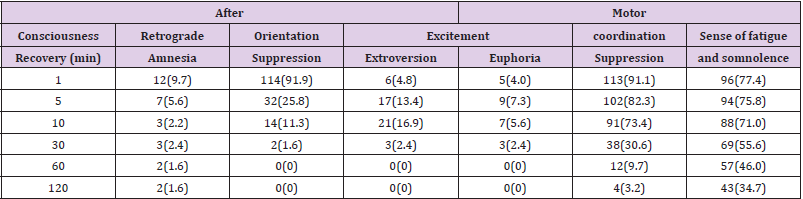
The systolic pressure decreased one and two min after anesthesia, a statistically significant difference compared with that before anesthesia (P <0.05). However, for patients without severe hypotension who needed ephedrine, there was no statistical difference in systolic pressure at other time points compared with that before anesthesia (P <0.05). There was no statistical difference in diastolic pressure, heart rate or blood oxygen saturation before or after anesthesia (P <0.05) Table 1. Eighty-nine (71.8%), 28 (22.6%) and 12 (9.7%) patients had adverse reactions of respiratory depression, injection pain and postoperative nausea, respectively. The respiratory cases showed lower respiratory frequency and apnea with a period of 36±15.8s after intravenous injection of propofol. It took the patients 3.8±1.4min to regain consciousness. Some patients had retrograde amnesia. The orientation suppression and increased excitability lasted 30 min after the operation, while motor coordination suppression and sense of fatigue lasted 2h after the operation Table 2.

biomedres-openaccess-journal-bjstr

Table 1: Changes in Patient Vital Signs before and after Anesthesia ( X ±S).

Note: Compared with that before anesthesia *P<0.05.

biomedres-openaccess-journal-bjstr

Table 2: Postoperative Recovery of Patients [Case (%)].

Discussion

In this group, patient systolic pressure was significantly decreased one and two min after the administration of drugs, which, however was within the normal range and did not significantly affect their recovery of consciousness, with no need for special treatment. It is common knowledge that an intravenous injection of propofol and sufentanil will cause apnea in most patients and so in administering anesthesia it is necessary to use auxiliary respiratory measures before hypoxia occurs [4,5]. Thus hypoxia had no influence on the recovery of consciousness in this group of cases with a blood oxygen saturation of < 96% [6]. After an intravenous injection of propofol, patients became unconscious with the disappearance of the eyelash reflex and respiration response. The inability to remember the operation is not amnesia. Retrograde amnesia within the initial 5 min following recovery of consciousness might be related to incomplete consciousness [7], but 2h later 1.6% of patients still did not have full preoperative recall, which might be relevant to propofol.
Wang Chunyan [8] thought patients undergoing non-cardiac surgery just after a general anesthesia had cognitive functional disorder. Simon [9] also thought that patients had preoperative retrograde amnesia after propofol anesthesia. As reported in most literature, propofol is not stimulatory [10]. However, it was discovered that in our target group, after regaining consciousness, patients experienced a definite degree of excitability. Different from hallucination or nightmare caused by ketamine, this was a feeling of comfort and pleasure lasting for 5 to 30 min, which expressed itself among some patients who had not liked communicating with others before the operation in that they actively began to talk about how good they felt after the operation. Individual patients displayed initiative in describing their own dreams and a few patients involuntarily swung their legs back and forth, seeming to forget they were in an operating environment. Finco G, et al. [11] also discovered that patients had a sense of well-being after gastroscopy and propofol anesthesia but did not analyze this. Dizziness and disorientation appeared for a certain period of time after the operation, but patients basically recovered within 10 min. This is similar to the observed results of Bouillon T, et al. [12].
But in the present study, we also discovered that the disorientation of a very few patients (1.6%) continued at some level 30 min after operation. The decrease in motor coordination was mainly manifested as wobbling as patients walked immediately after operation. Sometimes patients themselves described this as “weakness of legs.” In our observation, 2 patients nearly fell while walking, which was considered related to propofol and sufentanil. There were also reports of dizziness even with a single use of propofol [13]. As an opioid drug, sufentanil’s above-mentioned side effects were clearly in evidence. Currently there are no unified regulations concerning postoperative management for painless induced abortion using propofol and sufentanil [14].
In most hospitals, patients are kept under observation for 30 min, while some hospitals, especially small hospitals, don’t even have an observation room at all. Although an increase in postoperative excitement is transient, it is inappropriate for patients to leave the hospital too early due to the patient’s decreased safety awareness. Because orientation and motor coordination are affected, patients might fall or even hurt themselves if they began to walk alone immediately after the operation. Generally, patients have a sense of fatigue and some even have drowsiness. In our investigation, it was also discovered that a very few number of patients were not accompanied by family members or even returned home by themselves on bicycle after the operation due to insufficient awareness of the safety issues surrounding painless induced abortion.
The doctor should give patients safety instructions and explain to them preoperative fasting and water deprivation, the need to be accompanied by others and the prohibition against driving. Patients should be accompanied by nurses back to the observation room instead of walking alone immediately after operation. It is advisable that patients without nausea or vomiting after the operation take fluids or soft food, while fluid infusion may be considered for patients with a poor constitution who cannot eat [15]. In our hospital, an observation period of 30 to 120 min is determined based on whether a patient has had nausea, vomiting or dizziness. During this period, fluid infusion and oxygen will lead to a full recovery of patient strength and will avoid the possibility of postoperative orthostatic hypotension caused by preoperative fasting. In view of probable retrograde amnesia after anesthesia, it is necessary to register and check valuables carried by patients before the operation to avoid unnecessary issues later.
Anesthesia affected patient orientation and motor coordination and was probably responsible for a sense of fatigue and increased excitement thus leading to a decrease in patient safety consciousness or awareness. Therefore, it is suggested that patients be forbidden to drive or work high above ground for 24h after the operation. At the same time, patients must be accompanied by others when leaving the hospital. To sum up, it is not appropriate that all patients should be routinely observed for 30 min after painless induced abortion using propofol and sufentanil. The observation period should depend on the varying reactions of patients to the operation and the anesthesia and on whether or not they are accompanied by others to ensure their medical and personnel safety.

For More Articles: Biomedical Journal Impact Factor: https://biomedres.us
Open Access Journals on Medical Research

A Narrative Review of the Impact of Healthy Nutrition and Regular Exercise on Physical and Mental Wellness

Introduction

According to the World Health Organization (2017), being healthy is not defined as the absence of disease, but as a state of complete physical, mental and social well-being [1]. In this description, it is seen that health is considered to be multifactorial and well-being is underlined. It is not always possible or easy to be healthy in all areas of life due to hereditary and environmental factors, but it is emphasized that healthy living habits can be preventive for diseases [2]. Behaviors that serve to protect and increase the well-being of individuals are defined as healthy lifestyle behaviors [3]. These behaviors include responsibilities such as adequate and balanced eating habits, stress management, regular physical activity, cognitive development, and sociological development [4]. To live a healthy life and to minimize the health risks that may occur in aging, the main factors are nutrition and physical activity [5] emphasize that inadequate exercise or inactive life is a real cause of chronic diseases and death. Physical inactivity has been associated with the development of 40 chronic diseases and premature death, including major non-communicable diseases such as type 2 diabetes and coronary heart disease [6]. Blair et al. 1989 stated that cardiorespiratory condition, generally measured by maximum oxygen uptake (VO2max), is an important determinant of health. [7], showed in exercise tests that for every 1 metabolic equivalent increase, there is a 12% improvement in survival.

Exercise improves multiple factors that affect VO2max, including oxygen-carrying capacity, oxygen diffusion to working muscles, and adenosine triphosphate production [8]. Another main component of a healthy life is nutrition. A healthy diet with the appropriate balance of nutrients can prevent or delay the development and complications of not only common chronic diseases such as diabetes, high blood pressure, heart disease, and cancer but also diseases [9]. Healthy aging, maintenance of function, immunity, and healing are supported by a high-quality diet that meets micronutrients (vitamin C, A, D, E, and K; zinc; folate; calcium; iron; and B vitamins) and macronutrients (protein, carbohydrate, and fat) requirements [10]. No single food contains all the nutrients the body needs. There are different types of nutrients in each of the foods that have different properties and have different functions in body functioning [11- 13]. For optimal nutrition, it is necessary to take these nutrients in certain proportions [14,11-13]. The ratios of these nutrients in the diet affect each other’s absorption, metabolism, and requirement [11-13]. In addition, the foods consumed for optimal nutrition do not only contain essential nutrients, but also contain bioactive components called phytochemicals, which are effective in the protection and development of health and the prevention of dietrelated chronic diseases [15-17].

Discussion

Many studies aiming to reveal the importance of exercise for a healthy life have focused on improving health and increasing physical activity. A study of healthy community-dwelling older adults showed that seven to twelve months of regular exercise was associated with changes in self-efficacy and cognitive mediators, and these gains were associated with regular exercise [18]. In another study, self-efficacy was increased for those who completed an exercise prescription scheme, but not for those who left without completing a regular exercise prescription [19]. It has been concluded that positive changes can be achieved on health parameters through the nutrition education program conducted to improve the life health of CVD high-risk groups in socio-economically deprived regions [20]. Since it’s observed that in the school-age and pre-adolescent period, overweight and obesity tends to increase more frequently, it should be important for individuals in this age group to develop healthy living habits together with regular physical activity and healthy nutrition education [21-23].

Conclusion

The most important point to be emphasized about the concept of healthy life is health; not only the absence of illness and disability but also the fact that one lives in a state of complete well-being from a physical, psychological and social point of view. Being healthy all your life is everyone’s dream. In line with this goal, many factors can be mentioned in life to maintain health and become healthier, but among all these factors, a natural and balanced diet and physical activity are of great importance for a healthy life. With a better understanding of the importance and necessity of physical activity for health all over the world, a more active lifestyle and regular exercise have been adopted by the people. With the adoption of an active lifestyle shaped by physical activity, the chances of healthy aging will increase thanks to the preservation and improvement of the physical and psychological health of people of all ages. And with a natural and balanced diet, it is possible to provide all the nutrients necessary for the efficient and effective functioning of the whole body. And also, it is known that in the presence of a balanced diet, the body will be more resistant to all kinds of disease-causing factors, infections, chronic fatigue, and metabolic performance losses and a decrease in the incidence of chronic diseases such as cardiovascular diseases, hypertension, diabetes, depression, osteoporosis will be observed. And so it will be possible to increase the chances of a long and healthy life in the presence of healthy nutrition and regular exercise.

For More Articles: Biomedical Journal Impact Factor: https://biomedres.us
Open Access Journals on Regenerative Medicine

Infection of Piglets with the Porcine Respiratory and Reproductive Syndrome Virus (PRRSV): A Morphological Study

Introduction

The porcine respiratory and reproduction syndrome virus (PRRSV) forms small, enveloped particles (50-65 nm in diameter) harboring a relatively long (approximately 15 kb in size) single strand RNA genome [2]. The viral RNA (vRNA) is a positive-sense molecule with terminal cap at 5´-end and a poly-A repeat at 3´- end [3]. In the course of virus replication, the vRNA is copied as whole, when synthesized via a full length negative-strand RNA intermediate. The vRNA sequence begins with 2 (two) long open reading frames (called ORF1a and ORF1b), which together comprise about 75% of the total genome sequence [4]. This portion of the genome specifies 14 non-structural proteins (nsps) which are formed by cleavage of both translated polyproteins. Of special importance are, for example, two non-structural proteins (nsp9 and nsp12), which function as vRNA replicase, also termed RNAdependent RNA polymerase (RdRp) [5]. The rest of the genome encodes 7 structural proteins, out of which 5 are glycoproteins (designated GP2a/Gp2, GP2b/E, GP3, GP4 and GP5) along with the M (membrane) protein and the N nucleoprotein [6].
Regarding to the structure of the vRNA, the PRRSV has been classified as a member of family Arteriviridae (order Nidovirales), along with the equine arteriitis virus and the lactate dehydrogenase elevating virus of mice [7]. In the course of vRNA replication, a total length (genomic) minus strand is generated, which serves as template for the synthesis of new vRNA molecules. During viral mRNA synthesis, the negative sense RNA sequence is being formed first; then a set of positive sense nested sub genomic (sg) RNA molecules is transcribed. Finally, the full set of minus sense sub genomic (sg) RNAs is formed, which becomes a template for the synthesis of functional positive sense sg mRNAs [7]. Both strands are complementary to each other; the coterminal 3´-ends are equipped with a common leader sequence at their 5´-ends [8,9]. The viral genome reveals several (but at least two) conserved transcription regulatory sequences (TRS), which are located either in the front of ORF1a (encoding the structural protein GP2a) or before ORF2a (encoding the envelope glycoprotein Gp2b/E).
The classical PRRSV strains which were isolated in the US (VR2332) and/or in Europe (Lelystadt) differ at both, by serological as well as genome examinations [10]. Experimental infection with the PRRSV isolates can be lethal in newborn and/ or 3-week-old piglets. A key event of the infection process is the involvement of porcine alveolar macrophages, which are the most important virus target also mediating virus spread [11]. To date, at least two macrophage surface molecules are known as entry mediators: the siglec sialoadhesin and a scavenger receptor CD163 [12]. The PRRSV induced pneumonia is characterized by thickening of inter-alveolar septa due to infiltration with macrophages and by the presence of occasional inflammation and cell debris within the alveoli itself [13]. Also, alveolar pneumocytes of type II may be found PRRSV antigen positive along with the hyperplasia of peribronchial lymphatic tissue [14]. The severity of lung lesions may vary from relatively mild to quite extensive. The viral genotypes can differ in their pathogenicity, namely the Type 2 North American PRRSV induces more severe respiratory disease than type 1 European virus. Nevertheless, mild thickening of interalveolar septum can be mistaken with focal thickening of inter-alveolar septa in combination with slight infiltration of peri-bronchial connective tissue (referred to as mild non-specific interstitial infiltrate, MNSII), was occasionally seen in a proportion of non-infected control piglets and interpreted as unrelated to PRRSV infection [15]. In this paper we describe the correlation of the lung lesions as seen at histological examination slides stained with, HE on comparison to the immunohistochemical detection of viral N-protein along with the results of serological tests for N-protein antibodies.

Materials and Methods

Virus

A North American strain was cultured on the MARC-145 cell line; its titer end point (TCID50) was evaluated using a 96-well plate as described by Zhao, et al. [16] and/or Ramakrishnan (2016) [17].

Animals

Pigs (28 infected animals) were inoculated into both nostrils with 105 TCID50 of above mentioned PRRSV strain administered in a volume of 300μl culture supernatant. The negative control (9) animals were inoculated with a virus free culture medium; these animals were kept under conditions of careful isolation avoiding any contact with the virus-inoculated piglets.

Specimen Sampling and Histological Examination

At given intervals post-infection, the animals were succumbed. Blood was drawn for obtaining serum, whole the tissue samples (coming from each lung lobe, from both tonsils including adjacent paryngeal area, from spleen and liver) were removed and immediately immersed into in 10% neutral formalin for 24hr. Fixed tissue samples were rinsed in phosphate buffer, dehydrated in a series of corresponding reagents and embedded into paraffin as described Szeredi, et al. [18] and/or Stipkovits, et al. [19]. Next to sectioning, the sections were stained either by classical hematoxylin and eosin (HE) and/or treated by immunohistochemical reagents, namely using a commercial anti-PRRSV N-protein antibody mixture SDOW-17 and SR-30 in the first layer. This has been purchased from 4rtilab (SDOW17-A and SR30-A, respectively) and mixed for use in an equal 1:1 ratio.

ELISA Titer Measurements

The specific serum class IgG antibody levels against the PRRSV N antigen were determined using the INgezim PRRS 2.0 ELISA kit (purchaed from Eurofins) strictly following the procedure recommended by the manufacturer.

Saliva Collection

The pooled oral fluid was collected from each animal separately using the Civtest suis oral fluid rope IDEXX. Obtained saliva samples we examined for the presence of class IgA specific antibody to the N-antigen of PRRSV. The antibody test was performed with the Oral Fluids (IDEXX PRRS OF) kit as recommended in the manufacturer’ s manual.

Results

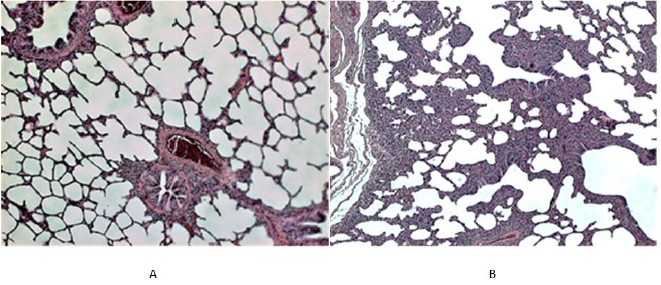
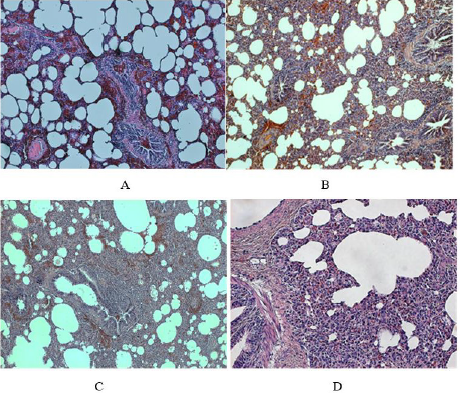
As documented in Figure 1A the interalveolar septi in normal lung tissue are very thin in order to ensure the diffusion of oxygen into blood capillaries, where the erythrocytes circulate. Occasionally, a few mononuclear cells (mainly lymphocytes) might be seen in the peribronchial connective tissue. Surprisingly, in 4 out of 9 uninfected (control) piglets, a slight focal thickening of interalveolar septi was noted along with the accumulation of relatively few interstitial infiltrates consisting of mononuclear cells, mainly lymphocytes (Figure 1B). As expected, staining for the N-antigen of PRRSV in the control lung tissue was negative by all control animals, including the above-mentioned areas in which the above mentioned mild interstitial infiltrate (MNSII) has been detected. The non-extensive MNSII (Figure 2A) has been also found in a few infected piglets (5 out of 28, 18 %), especially when the N-protein could not be detected (Table 1). As expected, in the majority of infected animals (23 out of 28) the lung tissue revealed a typical picture of usual interstitial pneumonia (UIP). In the latter, the interalveolar septi were thicker due to the presence of a rich mononuclear cell infiltrate. In UIP cases, the capillaries were widened along with occasional focal bleeding in result to the injury of endothelial cells (Figures 2B & 2C). High power view of such areas showed that the interstitial infiltrate in question consisted mainly of lymphocytes (Figure 2D). Occasionally (for example in piglet no. 40) the infiltrate was so extensive that it altered the original lung structure (Figure 3).

biomedres-openaccess-journal-bjstr

Figure 1: Histological picture of the lung tissue in uninfected (control) piglets.
A. In the left (piglet no. 5). The normal lung structure at low power view shows thin interalveolar septa devoid of any infiltrate; in the peribronchial (and/or perivascular) connective tissue a few mononuclear cells (mainly lymphocytes) can be seen.
B. In the right (piglet no. 2). Unlike to 1A, this Figure shows areas of thickened interalveolar septa due to the accumulation of monocellular cells (mainly of lymphocytes). Such focal mild non-specific interstitial infiltrate (MNSII) was found in the lungs of 5 out of 9 uninfected controls (Table 1).

biomedres-openaccess-journal-bjstr

Table 1: Survey of histological lesions and the N-antigen presence in infected piglets.

Note: *Mild non-specific interstitial infiltrate (in the peribronchial area and/or interalveolar septa); ** Severe interstitial infiltrate corresponding to the diagnosis of “Usual Interstitial Pneumonia” [1].

biomedres-openaccess-journal-bjstr

Figure 2: Histological findings in the lungs of PRRSV infected piglets.
A. In the left above (piglet no. 16). At low power view some areas of the lung tissue even in the infected animal showed rather less extensive thickening of interalveolar septa (infiltration by mononuclear cells referred to as mild non-specific interstitial infiltrate, MNSII); note the dilatation of small vessels (magn x100).
B. In the right above (piglet no. 16). In contrast to the area shown above, another lung area of the same reveals typical UIP with more widespread thickening of interalveolar septa and their abundant mononuclear cell infiltration (along with hyperemia, i.e. dilatation of capillaries and small blood vessels).
C. In the left below (piglet no. 25). The lung tissue of an animal who developed typical UIP shows widespread mononuclear infiltration of interalveolar septa and peribronchial connective tissue (a lymphatic follicle like structure can be seen, magn. x100).
D. In the right below, the same piglet as above (no. 25). The mononuclear infiltrate in the peribronchial area consists mainly of lymphocytes along causes thickening of interalveolar septa (magn. x240).

biomedres-openaccess-journal-bjstr

Figure 3: Extensive interstitial pneumonia in PRRSV infection.
Note: Lungs of the piglet no. 40 show severe interstial pneumonitis: the infiltration of interalveolar septa by mononuclear cells (mainly lymphocytes) is so widespread that the original lung structure can be hardly seen. In addition, the abundant hyperemia along with extensive proliferation of connective tissue is clearly visible (magn. 220x).

Staining with the anti-N antibody showed the presence of PRRSV antigen predominantly in the columnar ciliary epithelium lining the bronchial tree (Figure 4A). Details from such areas also demonstrated the presence of viral antigen in the cytoplasm of the small acinary mucous glands situated below the ciliary epithelium lining, namely in the connective tissue of bronchial wall (Figure 4B). The alveolar lining was rarely positive, though occasionally the type II alveolar cells could harbor the N-protein, mainly present in alveolar macrophages moving from the alveolar space across the thickened interalveolar septa into local lymphatic capillaries and/ or to the sinuses of regional lymph nodes (Figure 4C), where virus was finally deposited. Nevertheless, in some piglets the local lymph nodes did not stop the virus spread, which then might reach the spleen and/or liver via blood stream. The reticular cells of regional sinuses in spleen were found positive as well, and occasionally the antigen could be seen also in lymphatic follicles (Figure 4D).

biomedres-openaccess-journal-bjstr

Figure 4: Staining for N-antigen in the respiratory pathway and spleen
A. In the left above (piglet no. 34). The lungs of infected animals reveal overwhelming positive staining for N-protein, namely in the bronchial epithelium, in parabronchial mucinous glands and occasionally in the flat epithelium cells lining the aveoli (magn. 80x).
B. In the right above (piglet no. 12). The N-protein can be seen in the cytoplasm of ciliary epithelium cells lining the bronchi along with the negative goblet cells (magn. 120x).
C. In the left below (piglet no. 45). The N-protein can be seen in the cytoplasm of cells lining the alveolar wall and in mononuclear phagocytes which infiltrate the interalveolar septi (magn. 400x).
D. In the right below (animal no. 44): the spleen showing lymphatic follicles consisting mainly of lymphocytes positive for the N-protein (magn.x120).

Outside of lung tissue, the N-protein of PRRSV was found especially in the non-hornified squamous epithelium of the pharyngeal area including that over tonsil (Figure 5A). Here the virus antigen occupied the deeper layers of stratified epithelium, namely the multiplying parabasal cells as well as those in the medium layer. The virus was also found in the salivary glands as documented in submandibular gland, which acinar cells harbored the N-antigen in their cytoplasm (Figure 5B). While the tonsils and/ or pharyngeal epithelium were involved relatively frequently, the presence of the virus in salivary glands acinar cell was relatively rare. Nevertheless, the real incidence of given antigen in the salivary glands was difficult to assess, since such tissue has appeared in the sections examined just by chance. The development of antibody response in comparison with lung lesions as detected by ELISA in serum samples is documented on Table 2. This shows that the virusspecific antibodies were rarely detected on day 11 post-infection but were frequently found on day 18. This may not be surprising and can be explained by the viremia (Figure 6), which peaked on day 6 post-infection, but was absent by day 10. Interestingly enough, on next day 11, the ELISA could not detect free serum antibodies, probably because they were bound to virus particles. However, the specific antibodies were clearly detected at later intervals (i.e. by day 18), when their levels in the serum increased.

biomedres-openaccess-journal-bjstr

Figure 5: N-protein in the pharyngeal area of PRRSV infected animals.
A. In the left (piglet no. 26). In the tonsillar squamous epithelium, the N-protein is expressed mainly wthin cytoplasm of actively growing cells of the suprabasal and intermedial layers including a few basal epithelium cells (magn. 220x) B. In the right (pig no. 13). N-protein can be seen in the acini of a submandibular salivary gland as well as in the marginal sinus of adjacent lymph node (magn. 220x).

biomedres-openaccess-journal-bjstr

Figure 6: Presence of vRNA in the serum of infected pigs (viremia has been detected on days 6 and 8 post-infection).

biomedres-openaccess-journal-bjstr

Table 2: The comparison of UIP with serological response.

Discussion

The PRR syndrome in piglets is characterized with high mortality, reproductive failure (late-term abortions and stillbirths, premature farrowing, mummified pigs in pregnant sows) and a severe respiratory disease (interstitial pneumonia). The disease occurring in the nursery and among growing/finishing piglets causes significant economic losses to the swine industry worldwide. The corresponding virus (PRRSV) replicates mainly in the porcine alveolar macrophages (PAMs) and dendritic cells (DCs) [20]. The virus also causes persistent infection eliciting antibody dependent enhancement (ADE) and occasional immunosuppression. Being a member of the family Arteriviridae, it belongs to the order Nidovirales together with the Coronaviridae and Roniviridae families [21]. PRRSV was originally divided into European type 1 and North American type 2 genotypes. Later on, the East European PRRSV isolates have been found to be of the European genotype but forming different subtypes. A novel virus, namely the Belarusian strain Lena, has been recently characterized as a highly pathogenic East European subtype 3, which differs from European subtype 1 Lelystad and North American US5 strains at genetic as well as antigenic levels [22].
Numerous results suggest that PRRSV may utilize multiple strategies of replication and spread in the infected pigs, including subversion of the host innate immune response, inducing an antiapoptotic and anti-inflammatory state as well as developing ADE. The PRRSV induced immunosuppression might mediate apoptosis of infected cells, which causes depletion of immune cells and induces an anti-inflammatory cytokine response due to which the host is unable to eradicate the primary infection. The initial antibodies do not confer protection and can even be harmful by mediating an antibody-dependent enhancement (ADE), since they can facilitate the virus entry of into targets cells in vitro. To characterize the humoral immune response direct enzyme-linked immunosorbent assays (ELISA) can be used including different mainly recombinant PRRSV antigens. For example, the kinetics of antibody responses directed against nonstructural virus coded proteins (nsp) can be analysed in pigs experimentally exposed to the virus [23]. In such case, high antibody reactivities especially against nsp1, nsp2, and nsp7 were noted. Among the latter, nsp7 recombinant proteinbased ELISA showed good sensitivity and specificity most suitable for diagnostic development especially for identification and differentiation of type 1 and type 2 PRRSV. Several non-structural proteins (such as nsp1, nsp2, nsp5, nsp7 nsp9, nsp10 and nsp11) have been implicated in the induction of IFN-γ and also in the development of the cell-mediated immune response [24]. On other hand, the induction of neutralizing antibodies (NAs) may be delayed and/or their levels may remain low, which is not only the problem of early diagnostic, but is also of importance regarding effective virus elimination. NAs may protect against disease if present in sufficient quantities before infection, but they do not seem to be essential for clearing virus in blood during the course of the infection. PRRSV is able to modulate innate responses, probably through the regulation of IFN-α and IL-10 responses [25].
As described, PRRSV replicates predominantly in the lung alveolar macrophages, can induce prolonged viremia, and cause persistent infections lasting for months after initial infection. PRRSV strongly modulates the host’s immune response and changes its gene expression. Studies showed that PRRSV inhibits type I interferons (IFN-β). Regarding cell-mediated responses, development of PRRSV-specific gamma interferon-secreting cells (IFN gamma-SC) and interleukin 4-secreting cells (IL4-SC) in PBMC was examined by ELISPOT assay. Using this technic, no IFN gamma-SC was detected until day 14 p.i., whereas for IL4-SC, such differences were not seen. Concurrently with the onset of viremia and the development of clinical signs, serum haptoglobin levels and interleukin 10 (IL10) in PRRSV-stimulated PBMC-culture supernatants increased significantly. These results are compatible with the model of pathogenesis in which the immune response does not fully control the outcome of infection [26].
The PRRSV replication and its spread in the body subverts the host innate immune response as well when high jacking its lipid metabolism and inducing an anti-apoptotic and anti-inflammatory state. The latter is indicated by suppressing the expression of serine proteinase inhibitor 2 (SPI 2), IFN-α, and down-regulation of the expression of pro-apoptotic genes such as B-cell lymphoma 2 (BCL-2) antagonist/killer (BAK) and the BCL-2 associated X (BAX). Whereas BAX resides predominantly in the cytosol, BAK is constitutively localized to the outer mitochondrial membrane; both form toxic mitochondrial pores in response to cellular stress. Furthermore, the APR-1, i.e., the Adenomatous polyposis coli (APC) protein which is a Wnt signaling component along with a microtubule-associated protein SARP3 (several ankyrin repeat protein 3), may be downregulated. Both were shown to interact with all isoforms of PP1 (protein phosphatase 1). Infections of N-PRRSV viruses resulted in fever and inflammatory response, as indicated by high expression of proinflammatory cytokines and chemokines, adhesion molecules, inflammatory enzymes and their receptors, such as IL-1β, IL8, SELL, ICAM, CCL2, CXCL9, CXCL10, B2M, proteasomes and cathepsins. This was compounded by cell death and elevated expression of NFKBIA, XAF1, GADD45A, perforin, granzymes, and cytochrome C, coupled with increased ROS-mediated oxidative stress, as indicated by up-regulated expression of cytochrome b245. Taken together, the N-PRRSV infection may have resulted in an excessive immune and inflammatory response that contributed to tissue damage [27].

For More Articles: Biomedical Journal Impact Factor: https://biomedres.us

Open Access Journals on Biomedical Research

The Baseline of the Patient’s Cohort Undergoing Bariatric Surgery in Chile

Introduction

The prevalence of obesity worldwide has reached pandemic levels in recent years, mainly due to profound changes in lifestyles, among which sedentary lifestyle and high calorie density diets stand out [1-3]. The Chilean population is not exempt from this reality, according to the latest data published by the Organization for Economic Cooperation and Development (OECD), 74% of the adult population in Chile are overweight or obese, making Chile the country of the OECD with the highest rate of obesity and overweight, above Mexico (72.5%) and the United States (71%) [4]. These data are reaffirmed with the 2016-2017 National Health Survey, which show that in Chile 42% of the adult population between 30 and 49 years of age are overweight, 31.2% are obese, and 3.2% of the population is morbidly obese [5]. Currently, obesity treatments include first-line lifestyle modification diet, physical activity, and behavioral therapy, and in some case pharmacotherapy [6]. However, only some patients achieve satisfactory weight loss or resolution of comorbidities associated with obesity with these conventional treatments. When patients do not respond favorably to these treatments, BC is considered. Strictly speaking, the term ‘bariatric surgery’ (BC) is applied to all surgical procedures that aim to reduce excess weight, and actually is considered as the most effective therapy available for significant and sustainable weight loss and control of obesity-related comorbidities in morbidly obese patients, improves the quality of life and reduces mortality in obese people [7-9].

Currently, it is estimated that in Chile there are about 500.000 morbidly obese people eventual candidates for BC. However, the National Health Fund (FONASA) provides treatment consistent in comprehensive care and BC to 400 people per year, an insufficient considering the morbidly obese people that currently exist in the country. The first published cases of BC in Chile date back to 1986 when González et al. described six jejunoileal shunts [10] and, in 1999 when the first horizontal gastroplasty in Roux-In-Y was described by Csendes, et al. [11], one year later, in the 2000, the first RYGB was performed at the public hospital San Juan de Dios Hospital of Curicó. BARCO is a cohort of obese patients operated for RYGB and SG procedures at the San Juan de Dios Hospital, in Curicó, Maule district, from January 2000 to May 2018. BARCO was created to support clinical, epidemiologic, and behavioral research to patients operated by BC in public regional health. This paper aims to report the baseline characteristics of BARCO´s patients, to provide a basic description of the sociodemographic, anthropometric measurements, principal comorbidities, mental health, lifestyle habits, clinical, and post-surgical complications of patients undergoing BC.

Materials and Methods

Data Collection

For data collection, a standard review file was created that included 46 variables with sociodemographic, clinical, mental health, main comorbidities diagnosed by a doctor, complications after the intervention, and lifestyle habits of patients undergoing BC. The data were collected through an exhaustive review of physical clinical records, two members of the BC team (one physical therapist and one nursing intern) were trained in data extraction from clinical records, to standardize the information collection method, while avoiding the reduction of systematic errors in their transcription. The information was entered into a database by two surgical interns who, in case of having any doubts regarding the values or data, reviewed the clinical file again for corroboration, in case of discrepancy the chief surgical team determined the inclusion or exclusion of the data. The compilation lasted 6 months.

Patients

biomedres-openaccess-journal-bjstr

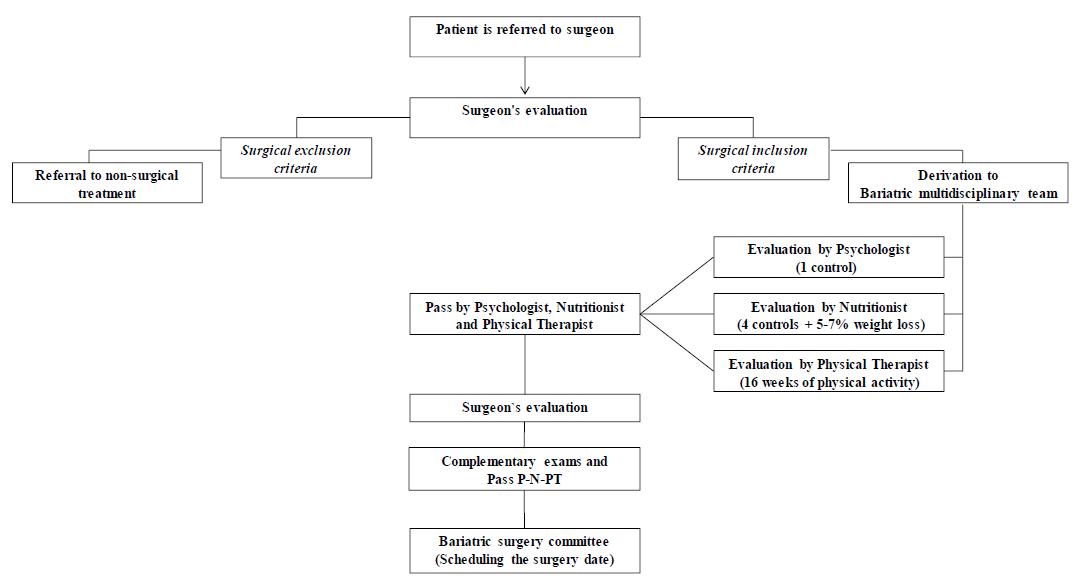
Figure 1: Diagram flow of the patients’ selection to bariatric surgery procedures. The patients’ selection to bariatric surgery procedures. Pass Psychologist = Pass P, Nutritionist = Pass N, Physical Therapist=Pass PT.

652 patients were operated on between January 1, 2000, to December 31, 2018, 3 adjustable gastric band, 5 deceased patients, and 19 patients whose clinical records were lost with the 2010 earthquake were excluded from this study. The remaining 625 patients, who were included, were older than 18 years with a BMI ≥ 35 kg / m2 in presence of at least one comorbidity, or BMI ≥ 40 kg / m2 without comorbidity, and who had undergone of RYGB or SG as the primary intervention. All patients had to be evaluated by the hospital’s BC multidisciplinary team, composed of bariatric surgeons, nurses, physical therapists, nutritionists, and psychologists (Figure 1).

Surgical Procedures Type

RYGB: For this procedure, a 5 cm gastric pouch with a 40-cc capacity was made with a 60 mm x 3.5 mm purple endo linear cutting stapler, between the 2nd and 3rd vessels of the lesser curvature, with 3 refills and 110 cm digestive loop and 150 cm biliopancreatic loop were used. SG: For this procedure, the greater curvature was dissected with a ligature from 4 cm proximal to the pylorus to the Hiss angle, and then the 36 F-calibration probe was installed under direct vision of the lesser curvature. Finally, an EndoGia 60 stapler was used for the section (5 purple loads). The Medtronic® kit was used for both procedures.

Variables

A database created included 46 variables referring to sociodemographic such as age, gender, occupation, and marital status: and the anthropometric measurements body weight, and BMI. The principal comorbidities like arterial hypertension, diabetes mellitus, insulin resistance, hypothyroidism, dyslipidemia, skeletal muscle diseases, obstructive sleep apnea, and gastroesophageal reflux, were included. Mental health including anxiety disorder, depression, bipolar disorder, and panic disorder were evaluated. Lifestyle habits such as alcohol, tobacco, and physical inactivity were also included. In the case of clinical parameters: pre-surgical exam results of upper gastrointestinal tract endoscopy and pulmonary evaluation by forced spirometry and rest EKG were evaluated. The number of RYGB and SG procedures between 2000 to 2018 years. Number of cholecystectomies during the surgical procedure and post-surgical complications. This study was approved by the Department of Teaching and Research of the San Juan de Dios Hospital of Curicó, complying with the criteria indicated in the Helsinki Declaration.

Data Analysis

Qualitative variables are presented as frequencies and percentages. The quantitative variables are presented as means, with standard deviations. It found that 34 were missing data, which were eliminated. The data observed mean in the case of continuous variables and use of the mode in the case of qualitative variables. To statistical analysis the data, the software SPSS version 2.4 was used.

Results

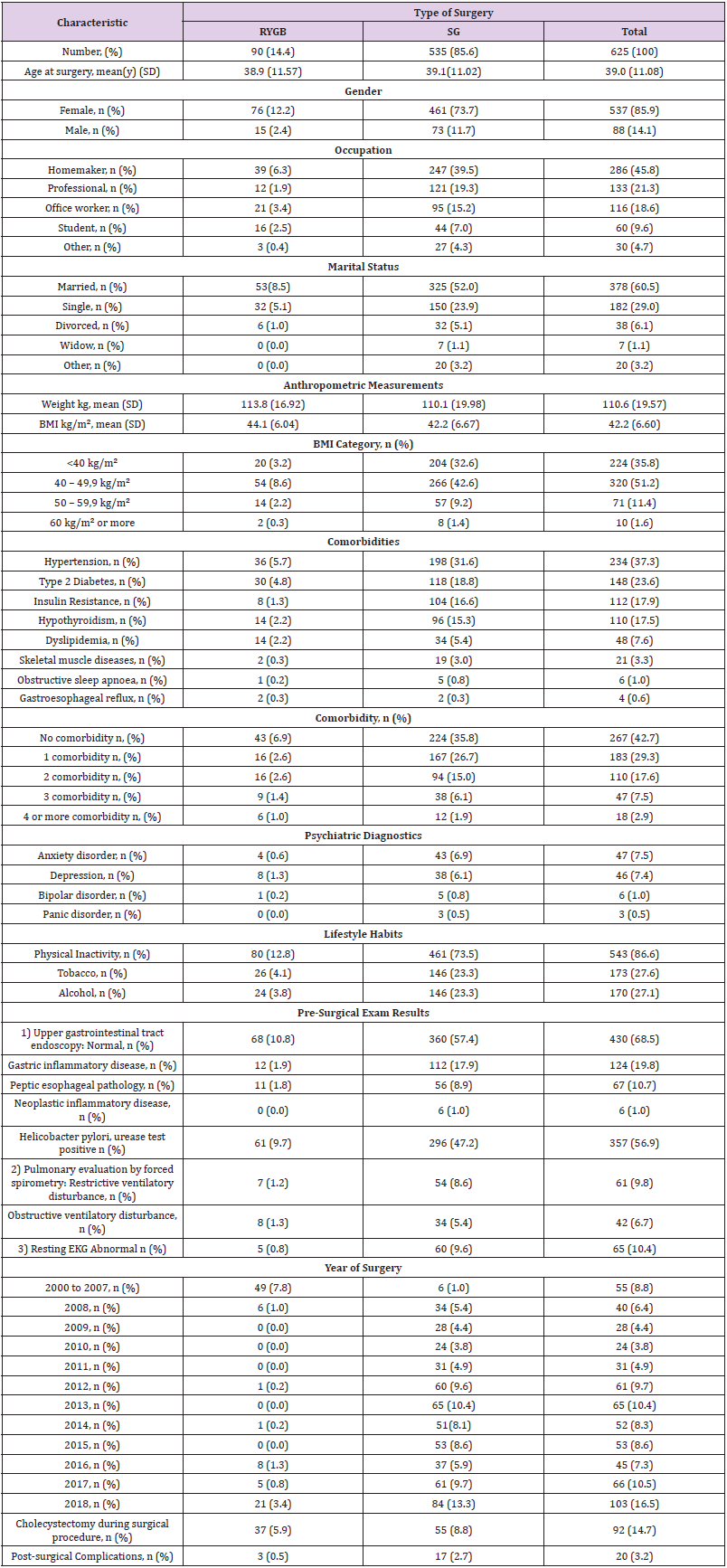
A total of 625 patients met the eligibility criteria of the study. SG was the most frequently reported procedure (85.6%) followed by RYGB (Table 1). Participants mean age was 39 years old and were predominantly female (85.9%). Most of the patients were homemakers (45.8%), professionals (21.3%), office workers (18.6%), 9.6% were students and 4.7% declared other kinds of occupation. Regarding marital status, 60.5% was married, 29% single, 6.1% divorced, 1.1% widows and 3.2% declared other. Regarding the anthropometric measurements, the mean of preoperative body weight was 110.6 kg and the mean of BMI was 42.2 kg / m². Most of the patients (87%) had a BMI ranged from <40 kg / m² to 49.9 kg / m², 11.4% 50 to 59.9 kg / m² and 1.6% have 60 kg / m² or more. The most prevalent comorbidities were hypertension (37.3%), type 2 diabetes (23.6%), insulin resistance (17.9%), hypothyroidism (17.5%), dyslipidemia (7.6%), the skeletal muscle diseases (3.3%), obstructive sleep apnoea (1%) and finally gastroesophageal reflux (0.6%). Regarding the total number of associated comorbidities, most of the patients (42.7%) did not present comorbidities at the time of surgery, 29.3% presented with one comorbidity, 17.6% presented with two comorbidities, 7.5% presented with three and 2.9% presented with four or more comorbidities.

biomedres-openaccess-journal-bjstr

Table 1: Baseline summary of BARCO patients.

Between the psychiatric diagnostic, the most prevalent were anxiety disorder (7.5%) and depression (7.4%), followed by bipolar disorder (1%) and panic disorder (0.5%). During the clinical interview, the patients declared about their lifestyle habits, 86.6% were sedentary, 27.6% smoked tobacco and 27.1% drank alcohol. The pre-surgical exam results indicated that 68.5% of patients presented with a normal upper gastrointestinal tract endoscopy, 19.8% gastric inflammatory pathology, 10.7% peptic esophageal pathology, and 1% presented neoplastic inflammatory disease. Notably, 56.9% of patients presented with Helicobacter pylori (H. pylori), positive urease test. Pulmonary evaluation by forced spirometry indicated that 9.8% presented with restrictive ventilatory disturbance and 6.7% obstructive ventilatory disturbance. Regarding the rest EKG, 10.4% of patients presented abnormal results.

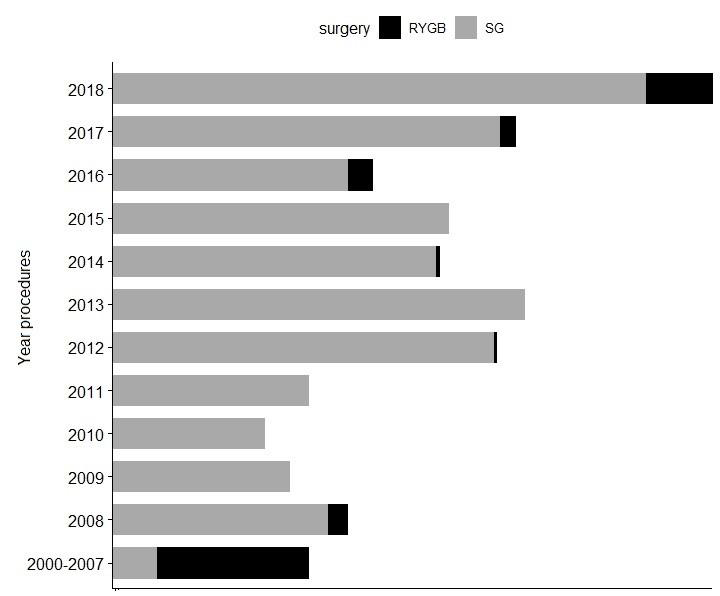
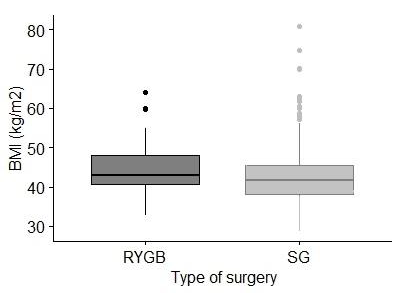
The number of bariatric procedures progressively increased, from 55 cases between 2000 and 2007, and over 100 cases in 2018. Regarding the type of surgery performed per year, between 2000 and 2007, RYGB was the most frequent procedure (49 of 55), however from 2008 to 2018, SG was the most reported procedure (528 of 568) used. During surgical procedures, 92 patients underwent a cholecystectomy, of which 55 were SG and 37 RYGB. Finally, the percentage of post-surgical complications was 3.2%, of which 2.7% corresponded to SG and 0.5% to RYGB. No patients died during the procedures (Table 1). The trends used from 2000 through 2018 are summarized by procedure types in Figure 2. The number of RYGB was higher compared to SG procedures between the years 2000 and 2008, and from 2008 onwards, the number of RYGB decreased and SG procedures had a significant increase. BMI distribution by bariatric procedure types is summarized in Figure 3. The mean BMI was 35 to 65 m/kg2 between both bariatric procedures, however, some patients operated with SG presented a BMI of over 60 m/kg2.

biomedres-openaccess-journal-bjstr

Figure 2: Bariatric surgery utilization trends over time, by procedures types.

Distribution of the number of bariatric surgery procedures from years 2000 to 2018. Roux-in-Y gastric bypass (RYGB) is show by the dark gray bars, and Sleeve gastrectomy (SG) by the light gray.

biomedres-openaccess-journal-bjstr

Figure 3: Body mass index by bariatric procedure types.

Box-and-whisker plots of body mass index (BMI) by surgery procedure types. Roux-in-Y gastric bypass (RYGB) is shown by the dark gray box and sleeve gastrectomy (SG) by the light gray box. The lines through the middle of the boxes are the means. The tops and bottoms of the boxes are the standard deviations.

Discussion

According to recent OECD data, Chile, a developing country, tops its list of obesity and overweight (74%), surpassing Mexico (72.5%) and the United States (71%) [4]. These data are reaffirmed with the latest National Health Survey, which shows an important increase of the obesity and morbid obesity from 21.9 % to 25.1 % and from 1.3 % to 2.3%, respectively, in the last 7 years [5,12]. Currently, it is estimated that in Chile there are about 500.000 morbidly obese people, who are eventual candidates for BC, an amount that according to projections is increasing. Although, the National Health Fund has annual coverage of 400 BC per year, it is insufficient considering the amount of morbidly obese people that currently exist in the country. It must be considered that, because BC is not routinely indicated for obese patients, the option of performing a SG versus RYGB was made according to a multidisciplinary team evaluation, considering comorbidities such as hypertension or type 2 diabetes. Effectively, as expected, SG patients had a higher prevalence of high-risk metabolic diseases as hypertension, type 2 diabetes, and insulin resistance. They also had higher rate of hypothyroidism, dyslipidemia and skeletal muscle diseases before surgery. As observed in this study, SG is the type of BC most performed followed by RYBG procedures, in public and private hospitals both in Chile [13] and in other countries [14,15].

However, in a recent article, Sun et al., indicated that RYGB was the BC type most frequently reported procedure in England followed by SG [16]. Despite these differences, it is important to note that both techniques are effective in the remission of the more prevalent comorbidities of the morbid obese, like type 2 diabetes, insulin resistance and hypertension [17,18]. In this study, it was observed that most of patients were female, which is consistent with other studies that point to a higher prevalence of surgical treatment for obesity among women [19]. This difference could be associated with the fact that in Chile, as well as in other countries such as the United States and Canada, the prevalence of obesity is higher in women than in men, and that women seek more health services compared to men, mainly because they have a greater concern for their health [20,21]. It can be assumed that this higher prevalence is due to the search for an ideal beauty and positive attributes, both associated with thinness, deriving from the many social demands that fall on women [22,23], although specific reasons for this disparity remain unclear. Considering the characteristics of the sample, it was observed that the majority ages of bariatric patients fluctuate between 39 to 46 years, are married or single, and BMI > 40 kg/m2, like other studies [13,21].

Most patients did not present comorbidities prior to surgery, and the prevalent comorbidities in patients are the same as those observed in other studies, type 2 diabetes, hypertension, insulin resistance, hypothyroidism, dyslipidemia and skeletal muscle diseases [21,24]. Interestingly, a higher prevalence of H.pylori (56%) diagnosed prior to surgery was observed, compared with similar studies that report 37.1% [25], and 22% [26] respectively. This difference may be due to the fact that the H. pylori infection is prevalent in 73% of the general Chilean population [27] and the social economic insecurity the patients face. However, the relationship between H.pylori and obesity is controversial, so further studies are needed in this area. It is known that obesity is a multifactorial disease that places individuals at risk for additional health compromising conditions such as biological, social consequences, psychological and psychopathology including depression and anxiety. In this study, it was observed that 93% of patients presented with psychiatric disorder including depression (47%) and anxiety (46%), higher than describe previously in another study of veteran women 60% (28% depression and 32% anxiety) [28].

One can also think that this higher prevalence is justified because most of patients were rural women, homemakers and sedentary. Therefore, it will be very interesting analyze the impact of BC procedure in these patients. Finally, none of the patients that died during the procedures were registered and only 3.2 % presented with immediate post-operative complications, which offers a satisfactory outcome when compared with other studies showing 5 to 10% [29]. These results obtained in the present study demonstrate that RYGB and SG BC procedures are feasible to be carried out in a public regional hospital with results comparable to those obtained in both public and private hospitals at the national and international levels. Although beyond the type of surgery applied, the therapeutic goals of surgery for morbid obesity are to improve quality of life and prolong life by counteracting the lifeshortening effect of obesity and its comorbidities, the future and ongoing investigations will provide evidence on the long-term benefits and risks of these most used bariatric procedures in current clinical practice.

This study presents some limitations, such as related to the external validity of our findings, because BARCO represents rural populations therefore, some results may not be applicable to residents of large urban areas. Here we report the baseline characteristics of BARCO´s patients, to provide a basic description of the sociodemographic, anthropometric measurements, principal comorbidities, mental health, lifestyle habits, clinical, and postsurgical complications of patients undergoing BC. In conclusion, given that BARCO is the largest cohort of the public health system patients operated of BC in Chile, these longitudinal data could be used to evaluate the effectiveness of the Chilean public policies related with the BC to treat the morbid obesity. Future and ongoing research will provide evidence on the long-term benefits, risks, and effectiveness of these bariatric procedures in reducing cardiometabolic morbidity, mortality related to obesity, and maintaining long-term weight loss. So, among the findings, the presence of Helicobacter pylori and the high prevalence of psychiatric disorders stand out as relevant factors for investigation in future studies.

For More Articles: Biomedical Journal Impact Factor: https://biomedres.us
Open Access Journals on Behaviorial Medicine

Dynamics of P Under Redox Conditions in Rice in Tropical Soils

Introduction

Rice is one of the main foods in the world, due to its nutritional content and because of the ease of handling and adaptation in different parts of the world, especially in tropical and subtropical conditions [1]. On the other hand, this crop is established under different types of management, depending on the genetic material to be managed, the type of tillage, agronomic management, fertilization plans and irrigation management [1]. Among the types of risks to be managed in rice cultivation, there is the condition of constant sheet or flooding, which has the advantage of properly managing weeds, avoiding stress in areas with high temperatures, reducing specific phytosanitary problems in each region; however, soil fertility is affected by the high and low availability of some nutrients [2,3]. Among the elements that are affected by its nutritional dynamics is Phosphorus (P), an element determined as a macronutrient and which is required to fulfill specific functions of the plant related to the production of energy (ATP) [4], in addition to the importance it has for the production of tropical agricultural systems [5].

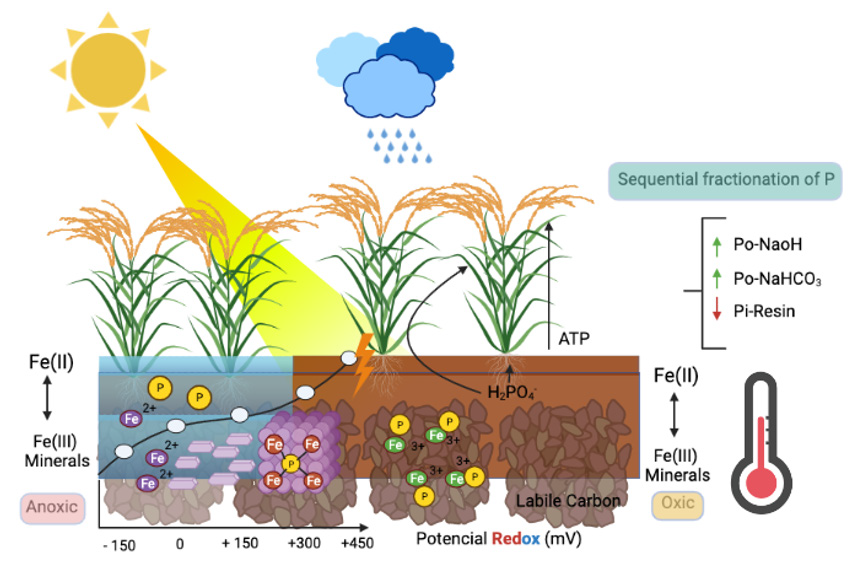
The behavior of this element is not the same when humidity is present at field capacity, as when flood irrigation is used in anoxic conditions, this, due to the fact that the concentrations of O2 in the soil are affected, the pH and pH are also affected. the dynamics of microorganisms that affect the available forms of P, as well as the concentration of elements such as Iron (Fe+2) that is found in the vast majority of tropical and subtropical soils in the form of minerals of high or low crystallinity. which directly influences the availability of P and the adsorption and desorption processes, in its Fe-P relationship, especially in acid soils where Fe is found in high concentrations and closely related to the oxidereduction conditions known as Redox conditions, which they are subject to the activity of electrons, pH and concentration of O2 in the soil; However, for this availability of P to exist, there are other parameters that must be present in the soil, such as high fertility defined by the cation exchange capacity (CEC), organic matter (OM) and especially dissolved organic carbon (DOC ) and a texture with high clay content [6,7], all this is described later as also in (Figure 1).

biomedres-openaccess-journal-bjstr

Figure 1: Dynamics of P in acidic soils in Redox processes in rice cultivation. Created with BioRender.com.

Relationship of pH and Eh in the availability of P

Is important to establish that flood periods do not generate immediate changes in pH, but can vary from a few to several weeks, among the factors that can establish changes in pH in flooded soils are: concentration of organic matter (dissolved organic carbon), Microbial activity, temperature, Fe concentration, ammonium accumulation, among other chemical properties of the soil [8,9]. Conditions such as pH and Eh are indirectly responsible for the release of P under reduced soil conditions [10,11]. After there is reduction in the soil by agronomic management such as flooding, regardless of the pH, which generally in tropical soils is very strongly acidic (<4.5) in soils of the orders Oxisol and ultisol, it has a tendency to rise until reaching the agronomic neutrality (6.5-6.8) [12,13], this is due to the fact that processes of reduction of MnO2 and Fe2O3 occur, to the production of OH- as a result of the mineralization of organic N to NH4 + through the process of the In the same way, the increase in pH can also be attributed to the rapid microbial mineralization of labile Carbon compounds (C), generating a rapid decarboxylation of organic anions and in addition to the ammonification as already mentioned above [14].

On the other hand, there is also a decrease in the redox potential (Eh), which is defined as a measure of the reduction state because it changes with the Oxidation / Reduction ratio; Eh is affected by the formation of complex ions and by pH [15]; It can be said that Eh decreases when the pH increases, therefore, the order of the compounds in which they are reduced in flood conditions in rice can be defined, which is described below: NO3 – = MnO2> Fe2O3 (Eh Low). In a soil with high Fe2O3 content such as oxisols, Eh remains an average of + 100 mV, however, in soils with little Fe2O3, Eh can range from -100 to -400 mV where the reduction of SO4 -2 to S-2 [16,17]. In the end, there is a correlation between pH and availability of P, studies carried out by [11] established that the increase in pH in acid soils (Oxisol and Ultisol), under flood conditions in rice, which indicated that these increases in pH, facilitated the Fe (III) reduction and associated P mobilization in the acid soils evaluated [18,19]

Dynamics of P and Fe Concentration

Lower Eh initial conditions in acidic soils such as oxisols [11], can result in a strong decrease in the sorption force of Fe-OP, leading to a strong increase in the P available in this type of soils [20,21]. In relation to this, it can be said that a reduction of Fe is more likely to occur at a slightly acidic pH, when the increase in pH is occurring in reducing environments [22]. It is important to bear in mind that potentially reducible Fe can be established, through methodologies such as the determination of Fe with Citrate-Ascorbate (FeCA), which indicates that the total concentrations of Fe (III) and recalcitrant Fe (Easily reducible) control the production. Fe (II) in acid soils such as Oxisols and Ultisols [11,23]. It is important to note that Fe (II) has a lower binding force for P than Fe (III) [24]; therefore soils with higher potentials to reduce Fe, an early increase and a higher bioavailability of P can be expected [22]. The reducing dissolution of crystalline Fe (FeCA, defines Fe and low crystallinity and potentially available and reducible Fe) can be catalyzed by a high concentration of Fe (II) [25,26], resulting in a higher initial availability of P in acid soils [11,27]. In short, the increase in the availability of P in flood conditions has to do with the reduction of ferric phosphates (Fe+3) to ferrous phosphates (Fe+2), to the release of P from insoluble components of Fe and Al and to a certain dissolution of Ca phosphates when there are high levels of CO2 in the soil solution (soils with alkaline pH). The release of P through these processes can take a few weeks after the flood. This initial flux of released P can be fixed on clay particles and Al hydroxides (AlOOH), and in some soils with high amounts of active Fe and Al it can still result in a reduction in the availability of P in the soil [28,29].

Organic Matter and P Concentration

Labile organic acids are more efficient to solubilize P from acidic soils, this because there is a greater solubility of Fe and Aluminum (Al) phosphates, with increasing pH and low Eh (Reference). Therefore, a decrease in Eh, followed by a reduction in Fe (III), can generate the release of P bound in Fe minerals; The reduction of Fe (III) and the corresponding accumulation of Fe (II), strongly depend on the labile mineralization of C and OM. Labile C can define the intensity of Fe (III) reduction because it is the main source of energy for microorganisms, in addition to being a strong electron donor [30]. These processes result in the production of Fe (II) but in the same way a desorption producing available P; therefore, higher OC and Fe (II) content in soils such as oxisols, generates a drastic decrease in Eh after immersion [11], which leads to a greater consumption of microbial O2 much faster, which can generate the release of large concentrations of P low binding energy (Reference). It is important to bear in mind that microbial mineralization with rapid activities due to the presence of labile C in acid soils can reduce P sorption, a specific adsorption analogous to phosphate ions [31] or by Fe and Al chelation [32].

Conclusion

It is important for the researcher, extension worker, professor in the area of agriculture, to understand the dynamics of P in systems where Redox processes are present, since for the producer it will serve as an orientation not to carry out high fertilization of phosphate fertilizers, which can lead to high processes of contamination by eutrophication, cost overruns, currently necessary due to the costs of fertilizers that have doubled and tripled their price in the market, in addition to the need to carry out calibrations in the determination of P in the soil, since in the tropics There is determination of P by the method of Bray II (Colombia), Mehlich 3 (Brazil – Minas Gerais), Resina (Brazil – São Paulo and Rio Grande do Sul), generating ambiguity by establishing non-standardized methodologies in various regions of the tropics and by Finally, in addition to values such as pH in the soil analysis, one should work on the fractionation of P as results in the soil analyzes for all The agricultural professional (Agronomist Engineer, Agroecologist Engineer, Agroforestry Engineer, etc.) who is the person in charge of the recommendation, with this, the forms of P, labile, moderately labile and nonlabile are determined to make a much clearer and more accurate recommendation.

For More Articles: Biomedical Journal Impact Factor: https://biomedres.us
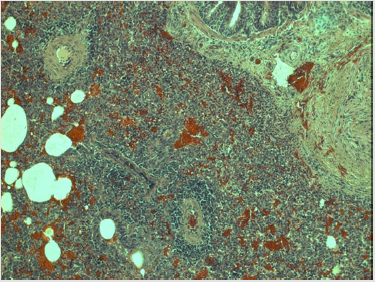
Open Access Journals on Behavioural Medicine

Wearable Self-Powered Sensors for Health Care, 5G, Energy Harvesting, and IOT Systems

Introduction

Basic theory and design of small, printed antennas is presented in [1]. However, the efficiency of small antennas is low, [2-4]. Compact printed metamaterials antennas and sensors are used in wireless communication systems and were discussed and presented in several publications in this century, [2-6]. Printed dipoles, FIPA and loop antennas, printed Slots, microstrip antennas, and other compact antennas are employed in radars, Internet of Things (IoT), 5G, and healthcare systems [2-6]. Several types of small efficient wideband wearable antennas are presented in, [2- 4]. Metamaterials are materials with periodic artificial structures. The metamaterial elements and structure define the electrical properties of the material. Metallic posts structures and periodic split ring resonators (SRRs) may be employed to produce structures with required permeability and dielectric constant as discussed in [7–11]. Metamaterials may be employed to develop efficient sensors for communication, wearable healthcare and IoT devices, [12-16]. In [6] the metamaterial antenna gain, and bandwidth are similar, to those of microstrip antennas. In [8] materials with negative dielectric permittivity are evaluated. In [9], a model and setup to simulate and measure the polarity of SRRs is presented.

The model is used to compare measured results to computed results. In [12] a transmission-line metamaterial antenna with two transmission line arms that resonate at two different frequencies, is presented. The antenna bandwidth is 3% with 2.6dBi directivity. The radiation efficiency is 65% at 3.3 GHz. The antenna gain is around 0.8dBi. Compact radiators such as printed loops and dipoles, patches, and FIPA antennas suffer from low efficiency [2- 5,16-28]. These antennas are linear polarized. Compact efficient metamaterial antennas may be important element in wearable medical and energy harvesting systems. In several 5G, energy harvesting, and medical systems, the receiving signal polarization may be horizontal, elliptical, or vertical polarized. In these cases, the antenna should be dual polarized sensors. Small efficient wearable metamaterials antennas for medical systems are presented in [15- 16]. Wearable antenna measurements in vicinity of human body are presented in [17]. Active wearable antennas for communication and medical systems are presented in [19]. Wearable healthcare devices are used to increase disease cure and prevention. Efficient medical care may be achieved by online evaluation of a continuous measured medical data of patients.

Healthcare remote monitoring system in hospitals is presented in [29]. A wireless wearable device with thermal-aware protocol is discussed in [30]. In [31-40] wearable sensors and antennas for medical applications are presented. Wearable medical sensors can monitor and check patient daily health [34-35]. Dual polarized dipole wearable antenna for medical applications is presented in [39]. In this article, metamaterials technology is used to design high efficiency sensors and antennas with harvesting energy unit for healthcare, 5G, and IoT devices. Dual polarized metamaterial antennas have significant advantages over regular printed antennas. Such as, high efficiency and gain. The antennas bandwidth is around 40%, for VSWR, better than 3:1. The gain of the antennas with CSRRs is around 7dB. The sensors efficiency is higher than 90%. The energy harvesting units connected to the sensors provides selfpowered efficient and compact sensors.

Wearable Technologies and Devices for Medical, 5G, IoT, and Sport Applications

Wireless Body Area Networks, WBANs, can measure and record several healthcare parameters such as body temperature, blood pressure, heartbeat rate, electrocardiograms, arterial blood pressure, sweat rate, and electro-dermal activity. Wearable devices will be in the next decade an important part of individuals’ daily lives. Wearable sensors may provide scanning and sensing features that are not offered by mobile phones and laptop computers. Wearable devices usually have communication links and users may have access to online information. Wireless technologies are used to process and analyze the data collected by the medical system. The collected data may be stored or transmitted to a medical center to analyze the collected data. Wearable sensors gather data which is analyzed by medical software. This analysis may send alert to the physician to contact a patient who needs urgent healthcare treatment.

Applications of Wearable Medical Systems

1. Wearable Medical devices help to monitor medical centers activities and accessories.

2. Wearable devices can help to operate and monitor companies’ activities and accessories.

3. Wearable Medical devices can assist several patients such as Diabetes patients, Asthma patients, Epilepsy patient, and Alzheimer’s disease patients.

4. Wearable devices can help to solve Sleep disorders, Obesity problems, cardiovascular diseases.

5. Wearable Medical devices help to gather data for clinical research trials and studies.

Several physiological parameters can be measured by using wearable medical devices and sensors. Each patient may have a wearable device attached to the body. The wearable device is connected to several sensors. Each sensor perform a specific task. The sensors measure heart rate, body temperature and blood pressure. Doctors may carry a wearable device, which allows other hospital personal to contact and locate them.

Measurements of Blood Pressure and Heart Rate

Usually, blood pressure and heartbeat are measured in the same set of measurements. The Blood pressure and heartbeat may be transmitted to a medical center and if needed the doctor may contact the patient for further assistant. Blood pressure indicate what is the arterial pressure of the blood circulating in the patient body. Some of the causes of high blood pressure may be obesity and stress. Blood pressure of a healthy person is around 70 by 120. Where the diastole is 70 and the systole is 120. The heart rate of a healthy person is 72 times per minutes. Changes in heartbeat can cause several cardiovascular diseases. A change in the heart rate change the blood pressure and the amount of blood delivered to the patient body. To measure and analyze the heart beat a wearable medical sensor can be connected to patient chest.

Measurements of Respiration Rate

Elderly, sick, and overweight people have difficulties in breathing normally. Measurements of respiration rate indicates if the patient is healthy and breathe normally. The measured respiration rate may be transmitted to a healthcare center and if needed the doctor may contact the patient for further assistant. It is better to use a wearable wireless medical device to measure accurate respiration rate.

Measurements of Human Body Temperature

Temperatures below 35˚C or above 38˚C can indicates that the person is sick and temperatures above 40˚C may cause death. The human body temperature may be transmitted to a medical center and if needed the doctor may contact the patient for further assistant.

Measurements of Sweat Rate

Measurements of sweat rate and PH can be used to monitor the physical activity of a person. A wearable medical device may be used to measure the sweat rate of a person when extensive physical activity is done. The wearable device may be attached to the person clothes close to the skin to measure the sweat rate. The device may be used to measure the sweat PH to analyze the patient health. When a person does extensive physical activity, glucose come out of the skin as a sweat. Sweat is a mix of water, glucose and minerals. Glucose is supplied to the body usually by sugar that is a monosaccharide that provide energy to the human body. The sweat evaporated from the skin is absorbed in the medical device to determine the sweat PH. If the amount of sweat coming out of the body is too high the body may dehydrate. Dehydration causes tiredness and fatigue. The patient sweat rate can be transmitted to a medical center and if needed the doctor will contact the patient for further assistant.

Measurements of Human Gait

Human gaits are the various ways in which a human can move. Walking, jogging, skipping and sprinting are natural human gait. Different gait patterns are characterized by differences in limb movement patterns, overall velocity, kinetic and potential energy cycles, forces, and changes in the contact with the ground. Gait measurements and analysis are fundamental research tool to characterize human locomotion. Wearable devices may be located at different parts of the human body to measure and analyze human gait. The movement signal recorded by these devices are used to analyze human gait. In sports, gait analysis based on wearable sensors can be used for sport training and analysis and for the improvement of athlete performance. The ambulatory gait analysis results may determine whether or not a particular treatment is appropriate for a patient. Parkinson’s disease is characterized by motor difficulties, such as gait difficulty, slowing of movement and limb rigidity. Gait analysis has been verified as one of the most reliable diagnostic signs of this disease. For patients with neurological problems, such as Parkinson’s disease and stroke, the ambulatory gait analysis is an important tool in their recovery process and can provide low-cost and convenient rehabilitation monitoring.

In healthcare centers, gait information is used to detect walking behavior abnormalities that may predict health problems or the progression of neurodegenerative diseases. Fall is the most common type of home accident among elderly people. Fall is a major threat to health and independence among elderly people. Gait analysis using wearable devices was used to analyze and predict fall among elderly patients. IoT systems are wireless communication devices of interrelated computing networks, personal devices, digital machines, mechanical machines, and medical sensors that have a unique identifiers UIDs).

IoT system consists of modules that use communication systems, sensors, processors, and antennas. IoT systems receive, transmit and process information received from their environments that are connected to the internet web. IoT devices are connected to an IoT gateway where the collected information is processed online or sent to data centers to be diagnosed and shared with other IoT devices. In several IoT and medical devices the polarization is not defined. In these cases, the antenna should be dual polarized. IoT has an important role in future medical centers and hospitals. IoT devices may connect several medical devices and medical data centers to improve medical treatment and to provide low-cost medical treatment.

1. Wearable sensors and IoT devices are used to automate processes, to reduce company and medical centers hardware and to reduce labor costs.

2. IoT antennas and devices can transfer information through a network without requiring human to computer interaction or human to human interaction.

3. IoT devices may have a complete control over routine services and tasks in medical centers and companies, helps people everyday life, and to work smarter.

4. IoT devices provides companies with an online observation how the company systems operate.

An application of WBANs in medical centers where medical parameters of large number of patients are constantly being monitored is presented in (Figure 1). A block diagram of IoT medical device is presented in (Figure 2).

biomedres-openaccess-journal-bjstr

Figure 1: Wearable Wireless Body Area Network, WWBAN, Health Monitoring System.

biomedres-openaccess-journal-bjstr

Figure 2: IoT Medical System block diagram.

IOT Major Disadvantages

As the number of connected devices increases and more information is shared between devices, the potential that a hacker could steal confidential information also increases.

1. If there’s a bug in the system, it’s likely that every connected device will become corrupted.

Mobile Networks Features

Cell phones began with 1G technology in the 1980s. 1G is the first generation of wireless cellular technology. First generation of mobile networks were reliant upon analog radio systems. In 2020 5G technology was developed and is used in cellular phones. A comparison of cellular phone technologies is presented in (Table 1).

biomedres-openaccess-journal-bjstr

Table 1: Comparison of cellular phone technologies.

5g Main Features

It is highly supportable to Wireless World Wide Web.

1. High speed, high capacity.

2. Provides large broadcasting of data in Gbps.

3. Multi-media newspapers, watch TV programs with the HD Clarity.

4. Faster data transmission than that of the previous generation.

5. Large phone memory, dialing speed, clarity in audio and video

6. 5G technology offer high resolution for cell phone user and bi- directional large bandwidth sharing.

Dual Polarized Wearable Passive and Active Sensor with Energy Harvesting Unit

A dual polarized metamaterial antenna with CSRR, metallic strips, and with energy harvesting unit is shown in (Figure 3a). The antenna consists of two layers with thickness of 0.16cm. The dipole matching network and the metallic strips are printed on the first layer. The radiating dipole with CSRR is etched on the second layer. The wearable antenna, with the matching network and the energy harvesting unit, dimensions are 21x4cm. The dipole with CSRR is horizontal polarized. The slot antenna is vertical polarized. The antenna is a dual polarized antenna. The resonant frequency of the antenna without CSRR is around 400MHz. The resonant frequency of the antenna with CSRR is around 330MHz. Several medical devices operate in the frequency range between to 200MHz to 500MHz. The computed S11 and antenna gain are presented in (Figure 4). The measured antenna bandwidth is around 50% for VSWR better than 3:1. The antenna radiates is in the z axis direction. The measured directivity and gain of the antenna with CSRR are around 5.5dBi as shown in (Figure 5). The feed network of the antenna in (Figure 3a) was optimized, see (Figure 3b), to yield VSWR better than 3:1 in frequency range of 180MHz to 400MHz as shown in (Figure 6). The antenna bandwidth is around 60% for VSWR better than 3:1.

biomedres-openaccess-journal-bjstr

Figure 3:

a. Dual polarized antenna with Metallic strips and CSRR with energy harvesting unit.

b. Optimized antenna with CSSR and metallic strips.

biomedres-openaccess-journal-bjstr

Figure 4: Gain and S11 of the dual polarized antenna with metallic strips and CSRR.

biomedres-openaccess-journal-bjstr

Figure 5: Radiation pattern and Gain of the antenna with metallic strips and CSRR.

biomedres-openaccess-journal-bjstr

Figure 6: S11 of the optimized dual polarized antenna with metallic strips and CSRR on human body.

(Figure 3a). Dual polarized antenna with Metallic strips and CSRR with energy harvesting unit b.Optimized antenna with CSSR and metallic strips. The dual mode energy harvesting unit is connected to the dipole and the slot feed line, see (Figure 3). The dual mode energy harvesting unit may charge the battery when the switch is connected to the harvesting module. RF AC energy is converted to direct current by using a rectifying diode. The rectifier can be a half-wave or a full-wave rectifier. The harvesting unit consists of an antenna, a rectifying diode, and a rechargeable battery, see (Figure 3).

Dual Polarized Wearable Active Receiving Sensor with Energy Harvesting Unit

The layout of a receiving active antenna with an energy harvesting unit is shown in (Figure 7). The harvesting energy unit operates as a dual mode RF harvesting system. The LNA may be connected to the harvesting unit via the switch to charge the battery. A matching network match the antenna to the Low Noise Amplifier, LNA. The TAV541 LNA, is a high linear PHMET gain block amplifier. At 1.9 GHz, the amplifier has 18dB gain and 0.5dB Noise Figure. The LNA output P1dB is 20dBm. The LNA specifications are listed in (Table 2). An output matching network match the LNA to the receiver. A DC bias network supply the required voltages to the amplifiers. The sensor dimensions are around 21x5x2cm. S11 and gain of the dual polarized antenna with CSRR and matching network is shown in (Figure 8). The active receiving metamaterial sensor gain is 12+3dB from 100MHz to 1GHz as shown in (Figure 9). The sensor noise Figure for frequencies from 100MHz to 1GHz is better than 1dB. The active receiving dual polarized sensor was evaluated with Triquint TQP3M9028 LNA. The LNA specifications are listed in (Table 2). The active receiving metamaterial sensor gain with TQP3M9028 LNA is 11+2.5dB from 150MHz to 0.9GHz as shown in (Figure 10). The sensor, with TQP3M9028 LNA, noise Figure for frequencies from 150MHz to 1GHz is better than 2dB. Comparison of measured performance of the sensors with different LNAs is given in (Table 3). The sensor with (Figure 8) LNA TAV541 has better noise Figure and higher gain. However, sensor with LNA TQP3M9028 has better gain flatness and 1dBc compression point.

biomedres-openaccess-journal-bjstr

Figure 7: Dual polarized receiving sensor with CSRR and with energy harvesting unit.

biomedres-openaccess-journal-bjstr

Figure 8: S11 and gain of the dual polarized antenna with CSRR and matching network.

biomedres-openaccess-journal-bjstr

Figure 9: Active receiving dual polarized receiving sensor gain, with LNA.

biomedres-openaccess-journal-bjstr

Figure 10: Active receiving dual polarized receiving sensor gain, with TQP3M9028 LNA.

biomedres-openaccess-journal-bjstr

Table 2: Comparison of the Specification of the S band Low Noise Amplifiers.

biomedres-openaccess-journal-bjstr

Table 3: Comparison of the Sensors measured performance with different LNA Amplifiers.

Dual Polarized Wearable Active Transmitting Sensor with Energy Harvesting Unit

The layout of a transmitting active antenna with an energy harvesting unit is shown in (Figure 11). The harvesting energy unit operates as a dual mode RF harvesting system. The harvesting unit can be part of a medical, IOT, and smartphone. The harvesting unit will charge the battery when the control unit will connect the switch to the harvesting unit input port. The radiating element is connected to the HPA via the switch to an output HPA matching network. The matching network match the metamaterial antenna to the HPA. Two amplifiers were employed to design the metamaterial sensor. The first amplifier is a HPA MMIC GaAs MESFET VNA25, The second amplifier is a HPA MMIC GaAs PHEMT HMC459. The amplifiers specification is listed in (Table 4). The active transmitting dual polarized antenna S11 parameters, computed and measured, is better than 3:1 in the frequency range from 250 to 450MHz. The antenna gain, computed and measured, is around 6dBi as shown in (Figure 12). The active sensor gain with the VNA25 HPA, computed and measured, is 13 ± 3dB for frequencies ranging from 100 to 800MHz. The active transmitting sensor S21 parameter, gain presented in (Figure 13). The active sensor gain with the HMC459 HPA, computed and measured, is 12±4dB for frequencies ranging from 0.1 to 1GHz. The active transmitting sensor S21 parameter, gain presented in (Figure 14).

The active transmitting dual polarized antenna output power is around 19dBm. Comparison of measured performance of the sensors with different HPAs is given in (Table 5). The transmitting sensor with VNA25 HPA has higher gain, better gain flatness, and lower DC power consumption. However, the transmitting sensor with HMC459 HPA has higher 1dBC compression point, higher input and output power. However, HMC459 has higher DC power consumption. Photos of the dual polarized metamaterial antenna with CSSR and metallic strips.are presented in (Figure 15).

biomedres-openaccess-journal-bjstr

Figure 11: Dual polarized transmitting sensor with CSRR and with energy harvesting unit.

biomedres-openaccess-journal-bjstr

Figure 12: Radiation pattern and Gain of the dual polarized antenna with metallic strips and CSRR.

biomedres-openaccess-journal-bjstr

Figure 13: Active transmitting dual polarized sensor gain, with HPA VNA25.

biomedres-openaccess-journal-bjstr

Figure 14: Active transmitting dual polarized sensor gain, with HPA HMC459.

biomedres-openaccess-journal-bjstr

Table 4: Comparison of the Specification of the HPA Amplifiers.

biomedres-openaccess-journal-bjstr

Table 5: Comparison of the Sensors performance with different HPA Amplifiers.

biomedres-openaccess-journal-bjstr

Figure 15: Photos of the dual polarized antenna. a. Feed network b. Radiator with CSSRs c. CSSR.

Wearable Dual Polarized Metamaterial Sensors for 5G, IoT and Medical Systems

The dual polarized antennas and sensors presented in this article may be employed in 5G, healthcare sensors, and IoT devices. The sensors S11 variation near the human body were computed by using the human body and antenna model shown in (Figure 16a). Dielectric constant and conductivity of human body tissues are listed in (Table 6), [16]. The effect of the antenna location on the human body is simulated by evaluating the antenna S11 coefficient on human body. The variation of the dielectric constant of the body tissues affects the electrical performance of the dual polarized sensor. The antenna resonant frequency is shifted up to 9%, in different locations of the sensor on the patient body. As listed in (Table 6) the dielectric constant is 5 at fat tissues, and 45 at the stomach area, and increase to 128 at the Small intestine tissues. The dual polarized sensors may be located inside a belt as presented in (Figure 16b). The belt thickness, and dielectric constant changes the antenna electrical performance. The sensors electrical and mechanical parameters were tuned to achieve the best sensor electrical and mechanical parameters. The sensors electrical performance were computed and measured for air spacing between the sensors and human body up to 20mm at different locations on the human body. Wearable sensors and antenna measurements and setup measurements are presented in [2-3,18]. RF measurements of wearable sensors and antennas are done by using a phantom with sugar, salt and water that represent the dielectric constant and conductivity of human body tissues, [2-3,18].

biomedres-openaccess-journal-bjstr

Figure 16:

(a) Model of Wearable Antenna environment;

(b) Wearable Medical System on human body.

biomedres-openaccess-journal-bjstr

Table 6: Electrical parameters of human body tissues [16,17].

(Table 7) presents a comparison between computed and measured results of sensors without and with CSRR. (Table 8) presents a comparison of computed and measured results of compact wearable antennas. As presented in (Tables 7 & 8) there is a good agreement between measured and computed results. Results presented in (Tables 7 & 8) verifies that the gain of the antennas without CSRR is lower by around 2.5dB than the antennas with CSRR. Electrical performance of passive and active patches and slot antennas, loop, dipoles, and other antennas were given in [2-5]. Smart City, healthcare, WWBAN, and IoT monitoring system with WBAN Networks is presented in (Figure 17). Patients can contact health care center and doctors from any place at any time.

biomedres-openaccess-journal-bjstr

Figure 17: Smart City, healthcare, WWBAN, and IoT monitoring system with WBAN Networks.

biomedres-openaccess-journal-bjstr

Table 7: Electrical performance comparison between wearable antennas without and with CSRR.

biomedres-openaccess-journal-bjstr

Table 8: Comparison of electrical performance of compact wearable printed antennas [2-5,15].

Energy Harvesting Module for Healthcare Sensors, 5G, IoT, and Communication Systems

As shown in (Figure 3) the energy harvesting module consists of compact dual polarized antenna, rectifying circuit, and a rechargeable battery. The energy harvesting modules and the antenna provide a self-powered sensor. The rectifier diode converts electromagnetic energy, AC energy, to direct current (DC energy). Two types of diode rectifiers are usually employed a half wave rectifier or a full wave rectifier, [41-45]. A Half wave rectifier is shown in (Figure 18). A half-wave rectifier converts only the positive voltage half cycle. It allows to harvest only one half of the RF waveform. The efficiency of the half wave rectifier is 40.6%. Only 40.6% of the input electromagnetic energy is converted into DC power and may charge the batteries. A full wave bridge rectifier is presented in (Figure 19). The bridge full wave diode rectifier circuit converts RF energy to DC energy. The bridge rectifier consists of four diodes D1 through D4, as presented in (Figure 19). During the positive half cycle voltage, terminal A will be positive and terminal B will be negative. Diodes D1 and D2 will become forward biased and D3 and D4 will be reversed biased. The rectifier output DC voltage,  The rectifier output voltage may be improved by connecting a capacitor in shunt to the resistor as presented in (Figure 19). The full wave rectifier efficiency is 81.2%. Energy harvesting systems provide green renewable energy and may eliminate the usage of power cords and the need to replace batteries frequently. Wearable RF System with energy harvesting unit for IoT, 5G, and healthcare devices is presented in (Figure 20). The wearable harvesting module with a compact battery charger is placed on the patient shirt as shown in (Figure 20) [46,47].

biomedres-openaccess-journal-bjstr

Figure 18: Diode Voltage rectifier with a capacitor, half wave.

biomedres-openaccess-journal-bjstr

Figure 19: Diode Bridge voltage rectifier with a capacitor, full wave.

biomedres-openaccess-journal-bjstr

Figure 20: Wearable RF System with Energy Harvesting unit for IoT, 5G, and Healthcare Systems.

In 2021 every person use wireless communication devices, cellular phone, tablet and other communication devices. This result in a huge increase in the amount of electromagnetic energy in the air. The expected amount of radio wave in the air in 2020 was around 50 Exa-bytes, EB, per month. However, the expected amount of radio wave in the air in 2025 is expected to be around 165 Exabytes per month. In electromagnetic energy harvesting systems, the electromagnetic waves propagating in free space may be received by the dual polarized harvesting antennas and converted to electric energy that is used to charge batteries, wearable sensors and other wearable devices. Harvested power amount in malls and stadiums range from 1 μW/cm2 to 5mW/cm2.

Conclusion

The active and passive dual polarized antennas and sensors discussed in this article are compact, wideband, efficient, and lowcost. Energy harvesting unit is connected to the dual polarized sensors. RF waves propagating in free space may be received by the harvesting antennas and converted to DC power that may recharge the medical system batteries, wearable sensors, and other wearable modules. Development of dual polarized efficient active and passive wearable sensors and antennas are one of the most important goals in development of wearable sensors, IoT, 5G and healthcare systems. Wearable passive and active dual polarized antennas may operate in receiving or transmitting BAN, IoT, 5G, and healthcare systems. In receiving sensors, the LNA is an integral module of the receiving sensor. In transmitting sensors, the HPA, is an integral module of the transmitting channel. The output power of the transmitting dual polarized sensor is around 18dBm. Passive and active dual polarized compact sensors performance such as efficiency, bandwidth, noise Figure gain, and radiation pattern were discussed in this article.

The dual polarized metamaterial patches and sensors presented in this research may be employed in wideband wearable communication systems for IoT, 5G, sport, and healthcare applications. Metamaterial technology is used to develop efficient antennas and sensors. The resonant frequency of the dual polarized antennas without CSRR is higher by 5% to 10% than the antennas with CSRR. The directivity and gain of the dual polarized patches with CSRR is higher by 2dB to 3dB than the antennas without CSRR. Electrical computed and measured results of several efficient antennas with and without CSRRs are presented in this paper. The bandwidth of the active dual polarized antennas is around 30% to 50% for S11 lower than -6dB. The dual polarized antenna efficiency, bandwidth, gain and radiation pattern were improved by optimizing the sensor dimensions and feed network. The active receiving and transmitting dual polarized antennas gain is around 14dB. The receiving module noise Figure is around 1Db, with TAV541 LNA. The wearable active and passive dual polarized antennas can be operated as linear polarized sensors.

The dual polarized sensors and antennas discussed in this article may operate in healthcare systems that improves the daily health and the life conditions of patients. Wearable sensors and medical devices seem to be an important choice for medical organizations, medical centers, and patients. Dual polarized wearable devices support the evaluation of personal medical devices with online immediate physician response to cure and improve patients’ health. The energy harvesting units connected to the sensors provides selfpowered autonomous compact sensors. In future work more types of fractal and metamaterial compact antennas and sensors with high efficiency for IoT, and 5G communication systems with energy harvesting units will be developed. In future research metamaterial fractal linear and dual polarized efficient sensors and antennas for wireless communication systems, healthcare, IoT and 5G systems will be developed.

For More Articles: Biomedical Journal Impact Factor: https://biomedres.us
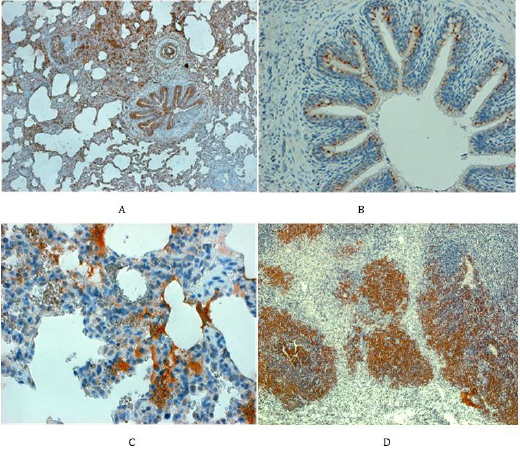
Journals on Microbiology Research

Free-Breathing 10-Min Cardiac MRI Protocol at 3.0t: Single-Center Experience

Introduction

Cardiovascular magnetic resonance (CMR) imaging has become an essential tool for the non-invasive examination of the heart. It has been used for the diagnosis, risk stratification, and prognosis of cardiac diseases [1,2]. Cine and late gadolinium enhancement (LGE) imaging are routinely included in the conventional cardiovascular magnetic resonance (CCMR) protocols in our center. Data acquisitions are typically performed with breath-holding (BH). While they work well in patients that are capable of holding their breath during image acquisition, such CCMR protocols remain challenging in patients with compromised BH capacities. In addition, the relatively long imaging time hinders the efficiency and throughput at a busy medical center like ours where there is a need to scan over 30 cardiac patients per MRI system per day. Real-time compressed sensing (CS) cine has been proved to be able to obtain high-quality images for evaluating cardiac function [3- 7]. Motion corrected (MOCO) single-shot LGE imaging techniques can also produce high-quality images without BH to detect fibrotic myocardial scars [8-9]. The novelty in this work is that both methods (CS cine and MOCO-LGE) are in corporate for a comprehensive FB CMR study. The feasibility and potential clinical utility of the proposed protocol were evaluated in patients that were unable to hold their breath during CMR imaging and in patients who could hold breath well.

Materials and Methods

Subject Enrollment

After the institutional review board approval was granted, adult patients scheduled for CCMR imaging were prospectively recruited for this study from February 1, 2017 to June 30, 2019. The inclusion criteria were as follows: in-patient at our hospital scheduled for contrast-enhanced CMR examination, a glomerular filtration rate of ³30 mL/min per 1.7m2, and no contraindications for CMR imaging. All patients who received FCMR protocols signed informed consent. A total of 148 patients were selected to complete both CCMR and FCMR protocols examination. These patients were divided into two groups,

a) Group 1, 111 patients with good BH;

b) Group 2, 37 patients with bad BH. The average age of these patients was 59 ± 16 years, with a male/female ratio of 90/58.

The CMR Imaging Protocol

CCMR and FCMR scans were performed on a 3 Tesla (T) clinical magnetic resonance imaging (MRI) scanner (MAGNETOM Skyra, Siemens Healthcare, Erlangen, Germany). The system was equipped with an 18-element body array coil and a 32-element spine array coil. Key sequences for the CCMR included:

a) BH-cine imaging with segmented, balanced steady-state free precession (BSSFP) readout;

b) BH-LGE sequence for viability imaging under breath-hold using segmented, fast low-angle shot (FLASH) readout and phase-sensitive inversion recovery (PSIR) reconstruction.

The primary FCMR protocols included:

a) Single-shot FB-CS-cine imaging with BSSFP readout, featuring a two-dimensional sparse data sampling and iterative reconstruction (SSIR).

b) FB-MOCO-LGE employs non-rigid motion-correction and averaging of multiple single-shot SSFP images with PSIR reconstruction.

c) The BH-cine, FB-CS-cine, BH-LGE, and FB-MOCO-LGE protocols comprised separate 2-, 3-, and 4-chamber long-axis (LAX) acquisitions, and a short-axis (SAX) stack covering the entire left ventricle (LV). All scans were started from running BH CCMR protocols, when the CCMR protocols were successfully finished, FCMR protocols were began. Intravenous gadolinium diethylenetriamine pentaacetic acid (Gd-DTPA) contrast agent was administered at a dose of 0.2 ml/kg of body weight. For all exams, the contrast agent was administered to each patient in one injection.

biomedres-openaccess-journal-bjstr

Figure 1: The workflow for the breath-holding (BH) conventional cardiac magnetic resonance imaging (CCMR) protocol and free-breathing cardiac resonance (FCMR) protocol. Abbreviations: HASTE, Half-Fourier-Acquired Single-shot Turbo spin Echo; MOCO, motion-corrected; LGE, late gadolinium enhancement; CS, compressed sensing.

The CMR protocol workflows is illustrated in Figure 1. Detailed information regarding the sequence parameters of both protocols is shown in Table 1. Both protocols were conducted using semiautomated cardiac day optimizing throughput (DOT) engine software including Auto Align feature to automatically prescribe the 2-, 3-, and 4-chamber views as well as the short axis stack [4,10]. Scan parameters like trigger delay were automatically adapted to patient physiology such as patient heart rate. The scanning time of every sequence and the total time of every protocol was write down, every two sequence intervals time was not included in the total time. Acquisition time, IQ were compared between the two protocols. The consistency of the two methods in diagnosis, LVF measurement and scar presence/absence was analyzed.

biomedres-openaccess-journal-bjstr

Table 1: CCMR and FCMR protocols’ imaging parameters.

Image Analysis

Image Quality: All CMR images were transferred to a workstation (cmr42, Version 5.12.1, Circle Cardiovascular Imaging, Calgary, Canada) for evaluations. For those 148 patients where both FCMR and CCMR images were acquired, FCMR and CCMR were randomly assigned to two senior doctors, Reader 1 and Reader 2, both with more than 5 years of experience in CMR reading, for double-blind evaluation respectively. Image quality scores were evaluated based on a five-point Likert score (5 = excellent, 4 = good, 3 = the presence of artifacts but acceptable, 2 = poor, and 1 = non diagnostic) [6-8].

Imaging Analyses: LVF measurements were assessed with cmr42 software. Endocardial and epicardial contours were automatically delineated on the short-axis cine images using the cmr42 software and manually adjusted as needed [11]. Papillary muscles and trabeculations of the left ventricle (LV) were included in the ventricular cavity volume measurements. Ejection fraction (EF), end-diastolic and end-systolic volumes (EDV and ESV), stroke volume (SV), and LV end-diastolic mass (LVEDM) measurements were accessed from the cine images acquired in both protocols, and the consistency of measurements between both protocols was analyzed by using linear regression analyses and Bland-Altman plots. If LGE involves the sub endocardial distribution of coronary artery, it can be identified as ischemic LGE type; otherwise, it can be identified as non-ischemic LGE [12,13].

Statistical Analyses: Statistical analyses were performed using dedicated SPSS (version 20.0, SPSS Inc., Chicago, USA) and MedCalc10.0 (Med Calc Software, Ostend, Belgium) software. Continuous data were checked for normality using the Shapiro-Wilk test and presented as the mean ± standard deviation or median (interquartile range, Q1–Q3), and compared using the T test or Mann-Whitney test. The FB-CS-cine and BH-cine imaging were compared using Bland-Altman. Intra class Correlation Coefficient (ICC) were used to evaluate the consistency of quantitative data. The Kappa statistics were used to evaluate consistency of qualitative variable. Agreement strengths for kappa values were classified as follows: <0.1, poor; 0.1 to 0.20, slight; 0.21 to 0.40, fair; 0.41 to 0.60, moderate; 0.61 to 0.80, substantial; and 0.81 to 1.00, almost perfect. P <0.05 was considered statistically significant.

Results

Image Acquisition Times

The total time of the FB-CS-cine SAX (25±5)s, FB-CS-cine LAX (8±2)s, FB-MOCO-LGE SAX (120±19)s, FB-MOCO-LGE LAX (37±6) s was significantly shorter than that of the BH-cine SAX (340±30) s, BH-cine LAX (75±16)s, BH-LGE SAX (331±29)s, BH-LGE LAX (100±9)s respectively, (all P-values < 0.001).The total time of the FCMR was significantly shorter than that of the CCMR protocol [(10.8 ± 0.6) minutes vs. (35.5 ± 2.9) minutes, P<0.001].

Imaging Analyses in the Group 1

IQ was significantly better in the BH-cine images compared to the FB-CS-cine images [5 (4-5) vs. 4 (3-4), P<0.001]. However, IQ was significantly better with FB-MOCO-LGE compared to BH-LGE [5 (4-5) vs. 3 (3-4), P <0.001]. When the cine and LGE scores were averaged, they were 4 (3-5) for the CCMR protocols, and 4 (3-5) for the FCMR protocols, no differences were seen in IQ between the CCMR and FCMR protocols (P = 0.623). Figure 2 showed images from patients with good BH cooperation acquired with both excellent CCMR and FCMR images. The comparison of LVF parameters between BH-cine and FB-CS-cine is as follows: LVEDV (ml) [ 161.7 ± 88.5 vs. 160.5 ± 90.4, P = 0.828], LVESV(ml) [ 90.8 (74.5 ± 107.1) vs. 91.6 (75.2 ± 107.9), P = 0.962], LVSV(ml) [ 70.8 ± 25.9 vs. 69.8 ± 25.7, P = 0.920], LVEDM(g) [ 161.6 ± 64.8 vs. 162.0 ± 65.3, P = 0.939], LVEF(%) [50.2 ± 18.6 vs. 49.3 ± 18.1, P = 0.685]. There was high consistency (ICC, 0.94-0.98) between BH-cine and FB-CS-cine for LVF evaluations. The Bland-Altman statistical method was used for intergroup bias analysis Figure 3.

biomedres-openaccess-journal-bjstr

Figure 2: Both conventional cardiovascular magnetic resonance (CCMR) late gadolinium enhancement (BH-LGE) images including breathing hold (BH) cine and BH and late gadolinium enhancement (LGE) sequences corresponding free-breathing cardiac magnetic resonance (FCMR) protocol including free-breathing (FB) cine and motion-corrected (MOCO) LGE sequences were excellent in patients with good breathing hold (BH).

biomedres-openaccess-journal-bjstr

Figure 3: Bland-Altman plots for left ventricle (LV) functional parameters in breath-hold cine MRI and free-breathing compressed-sensing cine MRI derived a cohort of 111 patients. A, LV ejection fraction (LVEF); B, LV end-diastolic volume (LVEDV); C, LV end-systolic volume (LVESV); D,) LV stroke volume (LVSV); and E, LV end-diastolic myocardial mass (LVEDM).SD= standard deviation.

The mean differences in LVF measurements between BH-cine and FB-CS-cine were as follows: LVEDV, 1.1 ml (95 % CI: -24.7 to 22.5 ml); LVESV, -0.8 ml (95% CI: -23.7 to 22.1ml);LVSV,1.8ml(95% CI: -5.0 to 8.7 ml); LVED mass, -0.4 g (95% CI: -17.5 to 16.8 g); LVEF, 0.9% (95 %CI: -5.7 to 4. 0 %). There was high consistency (kappa, 0.89) between BH-LGE presence 55.9% (62/111) and FBMOCO- LGE 54.1 % (60/111). All the 111 patients with suspected heart disease were diagnosed by CCMR as following: 18 patients were diagnosed as myocardial infarction; 40 patients were dilated cardiomyopathy; 23 patients were hypertrophic cardiomyopathy; 6 patients were hypertensive cardiomyopathy; 5 patients were restrictive cardiomyopathy; 1 patients were right ventricular cardiomyopathy; 1 patients were myocardial amyloidosis; 2 patients were non-compaction of the ventricular myocardium; 4 patients were myocarditis; 1 patient was pericarditis; 5 patients were atrial or ventricular septal defect; 1 patient was myxoma; In addition, 65 patients had some of the above cardiomyopathy combined with valve insufficiency.

There were 6 patients without any heart disease. All the 111 patients with suspected heart disease were diagnosed by FCMR as following: Among the 5 cases of CCMR trial or ventricular septal defect, 2 cases was positive and 3 cases were negative by FCMR. Among 65 cases with valvular insufficiency by CCMR, 39 cases were positive and 26 cases were negative by CCMR. The two diagnostic methods were completely consistent in the remaining patients. The diagnostic consistency of the two protocols was 0.56 for atrial or ventricular septal defect, 0.55 for valvular insufficiency, and 0.86 for all patients. Figures 4 & 5 show some cases with bad BH cooperation got both non-diagnostic CCMR but diagnostic FCMR.

biomedres-openaccess-journal-bjstr

Figure 4: Images of a patient with an uncertain diagnosis on conventional cardiovascular magnetic resonance (CCMR) imaging (a1-h1). IQ of 2-chamber short axis (LAX) breath-holding (BH)-cine was excellent, however, 2 chamber and 3 chamber long axis (LAX) BH-cine images (c1, d1) and BH-late gadolinium enhancement (BH-LGE) images (e1-h1) were poor. On free-breathing cardiac magnetic resonance (FCMR) imaging, FB-CS-cine images (a2-d2) and motion-corrected (MOCO)-LGE images (e2-h2) were all excellent. LGE appeared at Left ventricular free wall on the MOCO-LGE images (e2-h2).

biomedres-openaccess-journal-bjstr

Figure 5: Images show a few cases with various cardiac diseases acquired with breath-holding (BH)-LGE and corresponding free-breathing motion-corrected (MOCO)-late gadolinium (LGE). Some patients with bad BH cooperation had non-diagnostic BH LGE images (a1-d1) but diagnostic FB-MOCO-LGE images (a2-d2).

Imaging Analyses in the Group 2

In group 2, of those 37 patients with BH limitation, IQ was significantly worse in the BH-cine images compared to the FB-CScine images [3 (2-4) vs. 4 (3-4), P <0.001]. IQ was also significantly worse with BH-LGE compared to FB-MOCO-LGE [2 (1-2) vs. 5 (4- 5), P <0.001]. When the cine and LGE scores were averaged, the IQ of CCMR was significantly lower than that of FCMR [2 (2-3) vs.4 (3-5), P <0.001]. The consistency was low for the LGE presence (Kappa, 0.32), LVF assessment (ICC, 0.57-0.87) and the diagnosis (Kappa, 0.047). There were 24 patients with limited BH capabilities had inconclusive results with the CCMR protocol, but definitive diagnoses were made with the FCMR protocol. The diagnosis rate of FCMR was significantly higher than that of CCMR [94.6% (35/37) vs. 29.7% (11/37), P <0.001].

Discussion

The purpose of the study was to explore the feasibility of clinical utility of a FCMR imaging protocol at 3.0T. The results showed that FCMR and CCMR protocols had comparable image quality ratings, left ventricular function assessment, myocardial scar detection and heart disease diagnosis when both protocols were successfully obtained. The total acquisition time of FCMR including FB-CS-cine and FB-MOCO-LGE was significantly shorter than that of the CCMR including BH-cine and BH-LGE. Furthermore, our results showed that the FCMR protocols could get robust images even in patients with limited BH capabilities. In our study, the total acquisition time of FCMR was significantly shorter than that of the CCMR protocol. The CCMR imaging protocol requires multiple breath-holds to provide diagnostic image quality [14,15]. Generally, each BH takes 8-15 seconds per slice, with an additional pause that lasts 10 seconds before the next breath-hold session. So, the CCMR protocol needs longer scanning time than the FCMR protocol. Such repeated and long BH requirements can be challenging for patients who cannot hold their breath for extended periods.

Also, to achieve sufficiently high spatial and/or temporal resolutions during CCMR imaging, segmented k-space data are acquired over multiple heartbeats. Such segmented acquisition is prone to motion artifacts that could lead to repeated scans in case of suboptimal breath-holding. In our clinical setting, a few of the patients were unable to complete the CCMR examinations due to impaired BH capacity. The FCMR protocol not only removes the BH barrier which is particularly important for scanning most vulnerable patients with compromised BH capability, it also improves the scan efficiency. In addition, single-shot readout effectively eliminates breathing motion artifacts in both FB-CS-cine and FB-MOCO-LGE images [14-16]. High quality images were acquired for cine with CS acceleration, the high image quality of the CS technique translated into high agreement for left ventricular function. Also, high quality images were acquired for LGE by combining non-rigid MOCO and averaging of multiple single-shot measurements.

For patients with good BH, they can well cooperate with breath holding, high agreement between the BH and FB MOCO technique was also achieved for LGE, with a non-significant difference of LGE presence or types. Our study found that there was no difference in LVF calculation and LGE detection between CCMR and FCMR images obtained from 111 patients without BH impairment, which was consistent with previous studies [3-5,7-9]. Moreover, the consistency of the two protocols for the diagnosis of myocardial infarction and cardiomyopathy was excellent, although the consistency of the two protocols for detecting the atrial or ventricular septal defect and valvular insufficiency was moderate. However, we observed that FB-CS-cine scans sometimes lead to a little of image blurring and low spatial resolution, and the IQ in FB CS cine was lower than that of BH cine. In addition, CS cine of the FCMR protocol was worse than the segment cine of the CCMR protocol in the recognition of valve insufficiency and atrial septal or ventricular septal defect. There were some reasons for these phenomena as following [17].

First, FB-CS-cine was susceptibility for fold over artifacts, therefore, the field of view must cover the entire anatomy, and thus, some penalty in spatial resolution may occur in relation to the patient’s anatomy. Second, in some scans, flow-related artifacts occurred in the phase-encoding direction during systole because the sparsity in the temporal domain may be limited in anatomic regions of very high flow. Lastly, the contrast between myocardium and blood pool in FB CS cine images was not as good as that of the BH cine images.

Overall, FCMR imaging leads to consistent images for diagnosis in all patients, regardless of whether they could hold their breath or not. In comparison, the IQ of CCMR depends on the BH capability of a patient during data acquisition. For patients with BH impairment, CCMR images suffer from severe motion artifacts, interfering the radiologist’ ability to interpret morphologic cardiac structures, cardiac function calculations, and LGE detection. FCMR has been shown to be an effective alternative to CCMR in this study, expanding the application range of CMR imaging. There were several limitations to this study. First, the current study assessed FCMR and CCMR scans in patients with various cardiac diseases, complicating the comparison of the two protocols. Secondly, no advanced MRI sequences, such as mapping, perfusion, and flow quantification were performed in the study since they are not part of the standard CMR protocols at our institution. Finally, the consistent of myocardial strain between BH-cine and FB-CS-cine, and scar volume between BH-LGE and FB-MOCO-LGE was not assessment. The encouraging results from this study warrants future study with a larger sample size to demonstrate the clinical utility of free-breathing.

Conclusion

In conclusion, we demonstrated that FCMR imaging could be used as an alternative technique in patients with BH impairment to obtain high-quality images. FCMR significantly shortens the time needed for CMR imaging and resulted in improved image quality. We believe that the FCMR protocol will allow the fast screen of cardiac diseases in clinical practice, with the potential to increase both the throughput and robustness of CMR.

For More Articles: Biomedical Journal Impact Factor: https://biomedres.us
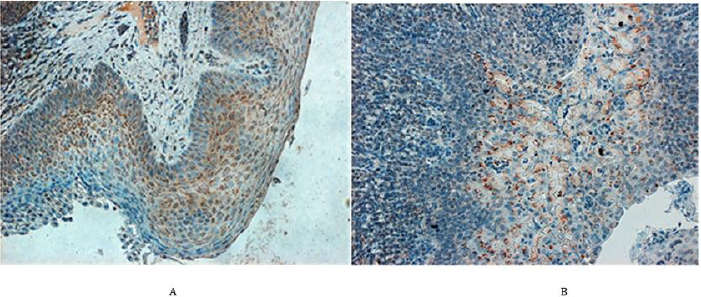
Open Access Journals on Microbiology Research

Lymphoma Masquerading as Chondrosarcoma: The Importance of Bone Biopsy Prior to Definitive Treatment

Introduction

Enchondromas are common, benign cartilage tumors that typically present as solitary lesions of long bones [1]. They begin growth in childhood, from chondroblasts and fragments of epiphyseal cartilage that leave the growth plate and subsequently proliferate within the marrow space. They are typically asymptomatic but can occasionally cause bone pain or pathologic fracture [2]. They carry an approximately 1% lifetime risk of malignant degeneration to chondrosarcoma [3]. When this occurs, they often transform to Grade 1 chondrosarcoma or dedifferentiated chondrosarcoma, and this diagnosis is challenging to make. Atraumatic development of deep bone pain is the most common suggestive symptom [3]. Radiographic features suggesting transformation are endosteal scalloping, cortical thinning and expansion, and intralesional lysis beside/replacing the well-calcified enchondroma [4-6]. En chondromas and Grade 1 chondrosarcomas are both treated effectively with intralesional curettage and an adjuvant to decrease local recurrence.

Due to the identical treatment methodology and the sampling error that exists when performing needle biopsy of cartilage tumors, some surgeons advocate against biopsy as a means to distinguish enchondroma from Grade 1 chondrosarcoma. Instead, they rely solely on radiographic findings and symptomatology to indicate surgical intervention [7]. Degeneration to a higher grade chondrosarcoma is suggested by frank cortical destruction, soft tissue mass formation, and extensive bone edema. Intermediateand high-grade chondrosarcomas are treated with wide en bloc excision.

Considerably less common are primary and secondary bone lymphomas. Diffuse large B cell lymphoma (DLBCL) comprises 70- 80% of all bone lymphomas and often presents with painful lytic bone lesions, which can be subtle and nonspecific. Occasionally, these lesions can be misdiagnosed as benign or malignant primary bone tumors. Therefore, clinical-radiological suspicion of bone lymphoma must be confirmed with histopathology.

Making this distinction is of utmost importance, as treatment of primary and secondary bone lymphomas differs greatly from treatment of primary bone malignancies such as chondrosarcoma [8]. Chemotherapy and potential radiotherapy are the gold standard treatments for DLBCL and can be curative [9], while cartilage tumors are surgically treated [8]. We present the case of a 58-year-old woman who presented with a painful right proximal tibia bone lesion, demonstrating a lytic area surrounding a wellcalcified enchondroma. Suspicion for secondary chondrosarcoma was high. The lesion underwent biopsy which revealed aggressive DLBCL, not chondrosarcoma, drastically changing the anticipated treatment. The patient was informed that data concerning the case would be submitted for publication, and she provided consent.

Case Presentation

A 58-year-old woman presented for evaluation of unilateral proximal tibial pain. Plain radiographs showed an intramedullary lesion within the proximal tibial metaphysis, with stippled calcification and intralesional/perilesional lysis, concerning for malignant degeneration of benign enchondroma to chondrosarcoma (Figure 1). MRI demonstrated an area of T2 hyperintensity and post-contrast enhancement surrounding the calcified tumor, with cortical thinning, further suggesting transformation of an enchondroma to chondrosarcoma (Figure 2). An open biopsy with frozen section of the right proximal tibia was performed, with the plan being to perform intralesional curettage with adjuvant treatment if low grade cartilage tumor was found. If higher grade malignancy was detected on frozen section, the plan would be to abort further excision at that time and defer to permanent section which would dictate further oncologic treatment. Frozen section indeed demonstrated a high-grade malignancy with sheets of blue cells that was not consistent with cartilage neoplasm. Additional tissue was sent for biopsy and flow cytometry, hemostasis was achieved, and the wound was closed at that time.

biomedres-openaccess-journal-bjstr

Figure 1: AP and lateral plain radiographs of right knee, demonstrating bone lesion in proximal tibia with calcifications in center, surrounded by lucency.

biomedres-openaccess-journal-bjstr

Figure 2: T1 sagittal MRI (a, left panel), T2 fat saturated sagittal MRI (b, right panel), and T1 fat saturated postcontrast axial MRI (c, bottom panel) demonstrating cartilaginous tumor surrounded by enhancing bone lesion and associated cortical thinning.

Permanent pathology indicated aggressive large B-cell lymphoma with germinal center derived phenotype, characterized by BCL6 gene rearrangement. A bland appearing hyaline cartilaginous lesion consistent with enchondroma was also noted among the biopsied tissue. A PET scan was obtained to evaluate the extent of her systemic involvement, which revealed extensive involvement of multiple lymph nodes in the axillary, supraclavicular, pelvic, and iliac regions, consistent with diffuse involvement of lymphoma (Figure 3). Six cycles of R-CHOP with radiation were planned. Her care was subsequently transferred to another medical center due to insurance issues and she was initiated on this program at the new facility. Shortly thereafter, the patient presented to the outside medical center for a bone marrow biopsy and port placement but was admitted due to hypoxia and hypercalcemia. She was diagnosed with pneumonia and cardiac tamponade and therefore underwent a cardiac window. After this, she completed her initial cycle of R-CHOP. During her hospital stay, she developed metabolic abnormalities, tumor lysis syndrome with subsequent acute kidney injury, as well as neutropenia status post chemotherapy. Soon after, she developed Pseudomonas urosepsis and shock, requiring intensive care. Her family was contacted, and comfort care was initiated. The patient passed away shortly thereafter.

biomedres-openaccess-journal-bjstr

Figure 3: Coronal PET scan image demonstrating multiple areas of intense abnormal hypermetabolism in the neck, right clavicle, mediastinum, and the nodes of the right supraclavicular, left axilla, chest wall, and pelvic/iliac basins; consistent with diffuse involvement in lymphoma.

Discussion

The differential diagnosis for an adult patient with a painful new bone lesion is broad. Plain radiographs are a quick and easy way to evaluate the patient’s condition, but this case report demonstrates the importance of tissue biopsy prior to definitive management of a bone tumor. The argument surrounding bone biopsy is not a recent development. In his study from 1982, Dr. Henry Mankin emphasizes the importance of a technically sound biopsy and highlights several pitfalls that can pose challenges to surgeons [10]. It is an inherently difficult yet invaluable procedure. Non-representative sampling can lead to errors in diagnosis, and poorly planned biopsies can lead to poor outcomes including amputation. Intramedullary tumors composed of cartilage matrix are still prone to sampling error [11].

With these considerations in mind, some surgeons today do not perform biopsies for tumors that have strong clinical and radiographic evidence to support chondrosarcoma diagnosis. Often, these cases suggest intermediate- or high-grade chondrosarcoma due to pain symptoms, an associated soft-tissue mass, endosteal scalloping, and aggressive radiological findings [12]. Therefore, these practitioners will rely heavily or exclusively on radiographic characteristics and clinical judgment, skipping biopsy and proceeding directly to wide en bloc excision. This patient’s presenting imaging studies were extremely concerning for high-grade malignant degeneration of a previously benign enchondroma of the proximal tibia; imaging showed intralesional lysis and bony destruction beside an area of calcified cartilage matrix, with marrow edema and enhancement. It is the authors’ opinion that, depending on their level of concern, many surgeons would have recommended definitive proximal tibia resection and endoprosthetic reconstruction based on these imaging findings suggestive of high-grade chondrosarcoma, and not learned of the true lymphoma diagnosis until several days postoperatively. Diagnosing this bone tumor as lymphoma was shocking and humbling to the surgeon, demonstrating that clinical suspicion can be gravely wrong and that rarities such as DLBCL arising within/ around an enchondroma do occur.

Mankin et al. supports the belief that a carefully performed and uncomplicated biopsy is essential to the operative treatment and control of disease despite potential biopsy dangers, suggesting that the benefits of biopsy far outweigh the considerable risks [10]. This case supports this argument that all suspected malignant bone lesions should be biopsied prior to definitive treatment, even those that are traditionally thought to be diagnoseable on imaging studies. If the surgeon in this case had empirically treated the patient with orthopaedic oncologic surgery based on the suspicion of highgrade chondrosarcoma, the patient would have been exposed to the considerable perioperative risks of unnecessary tibial resection and reconstruction, as well as a delay in systemic treatment for lymphoma. While chemotherapy in this patient unfortunately did not prolong life due to her comorbidities, the extent of her disease, and toxicity, the importance of biopsy cannot be understated.

For More Articles: Biomedical Journal Impact Factor: https://biomedres.us
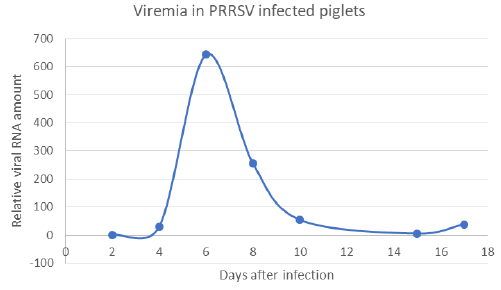
Open Access Journals on Cancer Research
Re-Irradiation Spine SBRT in Oligoprogression Breast Cancer: A Case Report

Introduction

The clinical state of oligometastases was first described by Hellman and Weichselbaum in the 1990s [1]. They suggested that there is an intermediate tumor stage between localized lesions and the widespread metastatic disease and proposed the concept of “oligometastatic disease” (OMD). Some studies have described OMD as a maximum of five treatable lesions. Recently, Guckenberger M, et al. redefined a new OMD classification system [2]. SBRT has experienced exponential development in recent years, as its ablative capacity has demonstrated a benefit in certain patients including OM and OP patients [3]. Oligoprogression is a limited tumor progression in some tumor sites with continued response or stable disease in other sites. SBRT allows the administration of high antitumor biologically effective doses. There are different dose fractionation schemes used depending on the anatomical location, size and tumor histology, among other factors. In general, the most common fractionation used in SBRT is over 6 Gy per fraction delivered 1-5 fractions. The radical treatment of metastatic lesions includes surgery, radiation therapy and combination therapies.

Case Presentation

We present a case of a 59-year-old woman with a history of infiltrating metastatic ductal carcinoma of the right breast. The subtypes of ER negative, PR 50%, Her2+ and ki-25% were identified at the time of diagnosis in March 2013. CT revealed multiple pulmonary and hepatic metastases. Prior to the diagnoses, the patient started systemic treatment with Navelbine given orally + Herceptin. Following two years with stable disease, on 15 January, CT revealed the progression of a unique bone metastasis of the vertebral column on vertebra T3. MRI confirmed the bone metastasis on the T3 right lateral vertebral body with bulging of the medullary canal. Given the oligoprogression of the disease, a radical treatment with SBRT was performed until reaching a dosage of 18 Gy in a single fraction of the T3 vertebral body at Hospital Vithas del Consuelo. The spinal cord received a maximum dose (Dmax, 0.01 cc) of 5.7Gy. Following treatment with SBRT, systemic treatment with Navelbine given orally and Herceptin resumed. In February 2019, follow up with CT indicated local progression of the previously treated lesion on vertebra T3. An MRI was performed showing an osteolytic lesion in T3 affecting the body, pedicle, and right lamina, with an extradural tumor mass occupying the spinal canal in 50% of T3 and medullary compression/deviation from right to left (Figure 1). Based on these findings, the tumor in the spinal canal was resected, with subsequent post-operative SBRT on the surgical site.

biomedres-openaccess-journal-bjstr

Figure 1: These images represent vertebral metastases before SBRT.

a) Saggital plane MRI before treatment.

b) Axial plane MRI before treatment.

On 1 March 2019, the extradural intra-spinal tumor mass was resected, decompressing the spinal cord and separating it from the surgical site using two Teflon sheets (the sheets surrounded the thecal sac). The postoperative period was without complications. After the resection, on 25 March 2019, SBRT was performed on the surgical site of the D3 vertebra. Fixation and immobilization were carried out using a body stereotaxic frame (BodyFix®, Elekta). The simulation was performed by CT and MRI. IRMT was used with stereotaxic coordinates on the tumor bed until reaching a dosage of 18 Gy in a single fraction (Figure 2). The spinal cord received a maximum dose (Dmax, 0.01 cc) of 7.3Gy. Following treatment with SBRT, the patient resumed systemic treatment with Navelbine given orally and Herceptin resumed. As of the last follow-up on 25 October 2021, the patient remained stable, with no evidence of local or distant progression.

biomedres-openaccess-journal-bjstr

Figure 2: Patient’s planning image with dose distribution.

Discussion and Results

Breast cancer (BC) is the most common cancer in women, with 2,26 million estimated new BC cases worldwide in 2020 [4]. Bone is the most common site of metastasis for BC [5]. Nevertheless, metastasis confined to the bone have a more favorable prognosis than other types of distant metastasis [6]. As we previously mentioned, SBRT and its ablative ability offers a greater tumor control compared to conventional palliative radiotherapy (CPR) [3]. A non-systematic review has been carried out on the topic of SBRT targeting oligometastases in BC. Table 1 summarizes the publications reviewed from PubMed database within the last 10 years. The potential benefit of SBRT in oligometastatic BC has increased the evidence supporting local control (LC), overall survival (OS) and progression free survival (PFS) in these patients. After this review, 12 articles were included, four of them were randomized clinical trials (RCT) [3,7-9], 2 were prospective studies [10,11] and 5 were retrospective studies [12-17]. The sample size is remarkably different among studies ranging from 22 to 227 patients. The follow-up is also distinct ranging from 17 to 73 months. Furthermore, 6 out of 12 articles include multiple histologies [3,7,10,12-14]. LC after SBRT is achieved in 60 to 100% of the cases [10,11], and OS varies from 24 to 50 months [3,18]. When focusing on studies including only BC patients [8,15,9,11,16,17] LC varies from 73% to 100% [8,11].

biomedres-openaccess-journal-bjstr

Table 1: A review of the different retrospective and prospective trials of SBRT in oligometastases breast cancer.

OS median ranges from 28 to 50 months and it was not reached in one of the studies [8]. PFS varies from 38 to 81% [15,9,16,17] and 2-year PFS from 17,3 to 65% [3,11]. A single study included exclusively bone lesions (47% spine metastases) in BC patients [11]. This prospective study reports up to 100% LC rates and a 2-year PFS of 65% of bone metastases treated with radiosurgery (20Gy in 1 fraction) [11]. Milano M et al. demonstrated a better LC (100% vs. 73%), OS (not reached vs 38 months; p=0.002) and PFS (75% vs 42%) after the treatment of extracranial bone lesions compared to those not involving the skeleton (adrenal gland, liver, lung or lymph nodes) [8]. Other authors also report differences in terms of LC depending on the target [3]. Palma et al. reported an improvement in LC (46% vs 63%; p<0.05) and OS (28% vs 50%; p<0.05) after SBRT to all metastatic sites compared to CPR standard-of-care in oligometastatic patients. No increase in toxicity was observed after SBRT [3]. In this context, Sprave and collegues showed no detriment in the quality of life (assessed through QOLBM22, QLQ FA13 and QSC-R10) following SBRT compared to CPR in vertebral metastatic lesions [19]. Grade 3 or higher toxicity reported in the articles reviewed ranges from 0% to 9%. In patients with spinal instability, cord compression, or neurologic deficits, the standard of care is surgery followed by radiation therapy.

Some authors report excellent results with the use of SBRT in patients who have undergone surgical intervention for spine metastases [19,20]. Separation surgery, as our case, refers to providing sufficient surgical circumferential decompression of the spinal cord to create at least 1–2 mm of space between the spinal cord and disease to optimize the SBRT dose distribution. SBRT in oligometastatic patients shows favorable results. In our patient, after radical surgical treatment and SBRT, a complete response was achieved. After more than two years of follow-up the patient remains with neither local nor distant recurrence. Finally, we have to consider that the studies reviewed show heterogeneity both in the target location and treatment site (lung, liver, bone…). Owing to the limitations mentioned above, few robust conclusions can be drawn to the date. There are currently several ongoing clinical trials, such as NRG BR002 (NCT02364557), AVATAR (ACTRN12620001212943) [21] or STEREO-OS (NCT03143322) [19], that will provide more data in relation to the SBRT in oligometastatic BC patients [22,23].

Conclusion

Patients with oligometastatic or oligoprogressive breast cancer are candidates for radical treatment modalities. SBRT has demonstrated promising LC, PFS and OS in these patients with an acceptable toxicity. In this context, there are currently ongoing phase III studies in order to provide stronger evidence.

For More Articles: Biomedical Journal Impact Factor: https://biomedres.us