Biomedical Journal of Scientific & Technical Research (BJSTR) is a multidisciplinary, scholarly Open Access publisher focused on Genetic, Biomedical and Remedial missions in relation with Technical Knowledge as well.
Human Health and Sustainability Depend on Diverse Ecological Environments- Monitoring of Flora and Flowering Phenology in Huajiang Wildduck Natural Park
Introduction
With the expansion of cities, the rise of power plants, and the improvement of living standards, many people can sit in well-airconditioned and elegantly decorated restaurants and eat delicious food made with ingredients from afar, but there is another group of people in the world facing poverty, hunger and disease. Their humble homes cannot resist natural disasters, and they do not have good job opportunities. They can only cultivate barren or contaminated farmland, or overwork in dangerous mines and factories. According to the United Nations’ Sustainable Development Goals (SDGs), 15 items are terrestrial ecology, emphasizing the importance of biodiversity. Human health and sustainability depend on diverse ecological environments Huajiang Wild Goose and Duck Nature Park” is located under the Huajiang Bridge in Wanhua District in the southwestern corner of Taipei City. The total area is about 28 hectares. It belongs to the category of Dahan-Xindian Wetland. In 1991, the Taipei City Industrial Development Bureau set up interpretive facilities in this area and set up the “Goose Duck Park” to introduce conservation concepts into the park’s management [1- 4]. It was officially renamed “Huajiang Wild Goose Natural Park” in 1996. The Huajiang Wetland Conservation Alliance started its environmental monitoring activities in 2007, so that more people who love ecology and value the environment will come to participate in wetland ecological monitoring and protection activities and build knowledge of the local environment through the process of participation. Improve emotional recognition of Huajiang Wetland.
Research Location
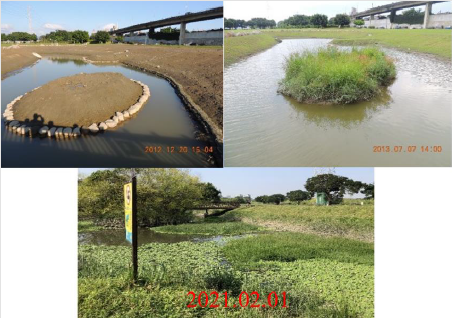
With Huajiang Bridge as the boundary, it is divided into north and south regions, and then divided into artificial grassland, short grass region, and long grass region according to the difference of the flora of the north and south regions, for a total of 6 sample stations. Artificial grassland: There are often human activities and regular artificial weeding. The vegetation is more complex, with low herb plants such as gooseberry, water centipede, and nightshade. The Moon Pond in Huajiang Wild Goose Natural Park has been completed since December 2012. The ecological island of the pond has been deserted. The area has been investigated and monitored without human intervention.
Methods
Before 2011, the survey method of the flora group was to set a crossing line and select a survey plot of 5m x 5m on the sample line. However, this kind of survey method is very hot in the unshaded wetland. After one or two times, no volunteers are willing to come. In response to this problem, the first author modified the plant sample area survey into plant phenology monitoring. After the operation, I found that the phenological survey is still too complicated for volunteers, so I had to simplify it and only focus on the species that bloom every month. The survey method is to survey once a month, dividing the Huajiang Bridge into two areas in the north and south, and then dividing it into artificial grassland, short grass area, and long grass area according to the plant phase. The crossing line through these three areas is used as the survey scope. Beginning in May of 2005, the species and quantity of plants will be recorded until 2019.From 2011 to the end of 2019, it will be carried out once a month by crossing the line and divided into 6 sample areas to investigate the flowering species of flowering plants.
Results
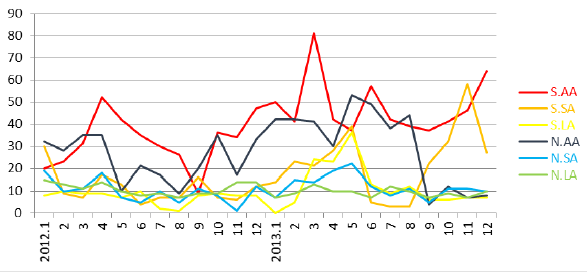
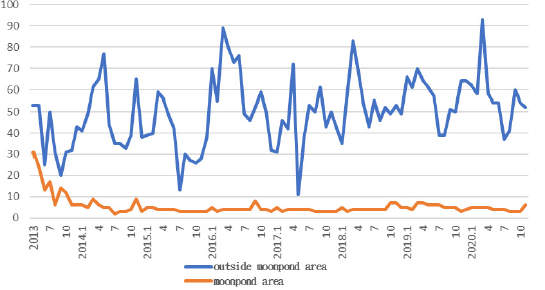
From 2011 to the end of 2019, Huajiang Wild Goose Nature Park has recorded a total of 262 species of vascular plants in 57 families, of which 44 species of Poaceae are the most, followed by 36 species of Asteraceae. Varieties of vascular plants in Huajiang Wild Goose Nature Park have changed since 2012.In the year, there were 199 species in 45 families. In the second year, it suddenly increased to 241 species in 46 families, an increase of 42 species in 1 family, and then by the end of 2019, it increased to 262 species in 57 families, and 21 species in 11 families (Table 1). The results also show that plants bloom every month. There are more plants in the southern area of Huajiang Bridge than in the northern area. The artificial grassland is the most, and the human disturbance is the largest. On the contrary, the species is taller than the short grass and long grass areas with less human disturbance (Figure 1).
Figure 1: Monthly change of flowering plants at 6 plots in Huaji ang Wild Goose Natural Park.
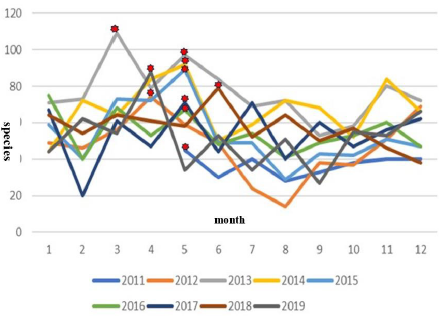
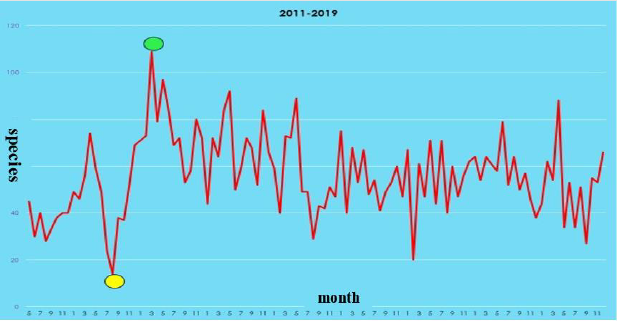
The rarer orchids, Spiranthes sinensis, Zeuxine strateumatica, and Eulophia graminea, are only found in artificial grasslands, and the flowering season is between March and April. The flowering species are unevenly distributed in the seasons. From 2012 to 2019, the most flowering seasons are 5 years in May, 2 years in April, and 1 year in March and June (Figure 2). The plants that bloom throughout the year are 6 species of Asteraceae, Youngia japonica, Eclipta prostrata, Bidens pilosa var. radiata, Ageratum conyzoides, Ageratum houstonianum, Wedelia triloba and Oxalis corniculata of Oxalidacaea. Around Moonpond, there are regular weeding. The most species month in 2014 was June, with 22 families and 77 species. The most frequent month in 2016 was April, with 23 families and 89 species. Among them, it was recorded in April 2020 (Figures 3-5).
Figure 2: 2011-2019 The most flowering month in Huajiang Wild Goose Natural Park ()
Figure 3: 2011-2019 Monthly changes of flowering phenology in Huajiang Wild Goose Natural Park(○Haikui typhoon)
Figure 4: Monthly Variations of Flowering Plants in Moon pond of Huajiang Wild Goose Natural Park.
Figure 5: Environmental changes of Moonpond.
Discussion
According to the survey results, March to April and November to December are the months with the most flowering plants. And the rarer orchids, Spiranthes sinensis, Zeuxine strateumatica, and Eulophia graminea, are only found in artificial grasslands, and the flowering season is between March and April. The competent authority should consider avoiding weeding during the months when flowering plants reproduce the most, moreover to maintain the flowering and reproduction of plants and protect the rarer plants from extinction. From 2012 to 2019, the typhoon had the greatest impact on the Huajiang Wild Goose Natural Park was the moderate Haikui typhoon on August 6, 2012, which caused the Huajiang Wild Goose Natural Park to be flooded to a depth of 3m, and the flooding time lasted than one week. (Figure 3) And there is nearly 1m high silt cover, the impact on flowering plants is only when the number of species decreased significantly in the month, only 14 species, and then the species gradually increased. By March 2013, 109 species of plants bloomed and reached the highest peak, which is the most month. This phenomenon is likely to be caused by the Haikui typhoon that brought many plant seeds from upstream in August 2012. The seeds gradually germinated, grew and bloomed. They reached the highest point in March 2013 and then gradually declined. The possible reason is adaptability. However, since only the Haikui typhoon has directly affected the Huajiang Wild Goose Natural Park in the past 9 years, whether this phenomenon is the norm under the influence of typhoons remains to be verified by the next typhoon directly affected. The monitoring results of the Huajiang Wild Goose Natural Park can provide the evidence of climate change. In the future, investigations of rare plants, such as the ethnic changes of orchids, should be strengthened. Under the influence of this increasingly violent climate change, it is imperative to create a biodiversity environment. Therefore, monitoring must continue. However, in addition to the enthusiastic support and participation of volunteers, monitoring also requires government support and financial subsidies.
Acknowledgement
This research monitoring case is grateful to Professor Li Zaiming of Cultural University, Dr. Chen Qidong, National Taiwan University Life Sciences Institute, Chen Jianwen, and Mr. Zhong Mingzhe of the Forestry Laboratory for their guidance and plant identification, and also to a group of people who are not fame and fortune, not afraid of the cold, the sun and the rain. plant group partners of Wetland Huajiang Wetland Guardian Alliance: Liu Jixiong, Huang Bingrong, Huang Jinyun, Chen Yanming, Zhang Yiting, Zheng Yingzhi, Huang Xincong and others have been able to complete the data that have been painstakingly recorded.
Declarations
All manuscripts must contain the following sections under the heading ‘Declarations’: • Ethics approval and consent to participate: Not applicable • Consent for publication: Not applicable • Availability of data and materials: Not applicable • Competing interests: Not applicable • Funding: Not applicable • Authors’ contributions: Data collection, literature review, manuscript writing • Acknowledgement: Not applicable.
Hand sanitizer also called antiseptic is a liquid or Gel type substance needed to kill various different germs including bacteria and viruses present on our external body surfaces. Hand hygiene is the single most important factor needed to control the spread of many contagious diseases. Routine hand hygiene with hand sanitizers is the single most effective way to prevent infections, especially in health care settings. Despite a lot of beneficial effects in daily life, it is not completely free of shortcomings. It is known to cause antibiotic resistance, dry skin, unsafe if ingested, and potential alternatives for alcohol abusers.
Editorial
Infectious diseases can spread from one person to another with contaminated hands. Therefore, Hand hygiene is one of the most important things needed today to prevent the spread of infectious diseases such as viruses or bacteria. The most widely used methods to prevent these infections are washing hands with soap and water or using alcohol-based sanitizers. Sanitizers may vary in their composition. According to World Health Organization [1], alcoholbased sanitizers are most effective compared to other methods of hand hygiene. Two formulations have been suggested to locally produce these products. One formulation includes (ethanol 96%, hydrogen peroxide 3%, glycerol 98%, and sterile distilled or boiled cold water) and formulation includes (Isopropyl alcohol 99.8%, hydrogen peroxide 3%, glycerol 98%, and sterile distilled or boiled cold water). Due to the presence of a significant amount of alcohol, these may be used as a substitute by alcohol abusers. In accordance with the Centers for Disease Control and Prevention, alcohol-based sanitizers are only effective if they contain at least 60% alcohol [2]. A 2013 study suggested; for highrisk individuals, ethanol-based sanitizers may be a substance of abuse and their access should be limited. However ethanolbased sanitizers were not considered as primary alternatives in alcoholics [3]. A 2015 study reported 385 total cases of hand sanitizer ingestion; 61% unintentional, 18% intentional misuse, and 10% miscellaneous. Most of them were younger males (potent abusers). However serious outcomes were not reported and cases were managed favorably [4]. In 2019 a case was reported in the New England Journal of Medicine, in which a 54-year-old man undergoing alcohol withdrawal ingested hand sanitizer (which contained 63% isopropanol) had access to hand sanitizer at his bedside which is commonly provided in health care settings for hygiene purposes [5]. In 2021 another case in Cureus journal was reported in which a 30-year-old male patient with alcohol use disorder was found intoxicated who was subsequently owning several bottles of sanitizers which gave a clue of his potential intoxication and withdrawal symptoms later. Therefore possible intervention should be applied in using these alcohol-based products in health care settings and their use should be limited for potential abusers. Hand sanitizers are the preferred way of protecting ourselves from the spread of such contagious diseases but steps should be taken to minimize their use as the potential choice of abuse. Washing hands with soap and water is the best alternative available for potential abusers as well as in health care settings.
today to prevent the spread of infectious diseases such as viruses or bacteria. The most widely used methods to prevent these infections are washing hands with soap and water or using alcohol-based sanitizers. Sanitizers may vary in their composition. According to World Health Organization [1], alcoholbased sanitizers are most effective compared to other methods of hand hygiene. Two formulations have been suggested to locally produce these products. One formulation includes (ethanol 96%, hydrogen peroxide 3%, glycerol 98%, and sterile distilled or boiled cold water) and formulation includes (Isopropyl alcohol 99.8%, hydrogen peroxide 3%, glycerol 98%, and sterile distilled or boiled cold water). Due to the presence of a significant amount of alcohol, these may be used as a substitute by alcohol abusers. In accordance with the Centers for Disease Control and Prevention, alcohol-based sanitizers are only effective if they contain at least 60% alcohol [2]. A 2013 study suggested; for highrisk individuals, ethanol-based sanitizers may be a substance of abuse and their access should be limited. However ethanolbased sanitizers were not considered as primary alternatives in alcoholics [3]. A 2015 study reported 385 total cases of hand sanitizer ingestion; 61% unintentional, 18% intentional misuse, and 10% miscellaneous. Most of them were younger males (potent abusers). However serious outcomes were not reported and cases were managed favorably [4]. In 2019 a case was reported in the New England Journal of Medicine, in which a 54-year-old man undergoing alcohol withdrawal ingested hand sanitizer (which contained 63% isopropanol) had access to hand sanitizer at his bedside which is commonly provided in health care settings for hygiene purposes [5]. In 2021 another case in Cureus journal was reported in which a 30-year-old male patient with alcohol use disorder was found intoxicated who was subsequently owning several bottles of sanitizers which gave a clue of his potential intoxication and withdrawal symptoms later. Therefore possible intervention should be applied in using these alcohol-based products in health care settings and their use should be limited for potential abusers. Hand sanitizers are the preferred way of protecting ourselves from the spread of such contagious diseases but steps should be taken to minimize their use as the potential choice of abuse. Washing hands with soap and water is the best alternative available for potential abusers as well as in health care settings.
Natural Patterns and Magnetic and Mental Processes of Coronavirus Activation and Neutralization
Introduction
The outbreak of coronavirus occurred simultaneously and almost synchronously in different countries. And this corresponds to the classical ideas of virology. Three waves of coronavirus exist from year to year at intervals of three months – three months – three months. There is a natural mechanism that can control such waves. June 22 is the day of the summer solstice, December 22 is the day of the winter solstice, September 22 and March 22 are the days of the autumn and spring equinox, respectively. Increasing and decreasing morbidity in humans is always close to these astronomical points. Statistics on heart attacks and strokes, and it turned out that non-communicable diseases have the same rise in mortality on the same dates. For other bacteria, streptococci and staphylococci, in these numbers all microflora is activated, which causes the corresponding diseases. Infections are usually transmitted under three conditions: a large dose of pathogen, quite close contact or epizootia – an outbreak of infection. Population density becomes additional stimuli for the high rate of infection. Viruses do not affect separately Chinese or representatives of other nations, viruses are apolitical and have no religion. They can adapt to any changes in the environment no worse than a person. The only thing to thank them for is the evolutionary perfection of the human immune system. For centuries, when any infection appeared, the human body produced antibodies and formed cellular immunity. When there are more than 30% of people with antibodies, we can say that the epidemic will end soon. Scientists have the opportunity to observe attempts by viruses to make a cross view transition thanks to laboratory tracking methods. The outbreak of epidemics is not an accident, but a combination of circumstances. And all of them are caused by changes in the environment. This is always a unique situation that occurs as a result of a change in the state of the environment, in which a person falls into new conditions of interaction with other species of animals. And today the anthropogenic impact on the environment has reached absolutely unmatched proportions compared to previous generations, in addition, man as a species is constantly growing. Waves of infectious diseases flare up in different countries at the same time. Now we have 80% delta, and before that there was a gamma, and before that the British strain. Each of the strains gives way to a new mutation. The evolution of viruses occurs just inside the human body, its living reservoir. The natural mechanism causes viruses to activate simultaneously and everywhere. In the spring of 2020, outbreaks of coronavirus were found on several warships in different parts of the world at once, and the ships were on the flight for a long time and the teams were isolated from everyone. Asynchronous incidence rises are caused by the influence of magnetic fields of natural origin. At the beginning of the last century, the famous scientist Chizhevsky studied dark spots in the sun and revealed the amazing synchrony of solar energies and their influence on terrestrial biological processes. Viruses have receptors that are simultaneously activated during this period. The pandemic is Covid-19 a direct consequence of the shift of the Earth’s magnetic poles. And the bigger the shift, the more waves the pandemic will have. Coronaviruses have been known since the 60s, there are several dozen of them, people are infected with them. Cases of COVID-19 disease are now recorded in all corners of the world. The activation of COVID-19 in humanity occurred right now. The pandemic Covid-19 reached MOSAIC’s unique Arctic scientific expedition in the fall of 2020, while a polar research vessel is locked in Arctic ice near the North Pole. In December 2020, the coronavirus reached the Antarctic continent, which has so far been free of COVID-19. Each selfrespecting newspaper writes something about the “pole shift” and “magnetic anomalies” at least once a month, and when NOAA, that is, the National Oceanic and Atmospheric Administration, hangs up another plate with measurements – so in the press for a couple of weeks just hysteria begins. Therefore, an international expert scientific council on coronavirus is needed, where objective information, statistics, recommendations and means of neutralizing coronavirus could be obtained. In Japan, a portable device appeared, capable of destroying 99.99 percent of COVID-19 viruses in half a minute. Device represents LED emitter of deep ultraviolet pulses. Deep ultraviolet is highly localized radiation with a very short wavelength, the duration of the pulses of which is measured by femtoseconds (quadrilion fractions of a second). The device LEDs emit deep UV light with a wavelength of 260-280 nanometers (nm) and an optical power of 70 milliwatts. The author has published several articles on coronavirus [1-7]. This article examines natural patterns and magnetic and mental processes of coronavirus activation and neutralization.
Cellular Adaptive Immunity
In conditions of pole change, the significance of cellular adaptive immunity comes to the fore, which is formed by the results of contacts with viruses. It is based on the so-called T-lymphocytes, which give the body’s cells a command to produce antibodies when they meet the virus again. As a result, even if no antibodies are found in the blood of the sick, this does not mean that they have no immunity: with a new contact with the virus, T-lymphocytes launch their “production.” As a result, people either show no symptoms of the disease at all, or it passes in erased form. Today, virologists explain that 80% of those infected survive a new coronavirus infection easily, precisely the work of T-cell immunity. One of the studies conducted in the United States analyzed donor blood samples obtained from 2015 to 2018 – 50% of them showed T cells by SARS-CoV-2. A similar study in the Netherlands revealed 20% of blood samples with T cells. In Germany, reactive T cells were found in a third of seronegative SARS-CoV-2 healthy donors (23 out of 68). In Singapore, a team of researchers analyzed blood samples taken from people who had no contact or personal history with SARS or COVID-19; 12 of 26 samples taken before July 2019 showed T cells to the SARS-CoV-2, as did 7 of 11 samples taken from people who were seronegative to the virus. Similar studies with approximately the same data were conducted in the UK and Sweden. Yes, all these studies examined small groups of people, but their results are difficult to ignore. And now they remembered that something similar happened during the swine flu pandemic in 2009. Many people carried it easily, which was already explained by the presence of reactive T cells formed as a result of encountering genetically similar influenza viruses. A study conducted during the 2009 outbreak by the U.S. Center for Disease Control and Prevention (CDC) found that 33% of people over 60 had cross-reactive antibodies to the H1N1 virus. Today, scientists suggest that cross-immunity to SARS-CoV-2 can be developed not only in those who once had seasonal human coronaviruses, but even in those who met with coronaviruses of some animals. In theory, outbreaks of infectious diseases follow a certain trajectory. Among the population deprived of immunity, the number of new infections is growing rapidly. At some point in this growth, a bend should occur, and the incidence will begin to fall. In the 1970s, a theory was born that defined this inflection point as the threshold of collective immunity (HIT) and even a formula for its definition HIT = 1-1/R0 (R0 is the average number of secondary cases). According to her, experts calculated that under SARS-CoV-2, at least 50% of people need to be ill in order to achieve collective immunity. But there are other, more optimistic calculations – such should be from 10% to 20%. Scientists at the University of Oxford, for example, believe that when there are people with already existing immunity in the population, as studies of T-lymphocytes can show, the threshold of collective immunity can be reduced to 10%. Today, for example, everyone is studying the phenomenon of Sweden, where quarantine was abandoned at the beginning of the epidemic – and the number of cases and deaths was off the scale. Today, there in Stockholm, a city of 2 million people, only 50 people were hospitalized with COVID-19. Has collective immunity developed in Sweden? Swedish scientist Buggert conducted a study: studying close relatives of patients with confirmed COVID, he found T-cell responses in those who were seronegative or asymptomatic. While about 60% of family members produced antibodies, others had T cell responses. However, today, speaking of immunity, everyone focused on antibodies. And talk that antibodies to SARSCoV- 2 begin to weaken after only 2-3 months suggests repeated infections. Even doctors are increasingly talking about them. A growing number of evidence from colleagues about re-infections and, worse, that occurred against the background of high antibody titers is encouraging. With T cells, things may be different: Singaporean scientists, for example, discovered reactive T cells to SARS-CoV-1 in patients with SARS coronavirus 17 years (!) After infection. The metropolitan doctor, who worked in intensive care in 2003, said that she herself had SARS-CoV-1, which was not believed to be in Russia: Almost all my colleagues were ill – we had severe pneumonia, very similar to those that we now see. However, this time, having contracted SARSCoV- 2, I suffered it almost without symptoms, on my legs, although I am at risk. And colleagues who were ill then, now, continuing to work in intensive care, either do not get infected or get sick easily. The viruses SARS-CoV-1 and SARS-CoV-2 are genetically identical by 80%, and obviously we acquired cross immunity. It is estimated that in early 2000, many store sellers, pilots, and airport employees were the first SARS. At the beginning of the pandemic, the key direction was that we needed antibody data to understand who was infected and how many were protected, “wrote immunologists from Imperial College London. – As we have learned more about this complex infection, it is time to recognize that we also need data on T cells. So against the background of the recent statement by the representative of WHO that we have not come close to collective immunity, the results of research on cellular immunity are encouraging [8-14].
Magnetic Coronavirus Therapy
The use of magnets as a physiotherapeutic agent has a long history. Famous doctors of ancient times used the power of magnetic fields to treat various diseases. Since the middle of the 20th century, magnetotherapy has been undergoing a rise, new devices have appeared, while the debate about the effectiveness of the method does not subside. In Russia, the physiotherapeutic school has a great history, and the methods of magnetic therapy are recognized as medical. Treatment with magnetic factors as part of physiotherapy today is one of the links of non-drug and nonsurgical rehabilitation. Studying the effects of magnetic fields on the body and a wide variety of devices in our time have led to a significant expansion of indications for the use of magnetic therapy. Today it is difficult to find a disease in the treatment of which one or another type of magnetotherapy could not be used. Softness of exposure, wide possibilities for personalization and accessibility of the method made magnetotherapy a popular type of treatment and prevention [15-18]. Clinics, sanatoriums and other medical institutions are developing rehabilitation programs after the COVID-19. Mechanisms for recovery from illness are still under study. But it is already clear that magnetic therapy can be safely added to basic medical recommendations – breathing gymnastics, outdoor walks and quality sleep. All microorganisms, ranging from viruses to fungi and microbes, reach the negative magnetic field. That is, a negative magnetic field is such a great universal antibiotic. When the electric dipole has a negative charge, the magnetic field will also be negative. The use of a magnetic field to help patients after a severe coronavirus infection began in several subjects of the Russian Federation. Special devices for this previously helped in the treatment of hypertension and diseases of the musculoskeletal system. The pioneers were doctors of the Ivanovo region. They tried to prescribe magnetotherapy to people in whom COVID-19 gave complications to the lungs. The wellness effect was evident. Today, this practice has been introduced in some other regions. For example, in Crimea, magnetic therapy is included in the rehabilitation programs of sanatoriums. Clinical trials have confirmed that the magnetic field has a good effect on the course of treatment of vessels and respiratory organs, spine and joints. The complex provides a medically free effect on the human body with weak and ultra-weak negative magnetic fields: both general and specific – with an eye on a particular organ or system. Metabolism is accelerated, blood oxygen saturation is increased, immunity is improved, cell and tissue regeneration is accelerated. Several hundred sources of magnetic field are controlled from a computer. The world lives in a state of struggle with a new coronavirus, and hundreds of thousands of patients need restorative treatment. Doctors note that most of those who have undergone coronaviruses even in mild form have symptoms such as shortness of breath, headache, fatigue, depressed mood – the so-called post covid syndrome. Multimag is used to restore patients after COVID-19. The therapeutic factor of the device is the effect of various magnetic fields. The purpose of the action is to activate the adaptation capabilities of the body and restore metabolic processes. Rostec development can be used in medical institutions, sanatoriums, rehabilitation and fitness centers. “Multimag” is successfully used to strengthen immunity and prevent diseases, including viral infections, which include coronavirus. It treats Multimag with the help of dosed exposure to weak frequency-modulated magnetic fields, and it is possible to affect both the body as a whole and individual organs. At the same time, 400 magnets are involved in the device, and wide possibilities for tuning allow you to choose individual treatment. The body in the magnetic field behaves like a diamagnet. Diamagnets – have the property of magnetization in the opposite direction of the external field, that is, they have a negative value of magnetic susceptibility, independent of strength. Many organic substances, such as silicon, germanium, spring water and others, contribute to the human body to acquire the properties of a diamagnet. Diamagnet magnetization occurs in the presence of an external field. Magnetic therapy helps the body become a diamagnet and neutralize coronavirus. The use of low-frequency magnetotherapy in the medical rehabilitation of patients after suffering pneumonia associated with COVID-19 allows improving the general condition, lung function, increasing physical activity and contributing to the restoration of activity in everyday life.
Mental Protection Against Coronavirus
In an environment with positive mental energy, pathogenic organisms do not develop: bacteria and viruses, including coronavirus. Scientists have identified a mental field around the brain [19]. The mental field ensures the normal course of all neurophysiological processes. It is determined that this mental field is highly energetic on special carriers, which are epiphysis crystals. They make it possible to keep a huge energy information volume in the protein body. In the situation with coronavirus, when the problem must be solved immediately, the active generation of mental energy of enormous strength begins. And then the psychoenergetic process of exposure to coronavirus is performed. Not many can consciously manage mental energy. Psychological protection is associated with positive content of thoughts, feelings and behavior. From a spiritual point of view, coronavirus is a cleaner. The level of moral, ethical and spiritual standards is low in large cities. Humans do not keep God’s covenants. The world lives in evil. It makes spiritual sense that the widespread disease with coronavirus occurred on the eve of Lent and understanding of sins before the celebration of the nativity of Christ. We must understand that this is a punishment for sins. We must understand and understand this well, and from this we must proceed in our lives [20-21]. And always ask God for forgiveness – both for himself and for peace. The Lord will pardon and protect, if we really all realize sinfulness, we will obediently strive to live according to the covenants of God, then the pandemic will end. Megacities are an urban environment with a concentration of low spiritual energies. Coranavirus causes people to cleanse themselves mentally and increase positive mental energy. The virus does not affect those who constantly seek to reveal their essence. Coronavirus has energy, information, and several molecules. It is at the level of energy frequencies and functions on other vibrations than a spiritual person with positive mental energy.
Conclusion
Long-term studies of viral mass diseases indicate the realizing role of natural processes and the controlling role of spiritual processes in the international phenomenon of pandemics. The results of the studies set out in the article and publications. confirm this. The controlling substance reveals the spiritual level of society. In accordance with the spiritual level of society and the ecological state of the environment, it launches natural processes and mechanisms according to spiritual laws to cleanse people. Currently, another natural process in the form of coronavirus infection has been launched to cleanse humanity in order to understand the unrighteous destructive activities of peoples, to correct and improve it by observing spiritual, hygienic, sanitary and environmental norms for the benefit of humanity and nature. Now in public places of crowds it is necessary to conduct constant testing for coronavirus. People with large amounts of antibodies can neutralize coronavirus in themselves, but may themselves be the source of infection. Continuous testing in public places will significantly reduce the number of diseases, as is the case, for example, in Germany and South Korea. Continuous testing and operative isolation of those infected with coronavirus is the optimal vital sanitation in the pandemic.
Introduction
The outbreak of coronavirus occurred simultaneously and almost synchronously in different countries. And this corresponds to the classical ideas of virology. Three waves of coronavirus exist from year to year at intervals of three months – three months – three months. There is a natural mechanism that can control such waves. June 22 is the day of the summer solstice, December 22 is the day of the winter solstice, September 22 and March 22 are the days of the autumn and spring equinox, respectively. Increasing and decreasing morbidity in humans is always close to these astronomical points. Statistics on heart attacks and strokes, and it turned out that non-communicable diseases have the same rise in mortality on the same dates. For other bacteria, streptococci and staphylococci, in these numbers all microflora is activated, which causes the corresponding diseases. Infections are usually transmitted under three conditions: a large dose of pathogen, quite close contact or epizootia – an outbreak of infection. Population density becomes additional stimuli for the high rate of infection. Viruses do not affect separately Chinese or representatives of other nations, viruses are apolitical and have no religion. They can adapt to any changes in the environment no worse than a person. The only thing to thank them for is the evolutionary perfection of the human immune system. For centuries, when any infection appeared, the human body produced antibodies and formed cellular immunity. When there are more than 30% of people with antibodies, we can say that the epidemic will end soon. Scientists have the opportunity to observe attempts by viruses to make a cross view transition thanks to laboratory tracking methods. The outbreak of epidemics is not an accident, but a combination of circumstances. And all of them are caused by changes in the environment. This is always a unique situation that occurs as a result of a change in the state of the environment, in which a person falls into new conditions of interaction with other species of animals. And today the anthropogenic impact on the environment has reached absolutely unmatched proportions compared to previous generations, in addition, man as a species is constantly growing. Waves of infectious diseases flare up in different countries at the same time. Now we have 80% delta, and before that there was a gamma, and before that the British strain. Each of the strains gives way to a new mutation. The evolution of viruses occurs just inside the human body, its living reservoir. The natural mechanism causes viruses to activate simultaneously and everywhere. In the spring of 2020, outbreaks of coronavirus were found on several warships in different parts of the world at once, and the ships were on the flight for a long time and the teams were isolated from everyone. Asynchronous incidence rises are caused by the influence of magnetic fields of natural origin. At the beginning of the last century, the famous scientist Chizhevsky studied dark spots in the sun and revealed the amazing synchrony of solar energies and their influence on terrestrial biological processes. Viruses have receptors that are simultaneously activated during this period. The pandemic is Covid-19 a direct consequence of the shift of the Earth’s magnetic poles. And the bigger the shift, the more waves the pandemic will have. Coronaviruses have been known since the 60s, there are several dozen of them, people are infected with them. Cases of COVID-19 disease are now recorded in all corners of the world. The activation of COVID-19 in humanity occurred right now. The pandemic Covid-19 reached MOSAIC’s unique Arctic scientific expedition in the fall of 2020, while a polar research vessel is locked in Arctic ice near the North Pole. In December 2020, the coronavirus reached the Antarctic continent, which has so far been free of COVID-19. Each selfrespecting newspaper writes something about the “pole shift” and “magnetic anomalies” at least once a month, and when NOAA, that is, the National Oceanic and Atmospheric Administration, hangs up another plate with measurements – so in the press for a couple of weeks just hysteria begins. Therefore, an international expert scientific council on coronavirus is needed, where objective information, statistics, recommendations and means of neutralizing coronavirus could be obtained. In Japan, a portable device appeared, capable of destroying 99.99 percent of COVID-19 viruses in half a minute. Device represents LED emitter of deep ultraviolet pulses. Deep ultraviolet is highly localized radiation with a very short wavelength, the duration of the pulses of which is measured by femtoseconds (quadrilion fractions of a second). The device LEDs emit deep UV light with a wavelength of 260-280 nanometers (nm) and an optical power of 70 milliwatts. The author has published several articles on coronavirus [1-7]. This article examines natural patterns and magnetic and mental processes of coronavirus activation and neutralization.
Cellular Adaptive Immunity
In conditions of pole change, the significance of cellular adaptive immunity comes to the fore, which is formed by the results of contacts with viruses. It is based on the so-called T-lymphocytes, which give the body’s cells a command to produce antibodies when they meet the virus again. As a result, even if no antibodies are found in the blood of the sick, this does not mean that they have no immunity: with a new contact with the virus, T-lymphocytes launch their “production.” As a result, people either show no symptoms of the disease at all, or it passes in erased form. Today, virologists explain that 80% of those infected survive a new coronavirus infection easily, precisely the work of T-cell immunity. One of the studies conducted in the United States analyzed donor blood samples obtained from 2015 to 2018 – 50% of them showed T cells by SARS-CoV-2. A similar study in the Netherlands revealed 20% of blood samples with T cells. In Germany, reactive T cells were found in a third of seronegative SARS-CoV-2 healthy donors (23 out of 68). In Singapore, a team of researchers analyzed blood samples taken from people who had no contact or personal history with SARS or COVID-19; 12 of 26 samples taken before July 2019 showed T cells to the SARS-CoV-2, as did 7 of 11 samples taken from people who were seronegative to the virus. Similar studies with approximately the same data were conducted in the UK and Sweden. Yes, all these studies examined small groups of people, but their results are difficult to ignore. And now they remembered that something similar happened during the swine flu pandemic in 2009. Many people carried it easily, which was already explained by the presence of reactive T cells formed as a result of encountering genetically similar influenza viruses. A study conducted during the 2009 outbreak by the U.S. Center for Disease Control and Prevention (CDC) found that 33% of people over 60 had cross-reactive antibodies to the H1N1 virus. Today, scientists suggest that cross-immunity to SARS-CoV-2 can be developed not only in those who once had seasonal human coronaviruses, but even in those who met with coronaviruses of some animals. In theory, outbreaks of infectious diseases follow a certain trajectory. Among the population deprived of immunity, the number of new infections is growing rapidly. At some point in this growth, a bend should occur, and the incidence will begin to fall. In the 1970s, a theory was born that defined this inflection point as the threshold of collective immunity (HIT) and even a formula for its definition HIT = 1-1/R0 (R0 is the average number of secondary cases). According to her, experts calculated that under SARS-CoV-2, at least 50% of people need to be ill in order to achieve collective immunity. But there are other, more optimistic calculations – such should be from 10% to 20%. Scientists at the University of Oxford, for example, believe that when there are people with already existing immunity in the population, as studies of T-lymphocytes can show, the threshold of collective immunity can be reduced to 10%. Today, for example, everyone is studying the phenomenon of Sweden, where quarantine was abandoned at the beginning of the epidemic – and the number of cases and deaths was off the scale. Today, there in Stockholm, a city of 2 million people, only 50 people were hospitalized with COVID-19. Has collective immunity developed in Sweden? Swedish scientist Buggert conducted a study: studying close relatives of patients with confirmed COVID, he found T-cell responses in those who were seronegative or asymptomatic. While about 60% of family members produced antibodies, others had T cell responses. However, today, speaking of immunity, everyone focused on antibodies. And talk that antibodies to SARSCoV- 2 begin to weaken after only 2-3 months suggests repeated infections. Even doctors are increasingly talking about them. A growing number of evidence from colleagues about re-infections and, worse, that occurred against the background of high antibody titers is encouraging. With T cells, things may be different: Singaporean scientists, for example, discovered reactive T cells to SARS-CoV-1 in patients with SARS coronavirus 17 years (!) After infection. The metropolitan doctor, who worked in intensive care in 2003, said that she herself had SARS-CoV-1, which was not believed to be in Russia: Almost all my colleagues were ill – we had severe pneumonia, very similar to those that we now see. However, this time, having contracted SARSCoV- 2, I suffered it almost without symptoms, on my legs, although I am at risk. And colleagues who were ill then, now, continuing to work in intensive care, either do not get infected or get sick easily. The viruses SARS-CoV-1 and SARS-CoV-2 are genetically identical by 80%, and obviously we acquired cross immunity. It is estimated that in early 2000, many store sellers, pilots, and airport employees were the first SARS. At the beginning of the pandemic, the key direction was that we needed antibody data to understand who was infected and how many were protected, “wrote immunologists from Imperial College London. – As we have learned more about this complex infection, it is time to recognize that we also need data on T cells. So against the background of the recent statement by the representative of WHO that we have not come close to collective immunity, the results of research on cellular immunity are encouraging [8-14].
Magnetic Coronavirus Therapy
The use of magnets as a physiotherapeutic agent has a long history. Famous doctors of ancient times used the power of magnetic fields to treat various diseases. Since the middle of the 20th century, magnetotherapy has been undergoing a rise, new devices have appeared, while the debate about the effectiveness of the method does not subside. In Russia, the physiotherapeutic school has a great history, and the methods of magnetic therapy are recognized as medical. Treatment with magnetic factors as part of physiotherapy today is one of the links of non-drug and nonsurgical rehabilitation. Studying the effects of magnetic fields on the body and a wide variety of devices in our time have led to a significant expansion of indications for the use of magnetic therapy. Today it is difficult to find a disease in the treatment of which one or another type of magnetotherapy could not be used. Softness of exposure, wide possibilities for personalization and accessibility of the method made magnetotherapy a popular type of treatment and prevention [15-18]. Clinics, sanatoriums and other medical institutions are developing rehabilitation programs after the COVID-19. Mechanisms for recovery from illness are still under study. But it is already clear that magnetic therapy can be safely added to basic medical recommendations – breathing gymnastics, outdoor walks and quality sleep. All microorganisms, ranging from viruses to fungi and microbes, reach the negative magnetic field. That is, a negative magnetic field is such a great universal antibiotic. When the electric dipole has a negative charge, the magnetic field will also be negative. The use of a magnetic field to help patients after a severe coronavirus infection began in several subjects of the Russian Federation. Special devices for this previously helped in the treatment of hypertension and diseases of the musculoskeletal system. The pioneers were doctors of the Ivanovo region. They tried to prescribe magnetotherapy to people in whom COVID-19 gave complications to the lungs. The wellness effect was evident. Today, this practice has been introduced in some other regions. For example, in Crimea, magnetic therapy is included in the rehabilitation programs of sanatoriums. Clinical trials have confirmed that the magnetic field has a good effect on the course of treatment of vessels and respiratory organs, spine and joints. The complex provides a medically free effect on the human body with weak and ultra-weak negative magnetic fields: both general and specific – with an eye on a particular organ or system. Metabolism is accelerated, blood oxygen saturation is increased, immunity is improved, cell and tissue regeneration is accelerated. Several hundred sources of magnetic field are controlled from a computer. The world lives in a state of struggle with a new coronavirus, and hundreds of thousands of patients need restorative treatment. Doctors note that most of those who have undergone coronaviruses even in mild form have symptoms such as shortness of breath, headache, fatigue, depressed mood – the so-called post covid syndrome. Multimag is used to restore patients after COVID-19. The therapeutic factor of the device is the effect of various magnetic fields. The purpose of the action is to activate the adaptation capabilities of the body and restore metabolic processes. Rostec development can be used in medical institutions, sanatoriums, rehabilitation and fitness centers. “Multimag” is successfully used to strengthen immunity and prevent diseases, including viral infections, which include coronavirus. It treats Multimag with the help of dosed exposure to weak frequency-modulated magnetic fields, and it is possible to affect both the body as a whole and individual organs. At the same time, 400 magnets are involved in the device, and wide possibilities for tuning allow you to choose individual treatment. The body in the magnetic field behaves like a diamagnet. Diamagnets – have the property of magnetization in the opposite direction of the external field, that is, they have a negative value of magnetic susceptibility, independent of strength. Many organic substances, such as silicon, germanium, spring water and others, contribute to the human body to acquire the properties of a diamagnet. Diamagnet magnetization occurs in the presence of an external field. Magnetic therapy helps the body become a diamagnet and neutralize coronavirus. The use of low-frequency magnetotherapy in the medical rehabilitation of patients after suffering pneumonia associated with COVID-19 allows improving the general condition, lung function, increasing physical activity and contributing to the restoration of activity in everyday life.
Mental Protection Against Coronavirus
In an environment with positive mental energy, pathogenic organisms do not develop: bacteria and viruses, including coronavirus. Scientists have identified a mental field around the brain [19]. The mental field ensures the normal course of all neurophysiological processes. It is determined that this mental field is highly energetic on special carriers, which are epiphysis crystals. They make it possible to keep a huge energy information volume in the protein body. In the situation with coronavirus, when the problem must be solved immediately, the active generation of mental energy of enormous strength begins. And then the psychoenergetic process of exposure to coronavirus is performed. Not many can consciously manage mental energy. Psychological protection is associated with positive content of thoughts, feelings and behavior. From a spiritual point of view, coronavirus is a cleaner. The level of moral, ethical and spiritual standards is low in large cities. Humans do not keep God’s covenants. The world lives in evil. It makes spiritual sense that the widespread disease with coronavirus occurred on the eve of Lent and understanding of sins before the celebration of the nativity of Christ. We must understand that this is a punishment for sins. We must understand and understand this well, and from this we must proceed in our lives [20-21]. And always ask God for forgiveness – both for himself and for peace. The Lord will pardon and protect, if we really all realize sinfulness, we will obediently strive to live according to the covenants of God, then the pandemic will end. Megacities are an urban environment with a concentration of low spiritual energies. Coranavirus causes people to cleanse themselves mentally and increase positive mental energy. The virus does not affect those who constantly seek to reveal their essence. Coronavirus has energy, information, and several molecules. It is at the level of energy frequencies and functions on other vibrations than a spiritual person with positive mental energy.
Conclusion
Long-term studies of viral mass diseases indicate the realizing role of natural processes and the controlling role of spiritual processes in the international phenomenon of pandemics. The results of the studies set out in the article and publications. confirm this. The controlling substance reveals the spiritual level of society. In accordance with the spiritual level of society and the ecological state of the environment, it launches natural processes and mechanisms according to spiritual laws to cleanse people. Currently, another natural process in the form of coronavirus infection has been launched to cleanse humanity in order to understand the unrighteous destructive activities of peoples, to correct and improve it by observing spiritual, hygienic, sanitary and environmental norms for the benefit of humanity and nature. Now in public places of crowds it is necessary to conduct constant testing for coronavirus. People with large amounts of antibodies can neutralize coronavirus in themselves, but may themselves be the source of infection. Continuous testing in public places will significantly reduce the number of diseases, as is the case, for example, in Germany and South Korea. Continuous testing and operative isolation of those infected with coronavirus is the optimal vital sanitation in the pandemic.
Determination of Arsenic in Minor Cereals (Barley, Foxtail Millet, Proso-Millet, Finger- Millet, Pearl -Millet, Buckwheat, Oat, Quinoa and Sorghum) in Gazipur, Bangladesh
Introduction
Cereals are a staple food for many people around the world including Bangladesh; however, they are also a major dietary source of toxic arsenic (As). Most agricultural lands of Bangladesh are contaminated with arsenic (59 out of 64 districts are arsenic contaminated according to IAEA [1] which can be accumulated to high levels in the grains of cereals cultivated in these regions, posing serious health risks to consumers. Arsenic has two forms such as trivalent (ASIII) and pentavalent (AsV), thus it has larger atomic radius, more electron clouds, relative higher reaction affinity (ASIII) to thiol group/sulfhydryl group (-SH) groups than other divalent cations Most and Papenbrock [2]. As such this notorious heavy metal being efficiently absorbed in skin, lung, kidney, liver, and bladder than any other heavy metals. Though, the level of arsenic contamination and its consequence has been well studied in rice, however, a similar study has not been performed in other cereals (like wheat, maize, barley, and foxtail millet, etc.) despite their increasing trend of production and end-use. Hence, to save the nation, it is imperative to develop cereals that will contain reduced levels of arsenic. Genetic engineering strategies could be employed to develop a variety that will retain a lower amount of toxic arsenic. Therefore, the level of arsenic in the existing cereals has to be determined as a starting point towards lower arsenic variety development. Thus, the arsenic content in the minor cereals available in PBD and grown in Joydebpur soil (Barley, Foxtail millet, Proso-millet, Finger-millet, Pearl-millet, Buckwheat, Oat, Quinoa, and BARI–Sorghum 1) were determined in this experiment. The primary arsenic status of these cereals may have given clues for designing the appropriate breeding program in the future.
Materials and Methods
The leaves of available nine kinds minor of cereal (Barley, Foxtail millet, Proso-millet, Finger- millet, Pearl-millet, Buckwheat, Oat, Quinoa, and BARI–Sorghum 1) were collected from Joydebpur experimental field to their total arsenic accumulation. Before elemental analysis, the leaves samples were oven-dried at a constant temperature of 65°C for 10 days. Subsequently, dried leaves were grounded into fine powder for arsenic level determination. Simultaneously, a soil sample from the same location was collected and subjected to arsenic level determination. The elemental analysis was performed by the soil science division of BARI.
Results and Discussion
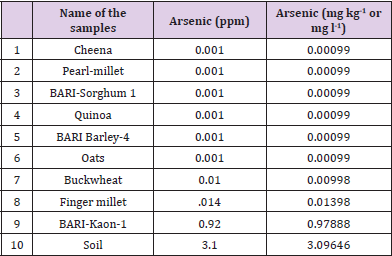
The chemical analysis of nine kinds of cereal has shown arsenic accumulation in their leaves in (Table 1). The unit value of arsenic was expressed in ppm (mg l-1 or mg kg-1). The table depicted that total arsenic accumulation of all the minor cereals was remaining an acceptable limit (1-920 μg kg-1). The acceptable limit of arsenic in the terrestrial plant was determined less than 10 mg kg-1 under normal conditions (Matschullat, 2000). Several plants contain arsenic in the following order: cabbage (0.020 – 0.050 mg kg-1) < carrots (0.040 – 0.080) < grass (0.020 – 0.160) < potatoes (0.020- 0.200) < lettuce (0.020 – 0.250) < mosses and lichens (0.26) < ferns (1.3) Matschullat [3]. Comparing the arsenic content in the abovementioned crops with the nine minor kinds of cereal of PBD, all the cereals have shown a negligible amount of arsenic. Although it has been shown that BARI Kaon-1 contains an increasing amount of arsenic comparing with others, it holds arsenic an acceptable limit; because, an average toxicity threshold of 40 mg kg-1was established for crop plants Sheppard [4]. The soil-arsenic analysis was shown 3 mg kg-1which is also negligible that indicates corresponding sites are not contaminated by arsenic. According to Adriano [5], soilarsenic concentration typically varies from below 10 mg kg-1 in noncontaminated soils to as high as 30,000 mg kg-1 in contaminated soils Vaughan [6]. So, it is pragmatic when the soil has less amount of arsenic and crop grown in that particular soil must have less amount of arsenic. In the current experimental condition, it is not possible to say that the crops have less capacity for arsenic accumulation. It could possible they can extract higher arsenic in contaminated soil.
Table 1: Total arsenic analysis of nine kinds of minor cereal and one soil sample.
Conclusion
The cereals grown in Joydeppur’s experimental field have shown non-contamination by arsenic. Therefore, it can be said that seeds produced in Joydebpur experimental field and distributed to farmers and other organizations are free of arsenic. Safe food consumption is not only significant for human but also require for other animals, therefore, ensuring safe food for all kind of lives is one of the objectives of sustainable development goal-2 (SDG- 2). The biochemical analysis needs to be extended for crops that are growing in arsenic-contaminated sites, typically Chandpur, Munshiganj, Gopalganj, Madaripur, Noakhali, Satkhira, Comilla, Meherpur, Bagerhat and Khulna region which are the high arseniccontaminated zone. In addition, similar analysis can be carried out in control conditions where crops will be subjected to varying concentrations of arsenic. The expected output could help to developing an arsenic resistance crop.
Frequency of Positive PPD Test After Inoculation of BCG Vaccine in 4-Month-Old Infants to 5-Year-Old Children
Introduction
Tuberculosis is an important cause of child mortality in developing countries. BCG vaccination of newborns has been shown to reduce the incidence and mortality of children with TB. Protection against TB by BG vaccination has been observed shortly after birth in Canadian Indians (80%) and Chicago (75%) [1]. Bacillus Calmette Guerin (BCG) is a live bacterium of Mycobacterium bovis that was first used by Calmette and Green to immunize against tuberculosis and mycobacterial infections. The wax was first used for the general population in 1921 for tuberculosis. Since then, various vaccines against tuberculosis have been developed and various models of this vaccine have been developed to enhance the effectiveness of this vaccine [2,3]. The BCG vaccine is the most commonly prescribed vaccine worldwide. The vaccine has been administered to approximately 3 billion people worldwide to date and is one of the major vaccines in immunizing newborns [4]. Virtually, such as mycobacterial infections, this vaccine provides some degree of immunity against tuberculosis and, in some cases, mycobacterial infections [2]. History of natural infection with Mycobacterium tuberculosis and previous infection with nontuberculosis mycobacteria provide immunity against tuberculosis [5,6]. Previous infection with Mycobacterium tuberculosis has been shown to increase immunity against recurrent infections in healthy individuals and in HIV-infected individuals, as well as in immunocompromised individuals who are susceptible to infection with other types of tuberculosis [7-11]. The duration of immunization of the BCG vaccine against tuberculosis is approximately 10 to 15 years. This period protects childhood against tuberculosis. Of course, this period can be different. A long-running clinical trial since 1930 of BCG vaccination among Native Americans and Alaskan Indians has shown that in some cases immunity may last up to 50 or 60 years [12]. The degree of usefulness of the BCG vaccine depends on three factors: the individual’s own immunity before vaccination, a history of mycobacteria infection prior to vaccination, and the potential of the species used in the BCG vaccine [13]. So far, no agreement has been reached on which type of BCG is best for the vaccine, and different types of BCG are used to make the vaccine. There has also been no evidence that repeated BCG vaccination is more effective than a single dose against tuberculosis [14]. The standard dose of BCG vaccine is 0.1 microgram per milliliter. Other childhood vaccines can be given at the same time as the BCG vaccine. The vaccine can be given intravenously or multiple subcutaneously using the device. WHO prefers the subcutaneous method [15]. Skin reactions at the injection site are a common complication of vaccination. Other common complications include osteitis, osteomyelitis and diffuse infection. Factors that affect the incidence of complications include the dose of the vaccine, the type of vaccine and how the vaccine is administered [16]. In preterm infants, it is recommended not to inject the vaccine because the risk of infection in this group is much higher than in term infants [17]. Among the tests currently used in clinical medicine is the PPD test, which has been developed in the last century. This long history of using this test indicates that the interpretation of this test is still controversial. However, it has been well shown that the tuberculin skin test reaction and immunity are in fact independent phenomena. The rate of tuberculin reaction is often consistent with immune conditions [1]. Tuberculin skin test is used to identify people with a history of exposure to mycobacterial antigens. The test involves an intradermal injection of tuberculin, which causes delayed hypersensitivity due to T lymphocytes and occurs within 48 to 72 hours. Tuberculin is actually purified protein derivative (PPD) (the recommended dose in North America is 5 units of tuberculin (0.1 ml)). The standard dose is 2 units of tuberculin [18]. The only way to test for tuberculin skin is the Mantoux technique, which involves injecting tuberculin intravenously into the forearm. To read the test, the diameter of the swollen area should be recorded and expressed in millimeters. This measurement should be done within 48 to 72 hours [19]. In this study, we aimed to evaluate the positive rate of tuberculin test after inoculation of BCG vaccine in infants 4 months to 5 years old children in university referral Hospital in Zahedan-Iran.
Methodology
The study was a descriptive study that included children between 4 months and 5 years old who were referred to Hospital in Zahedan who were vaccinated with BCG at birth. Inclusion criteria included having informed consent, age between 4 months to 5 years and history of BCG vaccination. Exclusion criteria also included congenital anomalies, cancer, immune disorders (acquired and congenital), history of infection during vaccination, palpable adenopathy, malnutrition, immunosuppressive drugs and concomitant viral diseases have been. At the beginning of the project, informed consent was obtained from all parents or legal guardians of the children. All children’s information is kept confidential. Sampling was performed through available and sequential samples. Then, for all these patients, a questionnaire form containing all the mentioned variables was filled out. Then PPD test was performed for all subjects and then after 48 hours to 72 hours later the bulge diameter was measured and then the data were entered into the computer and analyzed. To analyze and describe the data, descriptive statistics were used to describe the data including frequency – percentage – mean and standard deviation. Chi-square test was used to compare the frequency of qualitative variables between the two groups.
Results
In this study, 400 infants from 4 months to 5 years old children referred to university referral Hospital were evaluated. 173 (43.25%) were girls and 227 (56.27) were boys. In the age study, 128 subjects (32%) were 4 months to 1 year old. Also, 272 people (68%) were 1 to 5 years old. According to the positive and negative criteria of the test mentioned at the Introduction, 243 people (60.8%) were 0 to 5 mm. 157 patients (39.2%) were more than 5 mm in diameter, which indicates that this test is positive. In terms of protrusion diameter after inoculation, the mean protrusion diameter was 4.09 mm with a standard deviation of 2.88. The lowest was 0 mm and the highest was 17 mm. Among people aged 4 months to 5 years, 68% were 0 to 5 mm in diameter and 32% were more than 5 mm in diameter. Also, between 1 and 5 years old, 57% were 0 to 5 mm, 43 more than 5 mm in diameter. (Table 1) Chi-square test was used to evaluate the relationship between age and the possibility of a positive PPD test. After statistical analysis, P valuation was calculated to be 0.026 and there is a statistically significant relationship between age and the probability of positive PPD test. (P<0.05).
Table 1: Frequency of positive PPD test after inoculation of BCG vaccine in 4-month-old infants to 5-year-old.
Discussion
In our study, the bulge diameter was reported to be 4.09 88 2.88 after inoculation. Also, 61% of people had a negative test result and 39% had a positive PPD test result. Another goal of this study was to investigate the relationship between age and the probability of positive PPD test. In data analysis, there was a significant relationship between age and the probability of positive test (P <0.05), ie with these interpretations with increasing age of the child. The probability of a positive PPD test increase. In different studies, the percentage of PPD test positive in different communities, different results have been reported. Which, of course, is related to different conditions such as the prevalence of tuberculosis, the percentage of vaccination coverage, and so on. In a meta-analysis conducted by Dr. Rezai et al. In 2017, which analyzed the last 14 studies, among 26,281 Iranian children (CI: 95%), 8.5% reacted more than 10 mm, 29.9% reacted between 5 They had 9 mm and 60% less than 5 mm. In this study, it was shown that with increasing age, the percentage of positive test decreases. On the contrary, in our study, the test was more positive with age, which is most likely due to the wider age range selected by Dr. Rezaei. On the other hand, in our study, the rate of positive tests was 39%, but in Dr. Rezaei’s study, only 8.5% of cases above 10 mm reacted [20]. In the study of Alavi SM et al. In 2001 in Ahvaz, the percentage of positive test results was reported to be 2%, which was about 1% less than the amount obtained in our study. However, in this study, 90% of people in the first week after birth They had received the BCG vaccine [21]. In a study by Sleiman R in Saudi Arabia in 2007, the positive rate was much higher than our study and Mr. Alavi’s study in Ahwaz, which was reported to be 8%. About 62% of people were also vaccinated with BCG [22]. In 2008, Araujo Z et al reported a positive rate of 28%, which is very high. This high percentage can be due to the reasons mentioned above [23]. In a study published in Uganda, this study also reported a very high rate of positive testing. In this study, the prevalence of positive PPD test was 32%, which is due to factors such as the prevalence of tuberculosis and the percentage of vaccination coverage, etc. As a result of this study.
RP-HPLC Method Development and Validation for Estimation of Naftidrofuryl Oxalate Using Box- Behnken Design
Introduction
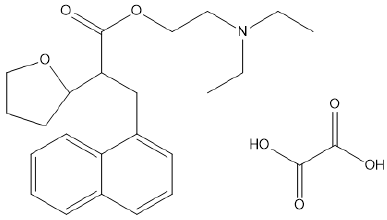
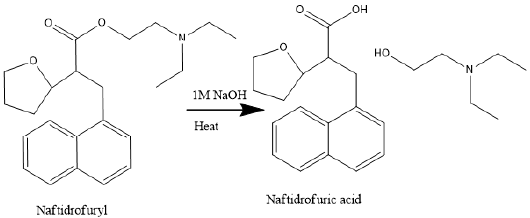
Naftidrofuryl, chemically it is a (RS)-2-(diethylamino) ethyl-3- (1-naphthyl)- 2-(tetrahydro furan-2-ylmethyl) propanoate and it is available in the form of oxalic acid. It is also known as nafronyl, INN, NF, NAFTI or as the oxalate salt nafronyl oxalate [1]. The chemical formula of Naftidrofuryl oxalate is (C26H35NO7) with molecular weight is 473.56 as shown in Figure 1 [2]. Naftidrofuryl oxalate shows smooth muscle relaxation, increases cerebral blood flow as well as peripheral blood flow, cerebral adenosine triphosphate concentrations and glucose utilization properties attracts its pharmacological applications in the treatment of senile brain diseases a vasodilator. Therefore, it is widely used in the treatment of peripheral and cerebral vascular disorders [3,4]. The British Pharmacopoeia (BP) describes a potentiometric non-aqueous titration and high-performance liquid chromatography (HPLC) methods for the assay of NF in bulk form and capsules, respectively [5,6]. The literature survey reveals that few analytical methods have been reported for the determination of Naftidrofuryl oxalate in biological fluids and/or pharmaceutical preparations by using high-performance liquid chromatography [7], high- performance liquid chromatography with fluorescence detection [8,9], RP-HPLC fluorimetry [10], phosphorimetry [11], phosphorescence [12,13], Phosphorimetric determination [14], ion-selective membrane electrodes method [15], spectrophotometric analysis [16], Spectrophotometric, spectrofluorimetric and voltammetric analysis [17] and Stability Indicating Methods [18] were reported till date. Naftidrofuryl oxalate molecule,is composed with the ester linkage associates naphtha- lene propionic acid and diethylaminoethyl moieties and easily hydrolysis in aqueous solutions by either acid-or basecatalyzed reaction to form 3-(1-naphthyl)-2-tetrahydro furfuryl propionic acid, (Naftidrofurylacid, NFA) and diethylaminoethanol. Figure 2 shows the degradation reaction pathway of Naftidrofuryl oxalate. NFA is the metabolite of naftidrofuryl oxalate has been found in human plasma [4,19].
Figure 1: Structure of Naftriduroyl Oxalate.
Figure 2: Hydrolysis rection of Naftidrofuryl.
It is desirable to develop a simple, precise, robust and fast procedure that could be applied in quality control laboratories for the selective determination of Naftidrofuryl oxalate in the pharmaceutical product. The developed method can be utilized for the determination of drug content in its pharmaceutical dosage form is also demonstrated. For this we select QbD based RP-HPLC method development. In a olden days, one factor at a time (OFAT) and keeping the others fixed as a traditional approach used for optimization of HPLC methods, results in achievement of narrow robust, precise and rugged behavior of the method for instrumental variables used in method development phase. This approach may cause high risk in method failure and always requires revalidation protocol after method transfer or alternative method development used to ensure the consequences; thereby it has been increasing the cost of the method, regulatory burden, recall of drugs and batch failure cost [20,21]. Nowadays, QbD is used as a systematic, scientifically based, holistic and proactive approach and powerful tool for chromatographic method development. In this approach we can understand process parameters that influence chromatographic separation by determination of critical ones, their positive or negative effect on the selected responses, and the multidimensional interaction between them. In addition, the change in variable of QbD facilitates the purposeful variables changes will gives desired response and suggests the optimal solution with variables value that best gives the maximum, minimum or target response, while at the same time it finds the spot with the minimum error transmitted to the responses. So, this should represent robust process conditions that not affected by slight variations in factor settings. It also suggests a mathematical model that relates the response and the experimental variables, thus allowing response prediction with minimum error transmitted to the response [22-26]. Application of DoE principles facilitates understanding of multiple method parameters and variables that tend to affect CMAs, while unravelling the prevalence of (any) interactions and reducing intricacies. For the successful execution of DoE study, the knowledge of response variables or CMAs, CMVs, their ranges, and best fitting of the mathematical model(s) is mandatory. DoE-based Response Surface Methodology (RSM) is helpful in systematic development of analytical methods involving significant nonlinearity between CMV-CMA relationship(s) using diverse experimental designs like Factorial design, Central Composite design, Box Behnken design, Optimal design, etc. The experimental designs help in mapping the responses on the basis of the studied objective(s), CMAs being explored, at high (coded as +1), medium (coded as 0), or low (coded as -1) levels of CMVs. It tends to unearth the mechanistic understanding of CMVs and CMAs relationship, and associated interactions among them. Various 3D and 2D-plots like response surface plots, contour plots, perturbation charts, linear correlation plots, outlier plot and Box-Cox plot are some of the key pictorial/ graphical tools of the experimental designs useful for the purpose [27,31]. The literature survey reveals that the BBD was one of the design strategies employed for selection and optimization of mobile phase during chromatographic analysis. The BBD is different from all screening designs as it contains combinations or midpoints of edges of the process space and at the center, i.e., variables at their highest or lowest levels, so that the designs will avoid all factors which affects method. These designs are useful in avoiding experiments performed under extreme conditions as these may give unsatisfactory results [32-34]. In the RSM design, Box–Behnken statistical design is an independent, rotatable or nearly rotatable, quadratic design, requires fewer experimental runs and less time and thus provides a far more effective and costeffective technique than the conventional processes of formulating and optimization of dosage forms [35]. Literature survey revealed that there is no previously reported analytical QbD based RP- HPLC method for NF. Thus, the main goal of this work was to establish a precise, accurate and sensitive QbD based RP-HPLC method for NF using RSM and Multiple responses optimization utilizing quadratic polynomial equation. Screening of the critical factors was achieved using BBD, the independent variables for the present study was Organic phase (X1), Aqueous phase(X2) and (X3) and the responses was Retention time (Y1), Resolution (Y2) and Tailing factor (Y3). The developed method was validated for linearity, system suitability, recovery (accuracy), precision, robustness, ruggedness, limits of quantitation (LOD) and detection (LOQ) as per the ICH guidelines [36,37].
Experimental
Materials
Naftidrofuryl oxalate was obtained as a gift sample from Zim Lab, Nagpur, India. All the chemicals such as Methanol and Acetonitrile (HPLC grade), Ammonium acetate, Tetra butyl ammonium hydroxide and Concentrated Nitric acid (AR grade), procured from Merk life science private limited Mumbai and Final limited Ahemdabad. Instrumentation and Chromatographic Conditions: HPLC analysis was carried out using Shimadzu HPLC series 1100. Separation was carried out on Zodiac column (C18 100mm×4.6 I.D., 3μm particle size column), Detection was achieved using SPD-10UV detector and LC 10 ADVP-pumps connected to a hp computer. The mobile phase was prepared by mixing Tetrabutyl- ammonium buffer and Acetonitrile (adjusted to pH7 with concentrated Nitric acid) in a ratio of 10:90 v/v, then filtered through 0.45μm membrane filter (Millipore, Milford, MA, USA). The injection volume was 20μL with a flow rate of 1.0mL/min and UV detection at 282nm. The wavelength of maximum absorbance was detected by UV-Visible spectrometer (double beam), Shimadzu UV-1700 model and wavelength scanning range was 200-400nm was exercised using UV probe software. For applying quality by design Design Expert® 11.0 – trial version software was used. Preparation of Standard Solutions: A stock solution of 1000 μg/mL was prepared by dissolving 10mg of Naftidrofuryl oxalate standard in 10mL of a mixture Tetrabutyl- ammonium buffer and Acetonitrile (adjusted to pH7 with Concentrated Nitric acid) in a ratio of 10:90 v/v. Standard solutions were prepared by further dilution of stock solution with the same solvent to get 30 μg/mL.
Experimental Design
Scouting Step: This step included some trials of the mobile phase that gives an acceptable well resolved chromatographic peak of analyte. At the beginning, different mobile phases containing Tetrabutyl ammonium buffer and Acetonitrile as the aqueous/ organic part of the mobile phase were tried. In addition, change in ratio of Tetrabutyl- ammonium buffer and Acetonitrile were tested. Finally, the variables that may affect the selected CQA were selected. Screening Design: In the present study, 3-factor, 3-level Box- Behnken statistical design was used to evaluate the effect of selected responses, to characterize the drug contents and to optimize the developed method. BBD is efficacious for exploration of quadratic response surfaces, mathematical screening and thus helping to optimize the process by using a small number of experimental runs. The dependent and independent variables selected are given Table 1 along with their low, medium and high levels, which were selected based on the results from preliminary experimentation. The observed responses are given in Table 2.
Table 1: Variables in Box Behnken Design.
Table 2: The observed responses in Box-Behnken Design for Naftidrofuryl Oxalate.
Note: *Variables X=Organic phase (X1), Aqueous phase(X2) and Flow rate (X3). Responses Y= Retention Time (Y1), Resolution (Y2) and Tailing factor (Y3).
BBD a also used to optimize and evaluate the main effects, interaction effects and quadratic effects of the independent factors on the dependent factors as 3-factor, 3-level Box- Behnken statistical design suitable for exploring quadratic response surfaces and constructing second order polynomial model with Design Expert® 11.0 – Trial Version software. The nonlinear computer-generated quadratic model is given as
where Yo is the dependent variable; bo is an intercept; b1–b33 are regression coefficients computed from the observed experimental values of Y; and X1–X3 are the coded levels of independent variables. The terms X1, X2 and Xi(i=1,2or3) represent the interaction and quadratic terms, respectively Optimization Data Analysis: The responses Retention Time (Y1), Resolution (Y2) and Tailing factor (Y3) of were treated by Design-Expert software design such as BBD which consist of three components include linear, quadratic and special cubic models. The best fitting mathematical model such as ANOVA method and Good fit evaluation were selected based on the comparisons of several statistical parameters including the coefficient of variation (C.V.), the multiple correlation coefficient (R2), adjusted multiple correlation coefficient (adjusted R2); and the predicted residual sum of square (PRESS), proved by Design-Expert software. Among them, PRESS indicates how well the model fits the data, and for the chosen model it should be small relative to the other models under consideration.Also various 3-D response surface graphs and counter plots were provided by the Design- Expert software. By intensive grid search performed over the whole experimental region, the optimum checkpoint mobile phase composition was selected to validate the chosen experimental domain and polynomial equations. The optimized checkpoint mobile phase composition was prepared and evaluated for various response properties. The resultant experimental values of the responses were quantitatively compared with that of the predicted values. Also, linear regression plots between actual and predicted values of the responses were produced using MS- Excel version 2019. Validation: The method was validated in accordance with the International Conference on Harmonization (ICH) requirements [37], which involved linearity, system suitability, recovery (accuracy), precision, robustness, ruggedness, limits of quantitation (LOD) and detection (LOQ). Linearity, LOD, and LOQ: The linearity of the method was assessed at five concentrations within the appropriate range. To construct the calibration curves the peak areas were plotted against concentrations. For an analyte in a sample, LOD is the lowest concentration which can be detected, not quantified. On the other hand, LOQ is the lowest concentration was calculated. System Suitability: The system suitability parameters area, retention time, tailing factor, theoretical plates and resolution were calculated by injecting standard Naftidrofuryl oxalate solution. Accuracy: The accuracy of the proposed method was indicated by % recovery of the five different concentrations of Naftidrofuryl oxalate. Robustness: In addition to identifying the design space that represents a robustness zone, the insensitivity of the proposed method to small changes in the optimized conditions such as deliberate changes in the method were done i.e., Change in flow rate (1.0 ± 0.2mL/min), change in mobile phase concentration (organic portion of 90% ± 5%), change in column and change in pH of Buffer solution (7.0± 0.2 pH) in mobile phase. Ruggedness: The studies were carried out for two different parameters i.e., Days (Intraday and Interday) and Analyst to Analyst variation. Single concentration level was selected and analyzed as described before three times within the same day (intra-day precision) by different analysts, and on successive three days (inter-day precision). The % RSD was calculated as a measure for method precision.
Results and Discussion
Scouting Step
An isocratic mobile phase consisting of Tetrabutyl- ammonium buffer 20% and acetonitrile 80% was applied at the beginning. This mobile phase gave strong tailing and no well resolved peak shape. When % of Tetrabutyl- ammonium buffer was increased and % of acetonitrile reduced, tailing increased strongly. Then we reduced % of tetrabutyl-ammonium buffer and % of acetonitrile increased in order to have better resolution. In this case, good peaks shape was obtained. In this step, three factors were chosen: the % aqueous part of the mobile phase, % of organic phase and flow rate.
Screening with BBD
The significance of model so obtained can be evaluated by two ways i.e. ANOVA method and Good fit evaluation. ANOVA is a statistical method based on F-test to estimate the significance of model. It involves subdividing total variation into variation due to Residual error, Main effects and Interactions.
ANOVA Technique
The ANOVA (one-way Analysis of Variance) is used to ensure about the significant differences between the means of three or more independent groups. The results of ANOVA of Variance for Retention time (Y1), Resolution (Y2) and Tailing factor (Y3) shown in Table 3. The Model F-value of Retention time (Y1), Resolution (Y2) and Tailing factor (Y3) was found to be 16.69, 10.72 and 7.11 respectively and it implies that the model is significant. There is only a 0.01% chance that an F-value this large could occur due to noise. P-values less than 0.0500 indicate model terms such as -A, C, AC in Retention time(Y1), – A, B, A², B², C² in Resolution (Y2) and -A², B², C² in Tailing factor (Y3) are significant model terms. Values greater than 0.1000 indicate the model terms are not significant. If there are many insignificant model terms.The Lack of Fit F-value of 66.01 and 32.46 in Retention time (Y1) and Tailing factor (Y3) respectively implies that the Lack of Fit is significant. Whereas in the Resolution (Y2), Lack of Fit F-value of 3.02 implies the Lack of Fit is not significant relative to the pure error. There is a 15.69% chance that a Lack of Fit F-value this large could occur due to noise. The average values obtained from the software are given in Table 4.
Table 3: ANOVA results of the Box Behnken design for response surface quadratic model.
Table 4: Table for average values obtained from the software.
Main Effects (Lack of Fit)
The Lack of Fit is one of the components of partition of the sum of squares in an ANOVA which can tell that that purpose model is fit or not. The results of Lack of Fit Test and Model Summary Statistics of Retention time (Y1), Resolution (Y2) and Tailing factor (Y3) showed in Table 5.
Table 5: Model Summary Statistics for Lack of Fit Test.
Interactions
The equation in terms of actual factors can be used to make predictions about the response for given levels of each factors are given in Table 6.
Table 6: Table for final Equation in Terms of Actual Factors.
Contour Plots and Response Surface Analysis
The graphical optimization was another tool used to specify the design space or sweet spot where the desired CQAs meet. The goal of graphical optimization was to maximize both responses after speci- fying their lowest acceptable limits. 3D plot showed the interaction effect of the critical factors. Two-dimensional contour plot of Retention time (Y1), Resolution (Y2) and Tailing factor (Y3) shown in Figures 3a-3c and three- dimensional response surface plot are presented in Figures 4a-4c which is very useful to study the interaction effects of the factors on the responses. These types of plots show the effects of two factors on the response at a time.
Figure 3:
a. Counter Plot for Response Retention Time. b. Counter Plot for Response Resolution. c. Counter Plot for Response Tailing factor.
Figure 4:
a. Surface Response Curve for Response Retention Time. b. Surface Response Curve for Response Resolution. c. Surface Response Curve for Response Tailing factor.
Validation
Linearity, LOD, and LOQ
Linearity study was performed on Naftidrofuryl oxalate under the optimized chromatographic conditions; a good linearity was obtained between the peak areas and the concentration ranging from 10 to 50μg/mL. The observations are shown in Table 7, from the data, a plot concentration (μg/mL) Vs Area Under Curve (AUC) was constructed for the Naftidrofuryl oxalate (Figure 5). The study of graphical plots represents correlation coefficient of Naftidrofuryl oxalate was found to be 0.997.
Table 7: Regression data and System suitability data.
Figure 5: Plot of Linearity Curve.
System Suitability
The study of chromatogram reveals that the Naftidrofuryl oxalate was well resolved hence, resolution of the same needs to be studied. The system suitability was performed by preparing the 30 μg/mL solution of standard Naftidrofuryl oxalate performed under optimized condition. From the observation of results, all the obtained results are in under the acceptance limit. Hence, according to acceptance criteria the system is suitable for analysis. The results for system suitability parameters are given in Table 7 and standard chromatogram is given in Figure 6. The correlation coefficient was found to be 0.997 for the drug.
Figure 6: Chromatogram of Std NF.
Accuracy
Accuracy of proposed method was as certain on the basis of recovery studies performed by standard addition method. Percent Recovery was performed by preparing the 30 μg/mL solution of Standard Naftidrofuryl Oxalate. The ±S. D and % RSD was calculated and the results for % Recovery is given in Table 8.
Table 8: Observation and Results of Recovery Study.
Robustness
In these study deliberate changes in the method were done i.e. Change in flow rate (1.0 ± 0.2mL/min), change in mobile phase concentration (organic portion of 90% ± 5%), Change in column (Agilent ZORBAX and ZODIAC) and change in pH of Buffer solution (7.0 ± 0.2 pH) in mobile phase. The robustness results Mean, SD and %RSD of series of measurement were found to be within limit as shown in Table 9.
Table 9: Table for summary data of Robustness results.
Ruggedness
The studies were carried out for two different parameters i.e., Days (Intraday and Interday) and Analyst to Analyst variation. In intraday and inter-day variations, results of estimation by proposed methods were found to be varying. In inter-day study% RSD and % estimation was found to be increased after one day storage suggest that the NF is unstable in solution form while in intraday study, solution was found to be stable up to 3 h. The result of estimation for Naftidrofuryl oxalate by different analysts was very much reproducible. This indicates the ruggedness of the method in the hands of different analysts. The results of Ruggedness study for the proposed method is given in Table 10.
Table 10: Results of Ruggedness study for the proposed method.
Conclusion
A validated QbD based RP-HPLC method has been developed for Naftidrofuryl oxalate utilizing “Analytical Quality by Design” (AQbD)- DOE approach. Multivariate regression analysis was successfully applied to study the main effects of three factors on the of retention time, resolution and tailing factor. BBD was employed for optimization of chromatographic conditions and used to analyse the analytical target profile by studying the interaction and quadratic effects on the factors for three selected responses. The models used for screening and optimization steps were found to be significant and confirmed method predictability. The developed method was validated for linearity, accuracy, robustness of test method, ruggedness, intermediate precision, recovery study, LOD and LOQ. The method is simple, robust, accurate and can be successfully applied to the analysis of Naftidrofuryl oxalate
Natural Compounds and Depressive Disorder: A Review Highlighting Botanical Sources and Reaction Mechanisms
Introduction
Etiology of Depressive Disorder
Depressive disorder is a recurrent serious neuropsychiatric disease, with an incidence of up to 17% [1,2]. What’s more, the direct or indirect cost of the depressive disorder has reached US$2.5 trillion and is expected to exceed US$6 trillion by 2030. Approximately 1,000,000 people die of suicide every year around the world [3,4], and more than 90% of them have been diagnosed with depression or other mood disorders [5]. In general, depression brings tremendous social and economic burdens, as well as a gigantic adverse effect on social activities and family responsibilities. As a complex multifactor disease, depressive disorder is initiated and triggered by psychological, genetic, social, and biological factors. Increasing evidence shows that the occurrence and development of depression are closely related to genetic factors, and depression is a highly inherited disease, with 40% – 50% of its risk coming from genes [6]. Multiple genes such as Nuclear receptor subfamily 3 group C member 1 (NR3C1), glutamate ionotropic receptor NMDA type subunit 2A (GRIN2A), and many others are closely related to depression outcome [7,8]. Psychological factors contain abuse (including sexual, physical, or emotional), psychological neglect, exposure to violence, separation, and bereavement, and so on. Social factors, such as chronic health problems, exposure to violence, financial insecurity, are strongly associated with the risk of developing depressive disorder. Biologically speaking, periodic changes of hormones and long-term health problems can also contribute to the occurrence of depression, such as postpartum depression and diabetic depression.
Animal Models of Depressive Disorder
Due to the complex pathogenic factors and the high comorbidity rate with other mental diseases (such as anxiety, phobia, schizophrenia, etc.), it is difficult to maintain a strict boundary between depression and other mental diseases, and the animal models of depression are essential to understand the pathological mechanism [9]. Presently, rats (Sprague-Dawley rats, Wistar rats), mice (C57BL/6 mice, ICR mice, Kunming mice), non-human primates (rhesus monkeys, cynomolgus monkeys, etc.), zebrafish, tree shrew are common model animals for the preclinical study of depression. In the aspect of animal modeling, stress exposure is the most common molding method, because it can simulate the clinical disease process of humans to the greatest extent, including chronic unpredictable mild stress (CUMS) [10,11], social defeat stress(SDS) [11,12], learned helplessness (LH), chronic restraint stress (CRS). On the other hand, some depressive animal models were set up guided by the corresponding hypothesis, such as injection of lipopolysaccharide (inducing inflammation) [13], corticosterone (destructing HPA axis) [14,15], and reserpine (exhausting monoamine transmitter) [16,17]. Besides, surgical models are also good choices to establish a depression model, including ovariectomized (OVX), olfactory bulbectomy (OB), and middle cerebral artery occlusion (MCAO). Despite multiple modeling methods, CUMS is the most classical and widespread one.
Intervention in Depressive Disorder
Presently, the commonly prescribed antidepressants have been divided into four categories, including tricyclic antidepressants (TCA), selective serotonin reuptake inhibitors (SSRI), non-selective monoamine reuptake inhibitors (NSMRI), and monoamine oxidase inhibitors (MAOI) [18]. However, conventional antidepressants lack efficacy in many patients (treatment-resistant depression), and combined medication (multitherapy) and several weeks were required to produce a therapeutic response in about 50% of depression cases [19,20]. Besides, there is also increasing evidence in terms of serious side effects of antidepressants, such as cognitive impairments, arrhythmias, sleep disorders, and gastrointestinal reactions. For example, fluoxetine is one of the most common antidepressants worldwide, while it also induces many side effects such as hepatotoxicity and gastrointestinal reaction [22]. Thus, these disadvantages of antidepressants may limit clinical use and are not directly conducive to the treatment of depression. Psychotherapy is a common treatment program for depression, but it does not demonstrate outstanding superiority compared with control [23]. Likewise, Cochrane reviews that the evidence of other alternative therapies, such as acupuncture and exercise, are short of persuasiveness and convincing [24,25]. Therefore, current researchers are devoted to the search and development of novel effective drugs with high efficacy and low side-effects during the past two decades [26,27]. Traditional Chinese medicine has unique advantages in prolonging the human life span, improving the quality of life, and preventing and treating chronic diseases, including diabetes, cancer, and depressive disorder.
Materials and Methods
We searched the relevant experimental articles published from October 2014 to July 2021 in the PUBMED database to clarify the antidepressant effects of natural compounds. Our search statement is designed according to the following criteria: the search language contains relevant keywords such as ‘depressive disorder’ and ‘natural product’ or compounds category, including alkaloids, flavonoids, polyphenols, phenylpropanoids, polyphenols, and quinones. After completing the preliminary search, duplicated or non-English articles, as well as studies involving natural products of multiple compounds such as extracts were deleted, and the literature on single compounds was retained so that we could completely comprehend how each natural compound exerts antidepressant effects and their potential mechanism.
Results
Natural Compounds that Restore Neurotransmitter Imbalance
Neurotransmitters are messengers of information exchange between neurons or between neurons and effector cells such as muscle cells, glandular cells, etc., including monoamines (norepinephrine, dopamine, and serotonin), amino acids (excitatory transmitters such as glutamic acid and aspartic acid; inhibitory transmitters such as γ-aminobutyric acid, glycine, and taurine), choline (acetylcholine) and others, such as neuropeptides and purines [28]. In this section, plant chemicals and/or extracts are listed according to their impacts on neurotransmitters. Their chemical structures, antidepressant activities, and action on restoring neurotransmitter imbalance in animal models of depression are discussed. Natural Compounds Regulating Monoamine Neurotransmitters and Related Receptors: Among all of the neurotransmitters, monoamine neurotransmitters are most closely related to depression, and valid antidepressant drugs are mainly designed to target the monoamine neurotransmitter system, including the serotonergic and noradrenergic systems. Currently, the monoamine transmitter hypothesis believes that the concentration of brain neurotransmitters in the synaptic gap is relatively or absolutely insufficient, which will lead to overall mental activity and mental function in a comprehensive state of depression [29]. Clinical studies have found that 5-hydroxytryptamine (5-HT) and norepinephrine (NE) are insufficient in the brain of depressed patients, while antidepressants can exert effects by inhibiting the reuptake of these two neurotransmitters and increasing the concentration of transmitters in the synaptic gap [30,31]. Ferulic Acid: Ferulic acid, or 4-hydroxy-3-methoxy-cinnamic acid, is derived from Umbelliferae family TCM plants, such as Ferulae Resina (e’wei, 阿魏), Angelicae Sinensis Radix (danggui, 当归), Aconiti Radix (chuanxiong, 川芎), Cimicifugae Rhizoma (shengma, 升麻), and Ziziphi Spinosae Semen (suanzaoren, 酸枣仁). As a polyphenol compound, ferulic acid has good blood-brain barrier permeability [32]. Many studies have shown that ferulic acid may be an MAOI antidepressant, suggesting that ferulic acid selectively increases the levels of serotonin and norepinephrine in the various brain to alleviate depression [33,34]. Moreover, the inhibitors of 5-HT1A/5-HT2A receptors can clear up the antidepressant activity of ferulic acid [35]. Furthermore, Li G, et al. [36] performed that the administration of ferulic acid exerts obvious antidepressant effects by reducing MAO-A activity and 5-HIAA content, which suggested that ferulic acid, combined with a low dose of piperine, may be a potential therapeutic method of depression with high efficacy and low side effects. Naringenin: Naringenin is a special flavonoid widely distributed in various Chinese Medicine for antidepressants, such as Menthea haplocalycis herba (bohe, 薄荷) and Auranrii fractus (zhiqiao, 枳壳). Compared with other flavonoids, it is more easily to be absorbed by the gastrointestinal tract, with high bioavailability and high safety dose [37,38]. Mounting evidence shows that naringenin is a potential antidepressant [39-44]. On the one hand, it can increase the 5-HT level by inhibiting MAO [45] or regulating the metabolic process of tryptophan [39,41]. Another, it exerts a neuroprotective role through the sonic hedgehog-Gli1 signaling pathway and restores alterations in the kynurenine (KYN) pathway via its antioxidant and anti-inflammatory potential [40,42]. Umbelliferone: Umbelliferone, or 7-hydroxycoumarin, is one of the coumarin derivatives. Many effects have been documented for this compound ranging from anti-oxidation, anti-inflammatory, and neuroprotection. As for depression, this compound can significantly improve CUMS-induced depressive behaviors, including lack of pleasure and prolonged immobility. It can inhibit the activity of MAO and lower the elimination of 5-HT [46]. Interestingly, many of its derivatives also are good MAO inhibitors [47]. Besides, umbelliferone can inhibit neuronal apoptosis via modulating the ROCK/Akt pathway or GSK-3β/PI3K/Akt pathway to treating depression [48,49]. Chrysin: Chrysin is a kind of flavonoid extracted from the plant of Oroxyli semen (muhudie, 木蝴蝶) or propolis, with extensive pharmacological activity, including strong neuroprotective and anti-inflammation effects [50]. And it is potent for depression caused by different reasons, such as ovariectomy, hypothyroidism, CUMS, traumatic brain injury, and olfactory bulbectomy [50-58]. Chrysin can not only increase the level of BDNF [51,57] and other neurotrophic factors, but also regulate the level of 5-HT and its production and metabolism [54,55,57,58]. Natural Compounds that Regulate Amino Acid Neurotransmitters and their Receptors: Amino acid neurotransmitters include excitatory transmitters (e.g. glutamate and aspartic acid) and inhibitory transmitters (e.g. γ-aminobutyric acid, glycine, and taurine). Growing evidence demonstrates that glutamatergic transmission may be the critical cause of depression occurrence, though the imbalance of monoamine neurotransmitters is the classic pathogenesis of depression [59]. Both clinical and preclinical results show that depression is closely related to the increase in glutamate concentration [60]. The receptors of glutamate are divided into ionotropic glutamate receptors (GluR) and metabotropic glutamate receptors (mGluR). The former includes N-methyl-D-aspartate receptor (NMDAR), α – amino-3-hydroxy-5-methyl-4-isoxazol-propionic acid receptor (AMPAR), and kainate receptor family, while the latter belongs to G protein-coupled receptors and involves eight subtypes, mGluR1~8. Previous studies have indicated that NMDAR, AMPAR, and mGluR (1/2/3/5) are closely related to depression [61,62]. However, lowering inhibitory transmitters GABA, also known as γ-aminobutyric acid, is associated with depression, and GABA regulates local neural circuits including norepinephrine, dopamine, and serotonin neurons [59,63]. Therefore, the balance between glutamate and GABA is considered one of the key points in the pathogenesis of depression. Curcumin: Curcumin is a polyphenol component extracted from Zingiberaceae and Araceae family, and the typical TCMs include Wenyujin Rhizoma Concisum (jianghuang, 姜黄), Curcumae Radix (yujin, 郁金), and Curcumae Rhizzoma (e’zhu, 莪术). Multiple functions have been reported for this agent, including lipid regulation, inflammation inhibition, and tumor suppression. As for depression, this compound can normalize the depressive behaviors in lipopolysaccharide-induced and chronic constriction injury (CCI) model mice [64-66]. And above ant depression was greatly eliminated by GABA receptor A antagonist bicuculline, but only partly abrogated by 5-HT receptor 1A antagonist [65]. Similarly, Ro25-6981 (GluN2B antagonist) was found to prevent the pharmacodynamics function of curcumin in FST [64]. From another perspective, curcumin can inhibit glutamate release from synaptosomes induced by 4-aminopyridine (4-AP), a K+ channel blocker, which can be completely abolished by fluoxetine, a clinically effective antidepressant [67]. Thus, the antidepressant effect of curcumin may be mediated, at least in part, by regulating the balance between glutamate and GABA. Natural Compounds that Regulate Cholinergic Neurotransmitters and their Receptors: The cholinergic system plays a significant role in regulating various CNS functions, including arousal, attention, cognition, and memory, and the abnormality of the cholinergic system is associated with depression. Although the role of the cholinergic system in the pathogenesis of depression is not as widely accepted as the monoamine hypothesis, it has been proposed decades ago. Recent studies have shown that increasing the activity of the cholinergic system shortly before stress induction can affect the ability to cope with forthcoming stress, bringing about depression-like conditions [68,69]. Scopolamine: Scopolamine, separated from nightshade family plant Dature Stramonium Datura L, is a nonselective muscarinic antagonist, especially for M1-type muscarinic acetylcholine receptors (M1-AChR); and its main effects are used to treat motion sickness and nausea, but growing studies have revealed that scopolamine posts a rapid antidepressant activity in humans and animals, and maybe a promising antidepressant agent or adjuvant. However, its antidepressant activity can be eliminated by M1-AchR knockout [70], AZD8055 (an orally-bioavailable mTOR inhibitor) [71], AMPT (a tyrosine hydroxylase inhibitor) [72], NBQX (an inhibitor of AMPAR) [73], or VGLUT1 knockdown [74]. Overall, these results indicate that although scopolamine is a muscarinic antagonist, its antidepressant effect in animal depression models is related to not only the cholinergic system but also to noradrenergic and glutamic acid systems and the mTOR pathway.
Natural Compounds that Maintain Neuroendocrine Homeostasis
The endocrine system is another important functional regulation system besides the nervous system, and the main endocrine organs include the pituitary gland, thyroid gland, adrenal gland, islet of the pancreas, and gonad. Especially, the hypothalamus cannot only regulate nerve function, but also measure endocrine function, and there are three important neuroendocrine axes, including the HPA axis, HPT axis, and HPG axis. Among these, the HPA axis is an important neuroendocrine system for the human body to cope with stress. When individuals are faced with stressors, they can increase hormone levels in a series of ways, causing the human body to produce a stress response. Ginsenoside Rg1: Ginsenoside Rg1 is one of the most active components in ginseng radix et rhizoma (renshen, 人参), which has a variety of biological activities, including promoting neurogenesis and neural plasticity, enhancing learn and memory, and improving immunity. Therefore, this compound may have great potential in the treatment of depression. Several studies have proved that ginsenoside Rg1 significantly alleviates depressive behaviors induced by CUMS, CSDS, or corticosterone [75-79]. It has been shown that ginsenoside Rg1 can protect the function of gap junction to repair the integrity of blood-brain barrier (BBB) and connexin43 (Cx43) is the key sensitive target [80-82]. Moreover, it also can reduce dendritic spine atrophy and modulate the homeostasis of the HPA and HPG axis [83]. Puerarin: Puerarin is a kind of isoflavone derivative isolated from TCM, Pueraria lobata (gegen, 葛根), and is also the main pharmacological component. Its main effects are to dilate blood vessels and improve microcirculation, so it is often used in the treatment of hypertension and coronary artery disease [84]. However, recent researchers have found puerarin may be a potential antidepressant, due to its neurotrophic and estrogenlike effects [85-87]. Of note, it has been reported that puerarin shows a significant antidepressant effect on ovariectomized ICR mice, including behavioral remission and corticosterone reduction [87]. Further, puerarin also dose-dependently normalized the downregulated transcription of estrogen receptor (Erβ and Erα) and BDNF mRNAs [87]. On the other hand, puerarin plays a biological role in the synthesis of allopregnanolone in the brain [88]. In summary, puerarin exerts antidepressant effects directly through its estrogen-like effect, or indirectly through promoting the biosynthesis of estrogen. Hyperforin and Hyperoside: Hypericum perforatum (guanyejinsitao, 贯叶金丝桃), namely St John’s wort, is a classic antidepressant plant drug. Hyperforin and hyperoside are its main active components, and even have been regarded as the quality control index. Due to their significant efficacy and small side effects, they have become the first choice for the treatment of depression in Europe and the United State. Previous evidence has shown that the two compounds can inhibit the activity of MAO and the synaptosomal reuptake of monoamine [89]. However, recent studies show that hyperforin can activate TRPC6-mediated currents and Ca2+ transients to modulate synaptic plasticity in rat PC12 cells, and change BDNF and zinc levels in mice exposed to CUMS to exert significant antidepressant-like activity [90,91]. Similarly, hyperoside protects rats from CMS-induced learning and memory deficits, while these effects could be prevented by K252a, an inhibitor of the BDNF receptor tyrosine kinase receptor B (TrkB) [92]. Therefore, hyperforin and hyperoside can recovery the synaptic function to treat depressive disorder. Hesperidin: Hesperidin is the main active component of TCM from the Rutaceae family, including Citri reticulatae pericarpium (chenpi, 陈皮), Auranrii fractus (zhiqiao, 枳壳), and Citri sarcodactylis fructus (foshou, 佛手), which are related to soothing the liver and relieving depression. Hesperidin has been reported to exhibit a beneficial effect on various depressive animals, and alleviating neuroinflammation may be the key mechanism of efficacy [92,93]. It has been reported that this phytochemical could not only inhibit the increase of KYN level in the prefrontal cortex of CSDs rats, but also antagonize the downregulation of miRNA-132 expression in lipopolysaccharide-induced depression mice [94,95]. Moreover, hesperidin reduces inflammatory cytokine levels by modulating the HMGB1/RAGE/NF-κB pathway and the BDNF/TrkB pathway both in vivo and in vitro [96]. Thus, hesperidin may be a potential antidepressant candidate. Paeoniflorin: Paeoniflorin, exacted from Paeoniae root, is the principal bioactive ingredient of Paeoniae radix rubra (chishao, 赤 芍) and Paeoniae radix alba (baishao, 白芍). Due to its low toxicity, there is no obvious adverse reaction under normal conditions. A large number of studies have proved that paeoniflorin has many pharmacological effects, including antidepressants, analgesics, liver protection, nerve protection, and immune regulation. Regarding depression treatment, paeoniflorin has a very significant therapeutic effect. This chemistry can promote neurogenesis in the hippocampal dentate gyrus (DG) and attenuate impairment of longterm potentiation (LTP) in hippocampal CA1 of animals subjected to CUMS [97-99]. Mechanically, the activation of the ERK/CREB pathway may be the internal reason for its antidepressant effect. On the other hand, paeoniflorin can also play a protective role in neurons through calcium antagonism [100,101].
Natural Compounds that Relieve Neurological and Synaptic Dysfunction
Synapse is the basic structure between neurons for information transmission and processing. Synaptic plasticity refers to the adaptive changes of the brain to stimulation, including structural and functional changes, which are manifested in the increase or decrease of the synaptic number, the change of synaptic morphology, and the adjustment of synaptic function. Peripheral inflammation and synaptic abnormalities are thought to directly or indirectly induce brain functional abnormalities contributing to depression [102,103], and the change of synaptic plasticity has become one of the key indicators in the treatment of depression. Asiaticoside: Asiaticoside, the main active ingredient in Centellae herba (jixuecao, 积雪草), has many pharmacological activities, including regulating immunization, anti-inflammatory and promoting wound healing [104]. Luo, L et al. [105] found that asiaticoside poses a significant antidepressant action in CUMS-exposed mice through activating BDNF signaling in the hippocampus, which could be totally eliminated by K252a, a BDNF receptor inhibitor. Furthermore, asiaticoside was able to reverse the inflammation and the PKA/pCREB/BDNF signaling pathway to play an antidepressant effect [106]. Harmine: Harmine, a confirmed MAO inhibitor, is a natural β-carboline alkaloid extracted from Peganum harmala L (luotuopeng, 骆驼蓬) used by Mongolian doctors and is considered a potential antidepressant. It was reported that harmine treatment (20mg/kg) decreases the immobility in TST and FST, and increases the sucrose intake in SPT, and prevents reductions of BDNF, GLT- 1, and GFAP in the hippocampus induced by CUS [107]. Besides, its antidepressant effects were able to eliminate by l-Alpha- Aminoadipic Acid, gliotoxin specific for astrocytes, which means harmine was an effective therapeutic agent via the restoration of astrocytic dysfunctions [108]. However, a study certified that harmine (15 mg/kg, i.p.) has no effects on RSD-induced acute depressive behavior, or even caused some unpredicted side effects, such as severe weight loss and reduced locomotion on open field tests [109]. Silymarin: Silymarin is a flavonoid mixture composed of silybin, isosilybim, silydianin and silychristin, which are extracted from Silybi fructus (shuifeij, 水飞蓟). Concerning antidepressants, silymarin has a distinct effect on olfactory bulbectomized (OBX) mice and CUMS mice [110,111]. These compounds were also shown to improve the proliferation of neural stem cells (NSCs), promote phosphorylation of ERK and CREB, as well as modulate the expression of BDNF and TrkB, while the above efficacy of silibinin is neutralized by TrkB antagonist, GNF5837 [112]. Baicalin: Baicalin, the main active component of Scutellariae radix (huangqin, 黄芩), has a variety of pharmacological effects, such as antibacterial, diuretic, anti-inflammatory, cholesterol lowering, antithrombotic, and so on [113]. Meanwhile, generous evidence shows that baicalin has a good therapeutic effect on depressive animals. On CUMS mice, baicalin can regulate the NMDAR/NR2B-ERK1/2-related pathway to ameliorate behavioral performance and reduce cytokines levels [114]. Differently, this compound can reduce the serum level of corticosterone on depression mice induced by 21-day corticosterone injection, and increase the expression of BDNF in the hippocampus by GR/SGK-1/ BDNF pathway [115]. Other, baicalin exert obvious antidepressant activity on rat induced by OBX, and its core mechanism is related to anti-oxidation and anti apoptosis [116]. Paeonol: Paeonol is an effective component extracted from the Moutan cortex (mudanpi, 牡丹皮), which has prominent effects on analgesia, anti-inflammation, antipyretic and anti-allergic reactions. This agent has been shown to attenuate lipopolysaccharideinduced depressive-like behavior in mice [117]. Furthermore, it also affects CUMS-induced rats. After Paeonol application for 4 weeks, the length and density of dendritic spines in hippocampal CA1 and dentate gyrus (DG) were considerably increased, while the expression of Rac1/RhoA was upregulated [118]. These results suggested that paeonol could restore synaptic plasticity through the BDNF-Rac1/RhoA pathway to an anti-depressant.
Neuroinflammation Reaction
Depression is accompanied by the up-regulation of inflammatory factors, such as IL-1β, IL-6 and TNF-α. Meanwhile, anti-inflammatory agents such as non-steroidal anti-inflammatory drugs (NSAIDs), inflammatory factor inhibitors, and statins can improve the behavioral score of depressive patients by improving neuroinflammation [119,120]. Additionally, some inflammatory factors, such as CRP, IL-6, and TNF-α, can be used as biomarkers of depression [121]. Microglia and astrocytes are also found to be activated in the brain of depressed mice [122]. Therefore, neuroinflammation may be the key pathogenesis of depressive disorder. In this section, we discuss the compounds and/or extracts that exert anti-neuroinflammation activities in microglia and/or depressive animal models. Sinomenine: Sinomenine is a monomeric alkaloid that can be extracted from Chinese traditional medicine Sinomenii caulis (qingfengteng, 青风藤). Multifold effects have been reported for this chemistry ranging from pain relief, inflammatory inhibition, and immunologic suppression [123]. Sinomenine has also be shown a significant anti-depressant effect on depressive animals treated by CSDS or CUMS [124,125]. It can reduce the levels of IL-1β, IL-6, and TNF-α in the hippocampus of mice, by preventing NF-κB pathway and NLRP3 inflammasome activation. Therefore, sinomenine may be a promising and effective drug for depression. Berberine: Berberine is the main component of the Chinese herb Coptidis rhizoma (huanglian, 黄连) with many pharmacological effects, such as anti-inflammatory, antiviral, anti-arrhythmia and antihypertension [126]. Differently, berberine has been documented to exhibit a favorable effect on neuroinflammation suppression [127]. It can decline the expression of pro-inflammatory cytokines (IL-1β, IL-6, and TNF-α), and inhibit microglial activation and NF- κB signaling pathway, including IκB kinase (IKK)α, IKKβ and nitric oxide synthase (iNOS), in the hippocampus. Moreover, another recent study shows that oral administration of berberine (150 mg/ kg) could increase consumption of sugar water in SPT, upregulate the expression of BDNF, GR, CREB, and NADH dehydrogenase, such as Ndufb (4, 5, 6), Ndufa (6, 7), and Ndufs4, et.al., which suggests that berberine is a potential antidepressant via ameliorating mitochondrial energy [128]. Dihydromyricetin: Dihydromyricetin (DHM), one type of flavonoid natural product isolated from Semen hoveniae (zhijuzi, 枳椇子), has a rapid antidepressant-like effect by activating the ERK1/2-CREB pathway. Ren Z, et al. [129] have found seven days of DHM treatment declined immobility time in the TST and FST both in normal mice and the lipopolysaccharide-induced acute depressive mice, and increased glycogen synthase kinase-3 beta (GSK-3β) phosphorylation, with the increase of BDNF expression, both in vivo and in vitro. Additionally, Guan S, et al. [130] studied that DHM could relieve diabetic depressive disorder, as indicated by a series of behavioral tests, such as SPT, FST, and OFT, and the mechanism may be through reducing the expression of the P2X7 receptor which is a member of the ATP-gated ion channel family, phosphorylated extracellular signal-regulated kinase 1/2(p-ERK1/2), TNF-α, and IL-1ß in the DRGs, spinal cord, and hippocampus. Icariin: Icariin, a flavonoid isolated from the Chinese herb Epimedii folium (yinyanghuo, 淫羊藿), can penetrate the bloodbrain barrier to play an anti-inflammatory and antioxidant role in CNS [131]. Moreover, it has been shown to decline depressive disorder in CMS-treated animals [132]. This decline covered inflammatory mediators (TNF-α, IL-1β, and NF-κB) and oxidativenitrosative stress markers (MDA, SOD, CAT, and iNOS) in CMS rats’ hippocampus. Importantly, icariin can inhibit microglial activation and regulate the NLRP3-inflammasome/caspase-1/IL-1β axis [133]. On the other hand, icariin also can regulate the expression of mGluR1, mGluR5, and EAAT2 in the hippocampus to ameliorate depression induced by prenatal restraint stress [134]. Apigenin: Apigenin is widely distributed in tropical vegetables and fruits, especially in celery or Apii herba (hanqin, 旱芹). Many studies [135,136] have reported that apigenin relieved depressive behavior induced by CUMS in rats. This fraction sharply lessens the production of IL-1β and IL-18, with balancing oxidation markers (GSH and MDA) in PFC [137]. Particularly, apigenin can up-regulate the expression of PPARγ to reduce NLRP3 inflammasome, and its antidepressant effect can be neutralized by GW9662, a selective PPARγ inhibitor [137], which suggests that PPARγ may be the crucial target for apigenin to exert antidepressant efficiency. Fisetin: Fisetin, a type of small-molecule flavonoid, is abundantly found in fruits and vegetables, with multiple roles including antitumor, hepatoprotective, and antidepressant [138]. Upon depression treatment, fisetin exerted a well-being response to the lipopolysaccharide-induced model by neuroprotective and anti-inflammation effects, except by inhibiting monoamine oxidase (MAO) [139,140]. It was able to reverse the expression of proinflammatory cytokines (IL-1β, IL-6, and TNF-α) and reduce iNOS mRNA expression by modulating the NF-κB pathway [140]. Resveratrol: Resveratrol is a natural phytoalexin, widely present in grapes, peanuts, and Veratrum nigrum (huzhang, 虎杖) [141]. Mounting evidence shows that resveratrol possesses various bioactivities, including cancer suppression, inflammation inhibition, oxidation-reduction, and many others. For depression, resveratrol has been reported to prevent depressive disorder depression in animals triggered by SD or CUMS [142,143]. The prevention was ascribed to a decrease of pro-inflammation cytokines (TNF-α, ILIβ, GM-CSF, NF-κB) in peripheral and central positions, including the spleen, hippocampus, and locus coeruleus. El-Fattah AAA, et al. [143] found that resveratrol can reveal depression-like phenotypes of depression rats induced by CUMS, which was relevant to the suppression of MDA and increase of GSH in the hippocampus. Likewise, chronic treatment of resveratrol manifests an obvious antidepressant effect on Wistar-Kyoto (WKY) rats, a putative and non-induced animal model of depression [144]. Overall, resveratrol may be a potential therapeutic drug for depression. Esculetin: Esculetin, a plant coumarin derived from the Fraxini cortex (qinpi, 秦皮), exhibited antidepressant-like effects on depressive mice induced by lipopolysaccharide [145,146]. It can significantly reduce pro-inflammation cytokines (IL-6, IL-1β, and TNF-α) in serum and hippocampus, attenuate the expressions of inflammation-related proteins (iNOS, COX-2, p-IKKα, p-IKKβ, p-IκBα, and p-NF-κB p65) and upregulate protein expression of BDNF and p-TrkB in the hippocampus [146]. Crocin: Crocin, derived from Croci stigma (xihonghua, 西 红花), has been reported to ameliorate depressive behavior in mice induced by lipopolysaccharide or CORT [147,148]. The amelioration was related to a reduction in the priming of NLRP3 inflammasome and pro-inflammation cytokines (IL-1β, IL-6, IL- 18, TNF-α). As well, crocin also decreases the ratio of M1/M2 of microglia and the production of cytokines (NO, TNF-α, IL-1β, ROS, iNOS, and NF-κB p65) in BV-2 microglial cells [147]. Overall, it may be useful for the treatment of depressive disorder by inhibiting the NLRP3 inflammasome and NF-κB pathway and suppressing microglial activation. Proanthocyanidins: Proanthocyanidins are flavonoids, mostly found in grapes, apples, sorghum, cherry, and other plants [149]. The TCM of Hippophae fructus (shaji, 沙棘) is also one of the main sources of phytomedicine. Jiang X, et al. [150] found that proanthocyanidin reduced the immobility time of FST and TST on the lipopolysaccharide-induced depression mice. These data performed that proanthocyanidin inhibited the overexpression of iNOS, COX-2, and NF-κB in the hippocampus, PFC, and amygdala, suggested that proanthocyanidin has an effective therapeutic role on depression by modulating the NF-κB pathway [150].
Discussion
Depression is a well-known neurological disease with a wide incidence, and many various mechanisms have been proposed to explain the disease, such as dysfunction of the monoamine transmitter system, hyperactive activation of the HPA axis [151], neuroinflammation [152], and neuroplasticity [153]. Therefore, neurotransmitter balance, neuroendocrine homeostasis, neural plasticity, and neuroinflammation are the focal points of many researchers to explore the pathogenesis of depression. Take together; researchers believe that the prevention and treatment of depression involve various signaling pathways, including the nuclear factor kappa B (NF-κB) pathway, peroxisome proliferatoractivated receptor gamma (PPARγ) pathway, NLRP3/caspase-1/ IL-1β pathway, BDNF-ERK signaling pathway, ROCK/Akt pathway, and MEK pathway. However, existing researches are excessively scattered and lack systematicness, and it is necessary to study it systematically and intensively. Natural products come from natural creatures, which are inexhaustible treasures. At present, multiple natural products with neuropharmacological effects have been used to treat depressive disorder and depressive-like symptoms, such as phenols and flavonoids [154,155]. Hence, this article summarizes natural products with antidepressant effects. The results showed that Umbelliferae had the highest frequency of occurrence and may be the main source of antidepressant natural products, such as ferulic acid [33-36], umbelliferone [46-49], and apigenin [135- 137]. Tracing back to its plant origin, it is found that most of its original plants are Chinese medicine with an obvious antidepressant effect. These plants include chaihu, danggui, jixuecao, qincai, and so on. Closely followed by Rutaceae and Ranunculaceae, representative compounds include naringenin [38-43, 45] and paeonol [117, 118]. The composition of traditional Chinese medicine is complex. Some compounds played antidepressant roles by regulating unique mechanisms like restoration of astrocytic dysfunctions and suppression of microglial activation, while others modified oxidation and inflammatory reaction. It is the only way to find the best component with a significant curative effect in the complex and various components from prescription to medicine and then to compound or single component research. However, a series of profound studies, including animal studies and clinical trials, are needed to identify the latent side effects of these compounds to treat this complex disease and to further confirm the great potentiality of these compounds as candidate drugs for depressive disorder. In the aspect of animal model, stress exposure is the most common molding method, because it can simulate the clinical disease process of humans to the greatest extent, including chronic mild stress [10,11], social defeat stress [11,12]. However, they have applied various animal models, including the stress model, chemical induction model, and surgical model. The stimulation method in the stress model includes chronic unpredictable mild stress, chronic unpredictable stress, and chronic social defeat stress, or socially defeated, which can be used to establish the depression model. In the chemical induction model, there are repetitive injections of lipopolysaccharide, corticosterone, reserpine, and 3,4-methylenedioxymethamphetamine; and the surgical model is olfactory bulbectomized. Nevertheless, the validation research is not deep enough, just like the antidepressant effect of one compound on different animal models (Table 1). If these researchers can do that, the antidepressant status of the above natural products will be consolidated and strengthened.
Table 1: Summary of the main botanical sources and pharmacological effects of natural compounds from TCMs for depressive diseases.
Conclusion
This paper reviewed the antidepressant activity and effect of various natural products. We classified natural products according to the botanical source and summarized their mechanism of action. Natural products are promising in that they have the great potentiality to treat depressive disorder. However, further animal studies and clinical trials are required to confirm the potential of these compounds as therapeutics for depressive disorder.
Protection and Utilization of Medicinal Biological Resources to Address Cross-Border Risk Challenges
Introduction
Biological resources are strategic resources for human survival and sustainable social development and have a direct bearing on our wellbeing, also the most basic component of biodiversity. Taking agriculture as an example, in the past few decades, new plant varieties have emerged one after another all over the world, and the grain yield per mu has reached new highs, which is due to the contribution of agricultural Germplasm. Biological species resources are at risk of loss and abuse. Climate change, environmental pollution,invasive species and deforestation, A special analysis carried out by the journal Nature indicates that an astonishing 41% of all amphibians on the planet now face extinction while 26% of mammals are similarly threatened [1]. The trade based on economic interests has led to the over exploitation and abuse of biological species resources, the development of new bioengineering technology has accelerated the possibility of biological resources becoming real productivity. Medicinal biological resources are important strategic biological resources in the coming era. With the increasing demand for medicinal plants, the protection of related wild plants is also facing increasingly severe challenges. Among the 28187 medicinal plants recorded by (State of the World’s Plants 2017) of the Kew Royal Botanical Gardens, 1280 are protected by the Convention on international trade in endangered species of wild animals and plants [2]. At present, the total annual demand of China’s market exceeds 600000 tons, of which nearly 300000 tons are exported [3]. From 2008 to 2010, a total of 41 medical plant species and 285 batches, involving 55 countries and regions, were recorded at all the ports of Entry-Exit Inspection and Quarantine Bureau in China (except Tibet). A total of 276 batches (97% in total) were exported to 53 countries and regions. 70% of the varieties of commonly used Chinese herbal medicines still depend on wild resources. In the past 25 years, the output value of traditional Chinese medicine industry has increased by more than 20% annually. Some famous international pharmaceutical companies have strengthened the research and development of natural drugs. The types and quantity of Chinese medicinal materials exported have increased significantly, and the large export of medicinal plant extracts has caused great pressure on wild medicinal biological resources. The protection of medicinal biological resources has become a key issue of biodiversity protection. Currently, as species worldwide are becoming extinct at an alarming rate, biodiversity loss and ecosystem degradation pose a major risk to human survival and development. The Convention on Biological Diversity came into effect, which set three objectives the conservation of biological diversity, the sustainable use of its components, and the fair and equitable sharing of the benefits arising out of the utilization of genetic resources, ushering in a new era for the protection of global biodiversity. There is systematic planning for biosecurity risk control and governance. Efforts have been made to improve the mechanism for preventing the invasion of alien species, promote the sound development of biotechnologies, and strengthen the protection, supervision and regulation of biogenetic resources. The aim is to protect nature and live in harmony with it.
RNAi and CRISPR: Promising Tool for Gene Silencing
Introduction
The emergence of multiple genome editing technologies in recent years has revolutionized molecular biology research and enhanced the promises of modification of gene expression according to need of experiment. Functional genomics determine the relationship between genotype and phenotype on a genomic scale. The forward genetic approaches through random mutagenesis or viral transposons are difficult to perform on a large scale for modifying gene function. Development of RNAi and genome editing tools like ZFN (Zinc finger nuclease), TALEN (Transcription Activator-Like Effector Nucleases) and CRISPR (Clustered, Regularly Interspaced Palindromic Repeat) has overcome the technical barriers and has become popular reverse genetic tools for gene expression modification.
Fire and Mello discovered that injecting double-stranded RNA into C. elegans silenced gene sequence and produce phenotypes that revealed gene function Fire, et al. [1]. The repression of gene expression by double-stranded RNA is known as RNAi mechanism. Over the past decade, RNA interference (RNAi) has dominated various research experiments of transient gene expression repression at the post-transcriptional level through double stranded RNA Unniyampurath, et al. [2]. Clustered Regularly Interspaced Short Palindromic Repeats (CRISPR) and the CRISPRassociated protein 9 (Cas9) (CRISPR/Cas9) system of prokaryotes has been used for stable genetic modifications Boettcher, et al. [3]. CRISPR/Cas9 system has the ability to introduce heritable site-specific insertions and deletions in the eukaryotic genome Unniyampurath, et al. [2]. The increasing popularity and superior capabilities of CRISPR/Cas9 system can make it able to occupy the position of RNAi in field of molecular biology research. Each of these two loss-of-function technology has their own advantages and limitations, so choosing the right tool for the job mainly depend on the requirement of specific experimental design. Both RNAi and CRISPR-Cas9 have significant milestones in field of molecular biology. In this review along with determining superiority, the history, mechanism and application of these two technologies are described (Figure 1).
Figure 1: The timeline of milestones in RNAi and CRISPR.
RNA interference (RNAi)
In C. elegans, fire and his colleagues (1998) first coined the term RNAi. It is a new and strong method for halting mRNA gene expression. In mammalian cells, the Dicer which is a family of RNase III endonuclease cleaves longer dsRNA precursors to produce siRNAs. Dicer is a large endoribonuclease that processes double-stranded RNAs (dsRNAs), produces approximately 20 bplong small interfering RNAs (siRNAs) that act as effectors during RNA interference (RNAi) and excises microRNAs (miRNAs) from the precursors molecules that is assemble into RISC complex and direct this complex to complementary mRNA targets. Once binding with small RNA, RISC complex silence the targeted genes.
Components of RNAi
Dicer
Dicer enzymes are often less diversified in animals Meister, et al. [4] The RNase III enzyme family includes dicer enzymes, which recognise the ends of lengthy dsRNAs and cleave the RNA approximately 21 nt from the end Treiber, et al. [5]. Dicer-like enzymes have two catalytic RNase III domains that cleave both strands and leave two nucleotides 3′ overhangs due to their location on the dsRNA.
Arganoute
AGO proteins are highly specialised sRNA-binding modules that are important components of RISCs in silencing pathways. Small RNAs created during the initiation step are loaded into AGO proteins to direct sequence-specific regulation of gene expression, and AGO proteins perform the effector phase of silence.
RNA-Dependent RNA Polymerase (RDR) Proteins
Third component of RNAi pathway is RDR (RNA dependent RNA polymerase) which convert ssRNAs to dsRNAs, which are then processed by DCLs resulting in a new cycle of RNA silencing. RDRs are required for the synthesis of phased and repeat-associated siRNAs in sRNAs, but miRNAs and hairpin-derived sRNAs are RDRs independent RNAs. RDR activity was originally investigated in Chinese cabbage in 1971 and tomato cDNA was obtained in 1972. RDRs are the first components of plant small RNA biogenesis pathways to be identified and they are distinguished by a unique RNA-dependent RNA polymerase catalytic domain (RdRp).
Mechanism of RNA interference
RNA interference (RNAi) is a type of gene silence caused by the processing of double-stranded RNA (dsRNA) into short interfering RNAs (siRNAs). Both post-transcriptional and transcriptional gene silencing can be induced by RNAi. An enzyme resembling RNase III called Dicer which produces a 19–21 nucleotide duplex Hutvagner [6] siRNA with two nucleotide projections at its 3ʹ end via the cleavage of long dsRNAs. In RNAi pathway, the siRNA guide strand directs RISC to perfectly complementary RNA targets, which are then degraded. RNA degradation is induced by the PIWI domain of the Ago protein. siRISC identifies a completely complementary mRNA, resulting in Ago-catalyzed mRNA cleavage at a single duplex site. The functional siRISC is regenerated after cleavage, while the mRNA fragments are degraded further. Simultaneously transcribed RNAs (siRNAs) can recognise targets with poor complementarity.
RNAi as a Anti Viral Defence Mechanism
Plant antiviral biotechnology is now using RNA interference (RNAi). Artificial miRNA (amiRNA) is a robust biotechnology utilised in plants for gene silencing, and amiRNA engineering has been widely employed for the targeted down-regulation of endogenous genes in a variety of plants. The endogenous precursor of miRNA produced from the host has been widely exploited to substitute 21-nt long miRNA sequence with a region complementary to the target viral genome sequence. Multiple-target miRNAs can also effect multiple viruses at the same time. miRNA precursors which containing complementary sequences with Turnip yellow mosaic virus (TYMV) and the transgenic Arabidopsis expressing the recombinant miRNA precursors displayed specific resistance to these viruses Niu, et al. [7]. Based on the structure of the rice osa-MIR528 precursor. Sun, et al. [8] created three dimeric amiRNA precursor expression vectors that target the 3-proximal region of the CP genes of RSV and Rice black streaked dwarf virus (RBSDV). At a low temperature, the transgenic rice plants demonstrated great resistance to both RSV and RBSDV infection Sun, et al. [8].
RNAi as a Functional Genomics Approach and its Therapeutic Applications
In several animals, RNAi technology can be used to silence genes. In C. elegans, RNAi has been widely utilized for functional genomics. The majority of the 19,000 genes have been investigated at a high-throughput level. Ahringer and his colleagues created an RNAi library that contained 86 percent of C. elegans genes. This method has been tried and tested in a variety of additional model organisms. Mammalian cells have also been effectively treated using RNAi Hu, et al. [9]. In mammalian cells, many approaches for siRNA knockdown of specific genes have been used. In mammalian cells, DNA-vector-mediated RNAi silences genes selectively, while alternative expression methods are used for long-term silencing. For stable silence, the promoters of RNA polymerase (pol) II and III (U6 and H1, alone or together) have been employed.
CRISPR: (Clustered Regularly Interspaced Short Palindromic Repeats)
CRISPR is an adaptive immune mechanism of prokaryotic organisms. They are a family of DNA sequences used to detect and destroy the foreign invading DNA of bacterial infecting viruses (bacteriophage) with the help of CRISPR asoociated nucleases thereby preventing infection. Consequently, utilizing this innate immune mechanism, so called the CRISPR technology, allows the generation of desired modifications on specific target sequences in a genome. This modification is utilized to introduce mutations barring the need for traditional breeding programmes. The mutations are induced by exploiting the DNA repair pathways of the cells either through homology dependent repair (HDR) or non homologous end joining (NHEJ) pathways. The mutations so induced changes the Open reading frame (ORF) which in turn creates, gene knock down and knock-offs thereby creating variation. The advanced utilization of CRISPR is the ability to alter one specific nucleotide into another which is known as base editing. Types of CRISPR and associated nucleases used in CRISPR cascade: 1. Type I: The Type I systems are encoded by a single operon and consists of a signature cas3 gene which codes for a large protein with a helicase activity. They possess a single stranded DNA stimulated ATPase activity associated with the unwinding of both DNA-DNA duplex and RNA-DNA duplex Sinkunas, et al. [10]. 2. Type II: The signature gene for this type of CRISPR system is cas9 which encodes for a multi- domain protein combining all the functions of effector complexes and cleavage of target DNA Jinek, et al. [11]. This system also has the ability utilize the cellular RNAse III and tracrRNA for processing the pre-crRNA Deltcheva, et al. [12]. Usually this system contains two domains in its nuclease namely the Ruv-C and the HNH domains which are both required to cleave the DNA in its targeted site. 3. Type III: The signature gene associated with this system is cas10 which encodes for a multi- domain protein. The protein consists of a palm domain which is similar to polymerases and cyclases of the polB family Anantharaman, et al. [13]. This type of CRISPR systems do not encode their own cas1 and cas2 genes but rather make use of crRNA produced from CRISPR arrays associated with type I or type II systems Nickel, et al. [14]. 4. Type IV: This type of CRISPR system is generally fond in the plasmids of bacterial genomes. They lack cas1 and cas2 genes and also are not involved with any of the CRISPR arrays. This has been identified as the only CRISPR/cas system with no detectable CRISPR cassettes in the genome Makarova [15]. 5. Type V: This type of CRISPR system comprises of rRNA and cas12a. The Cas12a protein contains a Ruv-C endo-nuclease domain which cleaves the non-target strand and the targeting strand to form a DSB Gao, et al. [16].
Advantages of CRISPR
To start with, this technology has been deemed to be more accurate and target specific for editing the sequences within the genome, thereby becoming one of the most widely used tool to create variations and mutations Zhang, et al. [17]. It is also efficient and fairly easy to use as compared to other editing tools like TALENs (Transcription activator-like effector nucleases) and ZFNs (Zinc finger nucleases) which are expensive and difficult to handle due to its simplicity in CRISPR/cas programming Qiu, et al. [18]. The efficiency of inducing mutation is highest through CRISPR. It is possible to target more than one target site from a single CRISPR cassette also known as multiplex CRISPR Sakuma, et al. [19].
Challenges in CRISPR Technology
Even though there has been advancement in scientific technologies, bioethical values play a huge role in the technology linked with genome editing technologies Brokowski [20]. Even though the efficiency of creating mutation in targeted sites are highest in CRISPR as compared to other gene editing tools, the efficiency of developing mutations through HDR is fairly low in comparision to the NHEJ pathway. Using CRISPR technology often triggers cell apoptosis on the subjected tissue intended for editing the genes, due to DSB’s Hu, et al. [21]. During the designing of gRNA, optimum care should be taken so that there is no off- target effects when subjected to editing the target tissue.
RNAi vs. CRISPR
RNAi is the post-transcriptional gene silencing mechanism generally found in eukaryotes. Whereas CRISPR is the new age genome editing tool that naturally serves as defence barrier found in prokaryotes. Because of its simplicity and wider capability, the type II CRISPR/Cas9 system has been widely used as a robust and versatile tool for gene editing now a day. RNAi, the major dominating genetic tool ruling the molecular biology laboratory over a decade, has some advantages and disadvantages over CRISPR technology. The CRISPR/Cas system has been used to induce gene modification by knockout via DSBs and NHEJ repair, transcription repression (CRISPRi/ CRISPR Interference) and transcription activation (CRISPRa/ CRISPR activation) Boettcher, et al. [3]. RNAi is the mechanism of post-transcriptional repression of gene expression by ds-RNA. CRISPR/Cas system and RNAi are occupying several overlapping domains of molecular biology research, raising the possibility that in near future one may selectively dominate the other. The fundamental difference between RNAi and CRISPRCas9 is that RNAi causes knockdown of gene expression at the post-transcriptional level by targeting mRNA, whereas CRISPRCas9 causes knockout of gene expression by targeting DNA. The main determinable factor for choosing the right tool is the aim of experiment.
In some cases like slow protein degradation and absence of rate limiting factor transcript levels—as caused by knockdown approaches may not produce a loss-of-function phenotype Boettcher, et al. [3]. In that case complete knock out of gene expression is the need of the experiment. When temporary reduction of gene expression is the primary need of experiment, RNAi can be advantageous over CRISPR as stable modification of the genetic code is undesirable and si-RNA may be lost after some generation Moreira, et al. [22]. Sometimes the complete elimination gene function is detrimental to the cell rather than partial loss Boettcher, et al. [3]. CRISPR/Cas system makes it possible to eliminate all variants of transcripts of a gene by using sg-RNA Wang, et al [23]. The CRISPR/Cas9 technique is a precise genome editing which leads to sequence-specific desirable modifications. The ontarget efficiencies of sgRNAs and shRNAs are found to be similar in a large-scale screen of CRISPR and RNAi (4). Off-target effects are less in case of CRISPR than RNAi (4). Due to the small length of si-RNA (24 nt), it can silence non-target mRNAs with only limited sequence complementarity (7). RNAi can only cause post-transcriptional or transcriptional gene silencing, while variations of CRISPR can be involved in gene knockout, knock down, transcrioptional activation or repression Boettcher, et al. [3]. Unlike CRISPR, RNAi targets RNA transcripts in the cytoplasm not genomic DNA in the nucleus. RNAi can be used in species for which only transcriptome data exists [24- 29].
Conclusion
CRISPR/Cas9 and RNAi both are powerful and useful tools for gene manipulations. CRISPR/Cas9 is more flexible than RNAi due to its versatile application in induction of InDels, repression or activatation of gene expression, and causing heritable and nonheritable genomic changes Unniyampurath, et al. [2]. The discovery of Cpf1 enzyme has revolutionized the CRISPR mediated genome engineering. RNAi is having a unique space in diverse genetic applications. But the increasing advantages of CRISPR/Cas9 may dominate over RNAi in near future. CRISPRi is the biggest threat to RNAi. However, wider application of CRISPRi system is yet to be established at a genome scale. In near future predictabily, CRISPR/ Cas9 will rule molecular biology lab for modifying gene expression, while RNAi will likely to be cornered with restricted domains of applications.
Pontocerebellar Hypoplasia Caused by De Novo Mutation in PAFAH1B1 (LIS1) Gene
Introduction
The advance of gene sequencing techniques has made it possible to determine the genetic origin of an increasing number of central nervous system malformations which previously did not have a defined etiology. Pontocerebellar hypoplasia (PCH) is a robust example of great variability of phenotypes associated with a specific group of malformations, characterized by atrophic changes of the cerebellar vermis and hemispheres, the ventral portion of the pons and inferior olivary nucleus, often associated with defects in cortical development and derived from mutations in a wide range of genes. To date, at least thirteen subtypes of pontocerebellar hypoplasia with distinct genotypes and phenotypes have been described, but none of them were caused by variants on plateletactivating factor acetylhydrolase IB subunit alpha gene (PAFAH1B1), related to lissencephaly [1]. Lissencephaly is a spectrum of cortical development malformations, characterized by neuronal migration defects, which comprises agyria, pachygyria and subcortical band heterotopia [2,3]. PAFAH1B1, also known as Lissencephaly 1 gene (LIS1), was the first gene identified as being related to lissencephaly, followed by X-linked doublecortin gene (DCX) [4]. Classical lissencephaly (or type 1 – lissencephaly), characterized by the presence of a thick cortex (composed of four abnormal layers) and the absence of other associated brain abnormalities (e.g severe congenital microcephaly, agenesis of the corpus callosum, or cerebellar hypoplasia) [4], is caused by mutations in some specific genes: PAFAH1B1, DCX (in males; in females, DCX mutations are associated with subcortical band heterotopia) and Aristaless-related homeobox, X-linked gene (ARX), in this case, characterized by a three-layered cortex [4]. There are other phenotypes of lissencephaly, associated with microcephaly (called “microlissencephaly”), agenesis of the corpus callosum or even cerebellar hypoplasia. However, until the present moment, there has been no record of mutations in PAFAH1B1 presented with pontocerebellar hypoplasia without cortical malformations, as we describe in this report.
Case Report
The proband is an 8-year-old male, first-child of nonconsanguineous parents, who was born after an uneventful pregnancy, labor and perinatal period (Birth weight: 3,960 g; occipitofrontal circumference: 33 cm). He presented micropenis and surgically corrected bilateral cryptorchidism. He has presented severe global developmental delay, a failure to thrive and deceleration of occipitofrontal circumference growth. Currently he has profound intellectual deficiency, inconstant eye contact, bilateral strabismus, inability to maintain his head up and presents spasticity and dystonia. His occipitofrontal circumference is 47.5 cm (z-score<-3) and fundoscopy is normal. Brain MRI (Figure 1) at 18 months of age disclosed a classic PCH with reduced white matter but normal cortical gyration pattern.
Note: Brain MRI at 18 months of age. Coronal FLAIR (A) and T1 inversion–recovery (B) images disclose a butterfly-type cerebellum, characterized by severe proportional hypoplastic vermis and cerebellar hemispheres. FLAIR image also shows diffuse cerebellar hyperintensity. A sagittal T1-weighted image (C) demonstrates thinning of the corpus callosum, attenuation of the pons, which is almost flat, and a small hypoplastic cerebellar vermis. Axial T2-weighted image (D) shows bilateral reduction of cerebral white matter with unremarkable cortical gyration pattern.
Figure 1: Neuroimaging of Pontocerebellar Hypoplasia.
Genetic Study
Whole exome sequencing was performed in order to identify genetic abnormalities that might be responsible for the clinical and radiological phenotype. No deleterious variants were detected in genes previously associated to PCH, but the patient harbors a missense heterozygous variant p. Arg273Gln (c.818G>A, NM_000430.3; Chr17:2,577,500) in exon 8 of PAFAH1B1, a highlyconserved (PhyloP>2) region and classified by SIFT and Polyphen as deleterious. This variant was neither present in 123,115 individuals from the Genome Aggregation Database (gnomad. broadinstitute.org) nor had been reported before. The variant c.818G>A was confirmed by Sanger sequencing in the index case and his parents were also examined, but it was not present in them.
Discussion
Pontocerebellar hypoplasia (PCH) is inherited as an autosomal recessive or X-linked trait, and it is characterized by profound congenital size reduction of the pons and cerebellum. Several genes have been implicated in PCH, including the autosomal transfer ribonucleic acid (tRNA) splicing endonuclease subunit 2 (TSEN2), TSEN15, TSEN34, TSEN54, O-phosphoserine t-RNA selenocysteine tRNA synthase (SEPSECS), cerebellar atrophy with progressive microcephaly (CLAM), arginyl-tRNA synthetase 2 (RARS2), vaccinia related kinase 1 (VRK1) and the X-linked Calcium/Calmodulin- Dependent Serine Protein Kinase (CASK) [5,6]. Up to now, no dominant inheritance has been associated with PCH. Herein, we report a case of classical PCH, associated with decreased white matter volume, although there is no cortical migration defect. However, molecular testing revealed a novel de novo heterozygous mutation in PAFAH1B1 (LIS1). This gene has been associated with laminar heterotopia and lissencephaly, occasionally combined with PCH [7,8]. In a comprehensive investigation of a large series of PCH, only 60% of cases have their molecular basis unraveled [5]. PAFAH1B1 product plays a critical role in neuronal migration during brain development [7,9]. Haploinsufficiency of PAFAH1B1 leads to neuronal migration defects of variable degrees of severity of the lissencephaly spectrum (OMIM # 607432), including Miller-Dieker syndrome (OMIM#247200). The p. Arg273Gln occurs in the hinge between two of the seven Water Displacement 40th Formula (WD40) domains, which are supposed to form a ring propeller-like structure. No missense mutations in any of the hinge regions of WD40 domains have been reported so far (The Human Gene Mutation Database). The variant Arg273*, leading to premature stop codon, has been reported several times associated with lissencephaly. De novo mutations in coding regions leading to protein structural change occur on average once at every generation [10]. Finding this type of change in a highly conserved 6 gene that is active during central nervous system formation strongly supports its association with PCH. As WES becomes more widespread, the number of genes associated with PCH will probably increase, and PAFAH1B1 might be one of these newcomers. A “new” phenotype for an “old” gene, or an “old” phenotype with a “new” gene?