
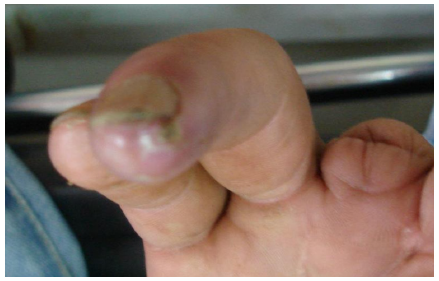
Treatment of Fingertip Gangrene in a Patient with Raynaud’s Phenomenon who Simultaneously Underwent Gastrectomy and Chemotherapy for Gastric Carcinoma: A Case Report | Raynaud’s phenomenon, characterized by recurrent vasospasm in the fingers and toes, is a common clinical disorder encountered by dermatologists. Hand-arm vibration syndrome is well known to cause secondary Raynaud’s phenomenon. The goal of treatment is to improve microcirculation and decrease inflammation, platelet activation, and vasospasm. We have reported a chronic case of Raynaud’s phenomenon in a 46-year-old aboriginal man with gastric carcinoma who simultaneously underwent gastrectomy and chemotherapy. The patient had developed gangrene at the tip of the right index finger and toes previously, and his fingers and toes had been amputated. The patient was hesitant to have another finger amputated. Hence, he was administered a combination therapy of pentoxifylline, extended-release nifedipine, and low molecular weight dextran for treating the acute symptoms of Raynaud’s phenomenon. At the later stages of his disease, only extendedrelease nifedipine was administered. Treatment with nifedipine resulted in an improvement in the symptoms. For More Articles: Biomedical Science Articles : https://biomedres.us/


 Biomedical Journal of Scientific & Technical Research (BJSTR)